| Emission nebula | |
|---|---|
| H II region | |
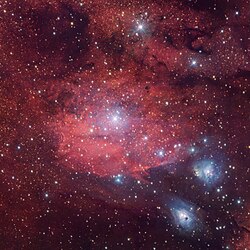 As viewed in 2023 | |
| Observation data: epoch | |
| Right ascension | 18h 18m 48s |
| Declination | −19° 45′ 03″1 |
| Distance | 58002 ly |
| Apparent magnitude (V) | 7.73 |
| Apparent dimensions (V) | 19.2' × 14.2' |
| Constellation | Sagittarius |
| Physical characteristics | |
| Radius | 344 ly |
| Designations | Gum 78, IC 1283/4, RCW 153, LBN 47 |
Sh 2-37, also known by the designation IC 1284, or the common name Twiddlebug Nebula,5 is an emission nebula in the constellation Sagittarius. It is located is the direction of ionizing star cluster Dias 5. It also contains the radio source W 34.6
It is located near the center of the galaxy, and is partially obscured by dust. Nearby Sh 2-37, which appears mostly red, are two small blue reflection nebulae, known as NGC 6589 and NGC 6590.78 SIMBAD notably provides the wrong coordinates for Sh 2-37, giving it the same coordinates as nearby NGC 6590.9
Discovery
Sh 2-37 was discovered by Edward Emerson Barnard on a photographic plate on 31 May 1892. He initially described it as a "nebulous star".10
References
References
- "IC 1283 - HII Ionized region in Sagittarius | TheSkyLive".
- "Around IC1283".
- "IC 1284 - Nebula in Sagittarius | TheSkyLive".
- "Around IC1283".
- "NGC 6589, VDB 118, GUM 78, HH 180 and IC 1283 - astrophotography by Stardoc".
- "Sh 2-37".
- "Sh2-37 - Nebula in Sagittarius".
- "New General Catalog Objects: NGC 6550 - 6599".
- "NGC 6589, NGC 6590, Ic 1283".
- "Galactic Nebula IC 1284 | Deep⋆Sky Corner".