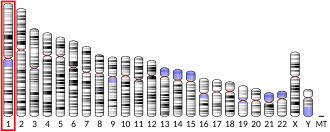
SH2 domain-containing protein 2A is a protein that in humans is encoded by the SH2D2A gene.56
Interactions
SH2D2A has been shown to interact with MAP3K2.7
References
References
- GRCh38: Ensembl release 89: ENSG00000027869 – Ensembl, May 2017
- GRCm38: Ensembl release 89: ENSMUSG00000028071 – Ensembl, May 2017
- "Human PubMed Reference:". National Center for Biotechnology Information, U.S. National Library of Medicine.
- "Mouse PubMed Reference:". National Center for Biotechnology Information, U.S. National Library of Medicine.
- Spurkland A, Brinchmann JE, Markussen G, Pedeutour F, Munthe E, Lea T, Vartdal F, Aasheim HC (February 1998). "Molecular cloning of a T cell-specific adapter protein (TSAd) containing an Src homology (SH) 2 domain and putative SH3 and phosphotyrosine binding sites". The Journal of Biological Chemistry. 273 (8): 4539–46. doi:10.1074/jbc.273.8.4539. PMID 9468509.
- "Entrez Gene: SH2D2A SH2 domain protein 2A".
- Sun W, Kesavan K, Schaefer BC, Garrington TP, Ware M, Johnson NL, Gelfand EW, Johnson GL (February 2001). "MEKK2 associates with the adapter protein Lad/RIBP and regulates the MEK5-BMK1/ERK5 pathway". The Journal of Biological Chemistry. 276 (7): 5093–100. doi:10.1074/jbc.M003719200. PMID 11073940.
Further reading
Further reading
- Marti F, Lapinski PE, King PD (March 2005). "The emerging role of the T cell-specific adaptor (TSAd) protein as an autoimmune disease-regulator in mouse and man". Immunology Letters. 97 (2): 165–70. doi:10.1016/j.imlet.2004.10.019. PMID 15752554.
- Maruyama K, Sugano S (January 1994). "Oligo-capping: a simple method to replace the cap structure of eukaryotic mRNAs with oligoribonucleotides". Gene. 138 (1–2): 171–4. doi:10.1016/0378-1119(94)90802-8. PMID 8125298.
- Suzuki Y, Yoshitomo-Nakagawa K, Maruyama K, Suyama A, Sugano S (October 1997). "Construction and characterization of a full length-enriched and a 5'-end-enriched cDNA library". Gene. 200 (1–2): 149–56. doi:10.1016/S0378-1119(97)00411-3. PMID 9373149.
- Choi YB, Kim CK, Yun Y (November 1999). "Lad, an adapter protein interacting with the SH2 domain of p56lck, is required for T cell activation". Journal of Immunology. 163 (10): 5242–9. doi:10.4049/jimmunol.163.10.5242. PMID 10553045. S2CID 12378851.
- Rajagopal K, Sommers CL, Decker DC, Mitchell EO, Korthauer U, Sperling AI, Kozak CA, Love PE, Bluestone JA (December 1999). "RIBP, a novel Rlk/Txk- and itk-binding adaptor protein that regulates T cell activation". The Journal of Experimental Medicine. 190 (11): 1657–68. doi:10.1084/jem.190.11.1657. PMC 2195727. PMID 10587356.
- Wu LW, Mayo LD, Dunbar JD, Kessler KM, Ozes ON, Warren RS, Donner DB (March 2000). "VRAP is an adaptor protein that binds KDR, a receptor for vascular endothelial cell growth factor". The Journal of Biological Chemistry. 275 (9): 6059–62. doi:10.1074/jbc.275.9.6059. PMID 10692392.
- Dai KZ, Vergnaud G, Ando A, Inoko H, Spurkland A (March 2000). "The SH2D2A gene encoding the T-cell-specific adapter protein (TSAd) is localized centromeric to the CD1 gene cluster on human Chromosome 1". Immunogenetics. 51 (3): 179–85. doi:10.1007/s002510050029. PMID 10752626. S2CID 37269923.
- Smerdel A, Dai KZ, Lorentzen AR, Flatø B, Maslinski S, Thorsby E, Førre Ø, Spurkland A (June 2004). "Genetic association between juvenile rheumatoid arthritis and polymorphism in the SH2D2A gene". Genes and Immunity. 5 (4): 310–2. doi:10.1038/sj.gene.6364093. PMID 15129233. S2CID 23995329.
- Rush J, Moritz A, Lee KA, Guo A, Goss VL, Spek EJ, Zhang H, Zha XM, Polakiewicz RD, Comb MJ (January 2005). "Immunoaffinity profiling of tyrosine phosphorylation in cancer cells". Nature Biotechnology. 23 (1): 94–101. doi:10.1038/nbt1046. PMID 15592455. S2CID 7200157.
- Matsumoto T, Bohman S, Dixelius J, Berge T, Dimberg A, Magnusson P, Wang L, Wikner C, Qi JH, Wernstedt C, Wu J, Bruheim S, Mugishima H, Mukhopadhyay D, Spurkland A, Claesson-Welsh L (July 2005). "VEGF receptor-2 Y951 signaling and a role for the adapter molecule TSAd in tumor angiogenesis". The EMBO Journal. 24 (13): 2342–53. doi:10.1038/sj.emboj.7600709. PMC 1173150. PMID 15962004.
- Park D, Park I, Lee D, Choi YB, Lee H, Yun Y (June 2007). "The adaptor protein Lad associates with the G protein beta subunit and mediates chemokine-dependent T-cell migration". Blood. 109 (12): 5122–8. doi:10.1182/blood-2005-10-061838. PMID 17327418.