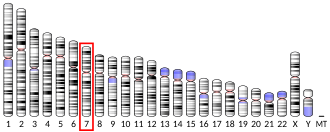




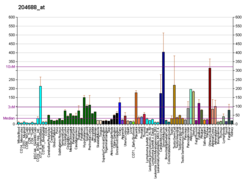
Epsilon-sarcoglycan is a protein that in humans is encoded by the SGCE gene.567
The SGCE gene encodes the epsilon member of the sarcoglycan family, transmembrane components of the dystrophin-glycoprotein complex, which links the cytoskeleton to the extracellular matrix.[supplied by OMIM].7
Clinical significance
Mutations in the SGCE gene are known to cause myoclonic dystonia (DTY11).8
References
References
- GRCh38: Ensembl release 89: ENSG00000127990 – Ensembl, May 2017
- GRCm38: Ensembl release 89: ENSMUSG00000004631 – Ensembl, May 2017
- "Human PubMed Reference:". National Center for Biotechnology Information, U.S. National Library of Medicine.
- "Mouse PubMed Reference:". National Center for Biotechnology Information, U.S. National Library of Medicine.
- McNally EM, Ly CT, Kunkel LM (Mar 1998). "Human epsilon-sarcoglycan is highly related to alpha-sarcoglycan (adhalin), the limb girdle muscular dystrophy 2D gene". FEBS Lett. 422 (1): 27–32. doi:10.1016/S0014-5793(97)01593-7. PMID 9475163. S2CID 43644239.
- Ettinger AJ, Feng G, Sanes JR (Jan 1998). "epsilon-Sarcoglycan, a broadly expressed homologue of the gene mutated in limb-girdle muscular dystrophy 2D". J Biol Chem. 272 (51): 32534–8. doi:10.1074/jbc.272.51.32534. PMID 9405466.
- "Entrez Gene: SGCE sarcoglycan, epsilon".
- "UniProt". www.uniprot.org. Retrieved 2023-11-23.
Further reading
Further reading
- Nygaard TG, Raymond D, Chen C, et al. (1999). "Localization of a gene for myoclonus-dystonia to chromosome 7q21-q31". Ann. Neurol. 46 (5): 794–8. doi:10.1002/1531-8249(199911)46:5<794::AID-ANA19>3.0.CO;2-2. PMID 10554001. S2CID 35450728.
- Barresi R, Moore SA, Stolle CA, et al. (2001). "Expression of gamma -sarcoglycan in smooth muscle and its interaction with the smooth muscle sarcoglycan-sarcospan complex". J. Biol. Chem. 275 (49): 38554–60. doi:10.1074/jbc.M007799200. PMID 10993904.
- Zimprich A, Grabowski M, Asmus F, et al. (2001). "Mutations in the gene encoding epsilon-sarcoglycan cause myoclonus-dystonia syndrome". Nat. Genet. 29 (1): 66–9. doi:10.1038/ng709. PMID 11528394. S2CID 13509152.
- Fanin M, Angelini C (2002). "Defective assembly of sarcoglycan complex in patients with beta-sarcoglycan gene mutations. Study of aneural and innervated cultured myotubes". Neuropathol. Appl. Neurobiol. 28 (3): 190–9. doi:10.1046/j.1365-2990.2002.00389.x. PMID 12060343. S2CID 32274307.
- Asmus F, Zimprich A, Tezenas Du Montcel S, et al. (2002). "Myoclonus-dystonia syndrome: epsilon-sarcoglycan mutations and phenotype". Ann. Neurol. 52 (4): 489–92. doi:10.1002/ana.10325. PMID 12325078. S2CID 37611994.
- Klein C, Liu L, Doheny D, et al. (2002). "Epsilon-sarcoglycan mutations found in combination with other dystonia gene mutations". Ann. Neurol. 52 (5): 675–9. doi:10.1002/ana.10358. PMID 12402271. S2CID 40452650.
- Müller B, Hedrich K, Kock N, et al. (2003). "Evidence that paternal expression of the epsilon-sarcoglycan gene accounts for reduced penetrance in myoclonus-dystonia". Am. J. Hum. Genet. 71 (6): 1303–11. doi:10.1086/344531. PMC 378568. PMID 12444570.
- Strausberg RL, Feingold EA, Grouse LH, et al. (2003). "Generation and initial analysis of more than 15,000 full-length human and mouse cDNA sequences". Proc. Natl. Acad. Sci. U.S.A. 99 (26): 16899–903. Bibcode:2002PNAS...9916899M. doi:10.1073/pnas.242603899. PMC 139241. PMID 12477932.
- Smallwood A, Papageorghiou A, Nicolaides K, et al. (2004). "Temporal regulation of the expression of syncytin (HERV-W), maternally imprinted PEG10, and SGCE in human placenta". Biol. Reprod. 69 (1): 286–93. doi:10.1095/biolreprod.102.013078. PMID 12620933.
- Grabowski M, Zimprich A, Lorenz-Depiereux B, et al. (2003). "The epsilon-sarcoglycan gene (SGCE), mutated in myoclonus-dystonia syndrome, is maternally imprinted". Eur. J. Hum. Genet. 11 (2): 138–44. doi:10.1038/sj.ejhg.5200938. PMID 12634861.
- Maréchal L, Raux G, Dumanchin C, et al. (2004). "Severe myoclonus-dystonia syndrome associated with a novel epsilon-sarcoglycan gene truncating mutation". Am. J. Med. Genet. B Neuropsychiatr. Genet. 119 (1): 114–7. doi:10.1002/ajmg.b.10062. PMID 12707948. S2CID 23612490.
- Foncke EM, Klein C, Koelman JH, et al. (2004). "Hereditary myoclonus-dystonia associated with epilepsy". Neurology. 60 (12): 1988–90. doi:10.1212/01.wnl.0000066020.99191.76. PMID 12821748. S2CID 1928194.
- Hillier LW, Fulton RS, Fulton LA, et al. (2003). "The DNA sequence of human chromosome 7". Nature. 424 (6945): 157–64. Bibcode:2003Natur.424..157H. doi:10.1038/nature01782. PMID 12853948.
- Clark HF, Gurney AL, Abaya E, et al. (2003). "The secreted protein discovery initiative (SPDI), a large-scale effort to identify novel human secreted and transmembrane proteins: a bioinformatics assessment". Genome Res. 13 (10): 2265–70. doi:10.1101/gr.1293003. PMC 403697. PMID 12975309.
- Kock N, Kasten M, Schüle B, et al. (2004). "Clinical and genetic features of myoclonus-dystonia in 3 cases: a video presentation". Mov. Disord. 19 (2): 231–4. doi:10.1002/mds.10635. PMID 14978685. S2CID 7632459.
- Nishiyama A, Endo T, Takeda S, Imamura M (2004). "Identification and characterization of epsilon-sarcoglycans in the central nervous system". Brain Res. Mol. Brain Res. 125 (1–2): 1–12. doi:10.1016/j.molbrainres.2004.01.012. PMID 15193417.
- Asmus F, Schoenian S, Lichtner P, et al. (2005). "Epsilon-sarcoglycan is not involved in sporadic Gilles de la Tourette syndrome". Neurogenetics. 6 (1): 55–6. doi:10.1007/s10048-004-0206-z. PMID 15627203. S2CID 10589152.
- Valente EM, Edwards MJ, Mir P, et al. (2005). "The epsilon-sarcoglycan gene in myoclonic syndromes". Neurology. 64 (4): 737–9. doi:10.1212/01.WNL.0000151979.68010.9B. PMID 15728306. S2CID 44785780.
External links
External links
- GeneReviews/NIH/NCBI/UW entry on Myoclonus-Dystonia
- LOVD mutation database: SGCE