| Sespia Temporal range: Late Oligocene
| |
|---|---|
| |
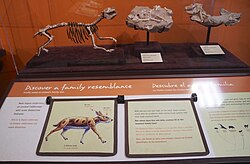
| Sespia californica fossils in San Diego | |
Scientific classification 
| |
| Kingdom: | Animalia |
| Phylum: | Chordata |
| Class: | Mammalia |
| Infraclass: | Placentalia |
| Order: | Artiodactyla |
| Family: | †Merycoidodontidae |
| Tribe: | †Sespiini |
| Genus: | †Sespia Stock, 1930 |
| Type species | |
| †Leptauchenia nitida | |
| Species | |
| |
| Synonyms | |
| |
Sespia ("of Sespe Creek") is an extinct genus of oreodont endemic to North America. They lived during the Late Oligocene 26.3—24.8 mya, existing for approximately 1.5 million years.1 Sespia was cat to goat-sized and desert-dwelling. The genus was closely related to the larger Leptauchenia.
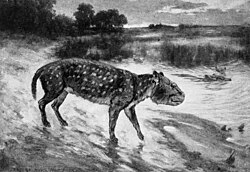
Fossils of the best known species, the cat-sized S. californica, have been found in California and are known from literally thousands of specimens. The largest species, the goat-sized S. ultima, is known from Late Oligocene deposits in Nebraska. S. ultima was once placed in a separate monotypic genus as Megasespia middleswarti. Other species were once placed within Leptauchenia.
Palaeoecology
Paired analysis of its dental mesowear and microwear suggests that S. nitida was a folivorous browser.2
References
References
- Sespia at fossilworks
- Semprebon, Gina M.; Rivals, Florent; Janis, Christine M. (19 March 2019). "The Role of Grass vs. Exogenous Abrasives in the Paleodietary Patterns of North American Ungulates". Frontiers in Ecology and Evolution. 7 65. Bibcode:2019FrEEv...7...65S. doi:10.3389/fevo.2019.00065. ISSN 2296-701X.
External links
External links
- [1] San Diego Natural History Museum "Fossil Mysteries Field Guide: Sespia californica