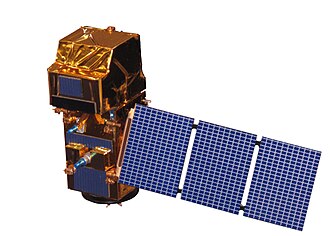
 Model of a Sentinel 2 satellite | |
| Mission type | Earth observation |
|---|---|
| Operator | ESA |
| COSPAR ID | 2015-028A |
| SATCAT no. | 40697 |
| Website | Sentinel-2 (ESA) |
| Mission duration | Planned: 7 years1 Elapsed: 11 years, 26 days |
| Spacecraft properties | |
| Spacecraft type | Sentinel-2 |
| Manufacturer | Airbus Defence and Space |
| Launch mass | 1,140 kg (2,510 lb) |
| Dry mass | 1,017 kg (2,242 lb) |
| Dimensions | 3.4 m × 1.8 m × 2.35 m (11.2 ft × 5.9 ft × 7.7 ft) |
| Power | 1700 watts |
| Start of mission | |
| Launch date | 23 June 2015, 01:51:58 (2015-06-23UTC01:51:58) UTC2 |
| Rocket | Vega (VV05) |
| Launch site | Kourou SLV |
| Contractor | Arianespace |
| Orbital parameters | |
| Reference system | Geocentric |
| Regime | Low Earth |
| Semi-major axis | 7,167.10 km (4,453.43 mi) |
| Eccentricity | 0.000127 |
| Perigee altitude | 788.06 km (489.68 mi) |
| Apogee altitude | 789.87 km (490.80 mi) |
| Inclination | 98.5623° |
| Period | 100.65 minutes |
| Epoch | 9 March 2017, 21:05:23 UTC3 |
| Transponders | |
| Band | S band (TT&C support) X band and optical laser through EDRS (data acquisition) |
| Bandwidth | 64 kbit/s upload (S band) 128 kbit/s - 2 Mbit/s down (S band) 520 Mbit/s down (X band/Optical) |
| Instruments | |
| Multi-Spectral Imager (MSI) | |
Sentinel-2A is a European optical imaging satellite launched in 2015. It is the first Sentinel-2 satellite launched by the European Space Agency's and this Sentinel is part of the European Commission's Copernicus Programme. The satellite carries a wide swath high-resolution multispectral imager with 13 spectral bands. Its observations support services such as forest monitoring, land cover change-detection, natural disaster management and water quality monitoring.4 On 7 March 2017 the Sentinel-2A was joined in orbit by its sister satellite, Sentinel-2B.
Mission history
Launch
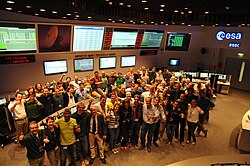
Sentinel-2A was launched by the Vega VV05 rocket on 23 June 2015 at 01:52 UTC. The satellite separated from the upper stage 54 min 43 s after liftoff.5
Orbital operation
The satellite captured its first image 100 hours after launch, covering a 290 km (180 mi) wide swath from Sweden through Central Europe to Algeria.67: 8 Commissioning occurred in October 2015.7: 8
Between 20 and 23 January 2017 the spacecraft suffered a mission planning anomaly which resulted in loss of data from its instrument, the Multi-Spectral Imager.8
-
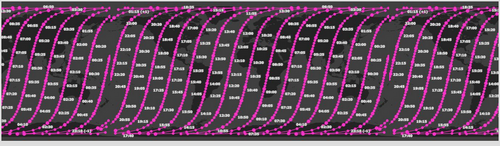 Sentinel 2A's descending orbital path
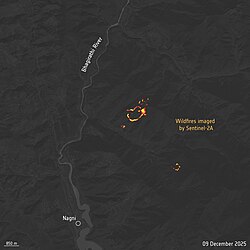
In December 2025, Sentinel-2A performed experimental night observations, something it was not designed to do, in order to test these operations for the follow-on Sentinel-2 Next Generation mission. The satellite successfully captured night-time images of gas flares from oil production in the Middle East, wildfires in India, and fishing boats off the coast of South Korea.910
References
References
- "Sentinel-2: The Operational Compernicus Optical High Resolution Land Mission" (PDF). European Space Agency. 2013. Retrieved 23 June 2015.
- "Second Copernicus environmental satellite safely in orbit". European Space Agency. 23 June 2015. Retrieved 24 June 2015.
- "Sentinel 2A - Orbit". Heavens-Above. 9 March 2017. Retrieved 9 March 2017.
- Justice, Adam (23 June 2015). "Sentinel-2A: Satellite blasts off to provide new, improved view of Earth". International Business Times. Retrieved 24 June 2015.
- Chris Bergin (22 June 2015). "Vega successfully launches Sentinel-2A mission". nasaspaceflight.com. Retrieved 19 March 2023.
- "Sentinel-2 delivers first images". European Space Agency. 29 June 2015. Retrieved 1 February 2017.
- Hoersch, Bianca (2015). A short success story of Sentinel-2A (PDF). Meeting of the Earth Observation Programme Board. 22–23 September 2015. ESRIN, Frascati, Italy. Archived from the original (PDF) on 1 December 2017. Retrieved 1 February 2017.
- "Loss of Sentinel-2A acquisitions between 20 and 23 January 2017". European Space Agency. 23 January 2017. Retrieved 1 February 2017.
- "Sentinel-2 explores night vision". www.esa.int. Retrieved 19 January 2026.
- Enthusiast, Space (18 January 2026). "ESA Switches on Night-Time Imaging for Sentinel-2A Copernicus Satellite [PHOTOS]". Orbital Today. Retrieved 19 January 2026.
External links
External links
- Sentinel-2 programme Archived 2 March 2017 at the Wayback Machine at ESA's Sentinel Online
- Sentinel-2 programme at ESA.int
- Real-time orbital tracking - uphere.space