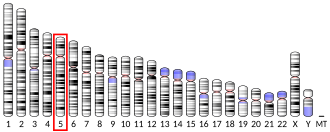



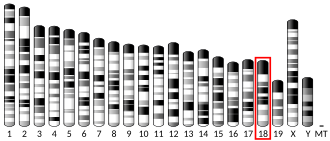

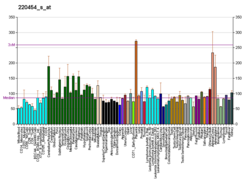
Semaphorin-6A is a protein that in humans is encoded by the SEMA6A gene.567
In melanocytic cells SEMA6A gene expression may be regulated by MITF.8
References
References
- GRCh38: Ensembl release 89: ENSG00000092421 – Ensembl, May 2017
- GRCm38: Ensembl release 89: ENSMUSG00000019647 – Ensembl, May 2017
- "Human PubMed Reference:". National Center for Biotechnology Information, U.S. National Library of Medicine.
- "Mouse PubMed Reference:". National Center for Biotechnology Information, U.S. National Library of Medicine.
- Zhou L, White FA, Lentz SI, Wright DE, Fisher DA, Snider WD (Sep 1997). "Cloning and expression of a novel murine semaphorin with structural similarity to insect semaphorin I". Mol Cell Neurosci. 9 (1): 26–41. doi:10.1006/mcne.1997.0607. PMID 9204478. S2CID 38730386.
- Klostermann A, Lutz B, Gertler F, Behl C (Jan 2001). "The orthologous human and murine semaphorin 6A-1 proteins (SEMA6A-1/Sema6A-1) bind to the enabled/vasodilator-stimulated phosphoprotein-like protein (EVL) via a novel carboxyl-terminal zyxin-like domain". J Biol Chem. 275 (50): 39647–53. doi:10.1074/jbc.M006316200. PMID 10993894.
- "Entrez Gene: SEMA6A sema domain, transmembrane domain (TM), and cytoplasmic domain, (semaphorin) 6A".
- Hoek KS, Schlegel NC, Eichhoff OM, et al. (2008). "Novel MITF targets identified using a two-step DNA microarray strategy". Pigment Cell Melanoma Res. 21 (6): 665–76. doi:10.1111/j.1755-148X.2008.00505.x. PMID 19067971. S2CID 24698373.
Further reading
Further reading
- Prislei S, Mozzetti S, Filippetti F, et al. (2008). "From plasma membrane to cytoskeleton: a novel function for semaphorin 6A". Mol. Cancer Ther. 7 (1): 233–41. doi:10.1158/1535-7163.MCT-07-0390. PMID 18187809.
- Katoh M, Katoh M (2007). "Comparative integromics on non-canonical WNT or planar cell polarity signaling molecules: transcriptional mechanism of PTK7 in colorectal cancer and that of SEMA6A in undifferentiated ES cells". Int. J. Mol. Med. 20 (3): 405–9. doi:10.3892/ijmm.20.3.405. PMID 17671748.
- Gautier G, de Saint-Vis B, Sénéchal B, et al. (2006). "The class 6 semaphorin SEMA6A is induced by interferon-gamma and defines an activation status of langerhans cells observed in pathological situations". Am. J. Pathol. 168 (2): 453–65. doi:10.2353/ajpath.2006.050288. PMC 1606484. PMID 16436660.
- Otsuki T, Ota T, Nishikawa T, et al. (2007). "Signal sequence and keyword trap in silico for selection of full-length human cDNAs encoding secretion or membrane proteins from oligo-capped cDNA libraries". DNA Res. 12 (2): 117–26. doi:10.1093/dnares/12.2.117. PMID 16303743.
- Ota T, Suzuki Y, Nishikawa T, et al. (2004). "Complete sequencing and characterization of 21,243 full-length human cDNAs". Nat. Genet. 36 (1): 40–5. doi:10.1038/ng1285. PMID 14702039.
- Strausberg RL, Feingold EA, Grouse LH, et al. (2003). "Generation and initial analysis of more than 15,000 full-length human and mouse cDNA sequences". Proc. Natl. Acad. Sci. U.S.A. 99 (26): 16899–903. Bibcode:2002PNAS...9916899M. doi:10.1073/pnas.242603899. PMC 139241. PMID 12477932.
- Nakayama M, Kikuno R, Ohara O (2003). "Protein-protein interactions between large proteins: two-hybrid screening using a functionally classified library composed of long cDNAs". Genome Res. 12 (11): 1773–84. doi:10.1101/gr.406902. PMC 187542. PMID 12421765.
- Nagase T, Kikuno R, Ishikawa KI, et al. (2000). "Prediction of the coding sequences of unidentified human genes. XVI. The complete sequences of 150 new cDNA clones from brain which code for large proteins in vitro". DNA Res. 7 (1): 65–73. doi:10.1093/dnares/7.1.65. PMID 10718198.