In robot combat, a self-righting mechanism or srimech (sometimes spelled as srimec or shrimech)1 is a device used to re-right a robot should it get flipped. Biohazard of BattleBots was the first robot to self-right.
Military applications
As of 2016, the U.S. Army Research Laboratory (ARL), based at Aberdeen Proving Grounds, MD, developed self-righting robots for bomb defusal and reconnaissance.2 Listed as a 2004–2020 effort, the prototype was called CRAM, for compressible robot with articulated mechanisms.34 ARL scientists were led by Chad Kessens, and collaborated with researchers from the University of California, Berkeley, and Johns Hopkins University to develop a prototype.5
Cockroach exoskeletons inspired researchers to manufacture a robot that can move around rapidly in both open and confined spaces with self-righting capabilities.5
In 2016, ARL and its collaborators published additional research, "Cockroach-inspired winged robot reveals principles of ground-based dynamic self-righting", demonstrating a bio-inspired design. Researchers showed that robots can use insect body structures to achieve self-righting, as demonstrated in the rounded shell and mobile wings of the robot prototype.6
American Robot Wars: 1994–1997
Biohazard was the first robot to self-right in combat, against Vlad the Impaler in the 1996 tournament, however since the match had ended it made no difference to who actually won. Terminal Frenzy had attempted to right itself when it earlier came up against Biohazard, but failed to do so. The next year Vlad the Impaler fought Biohazard again, and the former used its special pneumatic lifting arm to self-right numerous times, yet it still lost the judge's decision.
UK Robot Wars Series 2-3
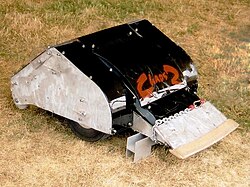
The first attempted self-right in the UK Robot Wars was by a robot called Chaos, during its Series 2 heat final. However, it was unable to do so. Later in the series, Cassius successfully righted itself with its pneumatic flipping arm, after Sir Killalot had flipped it over with his drill during the semi-final pinball trial.7 Cassius was flipped again in the Grand Final, but it self-righted and flipped Roadblock to win the eliminator. In Series 3, Chaos' successor Chaos 2 used its innovative rear-hinged flipper panel to catapult itself through the air and then land on its wheels, a technique that later became standard.
Weapon srimechs
The majority of flippers can double as srimechs. However, most flippers are powered by CO2 and therefore have limited uses. Some axes can also be used as srimechs; the first robot to successfully use an axe to self-right was Iron Awe in Robot Wars Series 4.
Robot Wars robots with notable weapon srimechs
| Robot's name | Competing series | Weapon | Notes |
|---|---|---|---|
| Cassius | Series 2–3 | Flipper | First robot to successfully self-right in UK Robot Wars |
| Chaos 2 | Series 3–6, Extreme 1–2 | Flipper | First rear-hinged flipper to catapult the robot back onto its wheels |
| Iron Awe | Series 4 | Axe | First robot to successfully self-right with an axe |
| Lightning | Series 7, Extreme 2 | Flipper | First robot to self-right with a side-hinged flipper |
Other methods of self-righting
Some robots use weapons that cannot assist in self-righting, requiring the addition of a dedicated self-righting mechanism. These designs vary in complexity and effectiveness, such as the side wings on Razer, the motorised bar on Hypno-Disc, or the lifting top lid of Panic Attack. While these systems allow the primary weapon to remain specialised for attack, they consume a portion of the robot's strictly limited weight budget, often forcing a compromise in armour thickness or internal components.
Body shape
A rarer and more difficult type of srimech was to design the robot's body in such a way that it could roll back onto its wheels when flipped. Sometimes known as a "rollover" design, robots with this ability included Mega Morg. While a fairly ingenious solution, that did not require any additional power or mechanics, there were still flaws. It was extremely difficult to get the design perfect, and if flipped without enough momentum or flipped from the front or back, the robot would be left stranded. Mega Morg's predecessor, The Morgue, was also defeated in Series 4 by Firestorm when it was flipped against the arena wall, preventing it from rolling over.
Some robots were not true rollover designs, but had other design elements intended to aid them in self-righting. Examples include the rounded Lexan panels on the rear of Behemoth, without which it would have stranded itself on its back when self-righting, and Spikasaurus' roll-bars. These were often effective but, like active srimechs, they were vulnerable to damage.
References
References
- " SRIMEC What does "self-righting mechanism" stand for?
- "Army researchers developing self-righting for robots". www.army.mil. Retrieved 2018-07-30.
- Medicine, National Academies of Sciences, Engineering, and; Sciences, Division on Engineering and Physical; Board, Laboratory Assessments; Board, Army Research Laboratory Technical Assessment (2016-05-12). 2015-2016 Assessment of the Army Research Laboratory: Interim Report. National Academies Press. ISBN 9780309392105.
{{cite book}}: CS1 maint: multiple names: authors list (link) - "Cockroaches inspire a new breed of disaster-site, battlefield robots -- Defense Systems". Defense Systems. Retrieved 2018-07-30.
- "Cockroach-inspired robotics research supported by the Army opens new doors for military and civilian missions". www.arl.army.mil. Archived from the original on February 18, 2016. Retrieved 2018-07-30.
- Li, Chen; Kessens, Chad; Young, Austin; Fearing, Ronald S.; Full, Robert J. (October 9–14, 2016). Cockroach-inspired winged robot reveals principles of ground-based dynamic self-righting (PDF). IEEE/RSJ International Conference on Intelligent Robots and Systems (IROS). Retrieved 21 February 2019 – via jhu.edu.
- Cassius self-rights