| Scaptia auriflua | |
|---|---|
| |
Scientific classification 
| |
| Kingdom: | Animalia |
| Phylum: | Arthropoda |
| Clade: | Pancrustacea |
| Class: | Insecta |
| Order: | Diptera |
| Family: | Tabanidae |
| Subfamily: | Pangoniinae |
| Tribe: | Scionini |
| Genus: | Scaptia |
| Species: | S. auriflua
|
| Binomial name | |
| Scaptia auriflua | |
| Synonyms | |
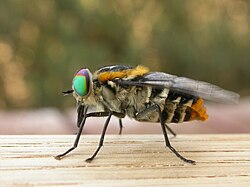
Scaptia auriflua, the flower-feeding march fly, is a species of horse flies that occurs in Australia. Unlike other march flies this species does not bite and does not feed on blood, it strictly drinks nectar.23
Description
Adults are about 10 millimetres (0.4 in) in length and mimic bees with dense hair and a golden coloration. Their eyes meet in the middle and the eye coloration differs from light source to light source.4
References
References
- Donovan, E. (1805). An epitome of the natural history of the insects of New Holland, New Zealand, New Guinea, Otaheite, and other islands. London: Rivington. pp. iv + [167] pp. + [41] pl. Retrieved 7 October 2022.
- González, C. R.; Sanhueza, Y. (2004). "Comparative study of mouthparts of the female of three species of Scaptia (Scaptia) Walker from Chile (Diptera: Tabanidae)". Acta Entomologica Chilena (PDF Adobe Acrobat). 28 (1). Instituto de Entomología.
- Moucha, J. (1976). "Horse-flies (Diptera: Tabanidae) of the World. Synoptic Catalogue" (PDF). Acta Entomologica Musei Nationalis Pragae Supplements. 7: 1–320. Retrieved 11 September 2022.
- "Flower-feeding March Fly - Scaptia auriflua". Archived from the original on 2008-07-05. Retrieved 2009-02-24.
- Media related to Scaptia auriflua at Wikimedia Commons