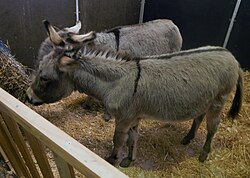
 At Fieracavalli in Verona, 2014 | |
| Conservation status | |
|---|---|
| Other names |
|
| Country of origin | Italy |
| Distribution |
|
| Standard | MIPAAF |
| Use |
|
| Traits | |
| Height |
|
| |
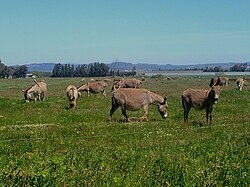
The Sardinian (Italian: Asino Sardo, Sardinian: Molente or Molenti) is an Italian breed of donkey from the Mediterranean island of Sardinia, to the west of Italy.4 It is raised throughout the island; there are also some small populations in mainland Italy.5: 172 It is one of the eight autochthonous donkey breeds of limited distribution recognised by the Ministero delle Politiche Agricole Alimentari e Forestali, the Italian ministry of agriculture and forestry.6 Its conservation status was listed as 'endangered' by the Food and Agriculture Organization of the United Nations in 20071: 70 and as 'at risk/endangered' in DAD-IS in 2024.2 The breeding population reported for 2022 numbered just over 3600 head, with 2094 jennies and 963 jacks in 788 herds.2
References
References
- Barbara Rischkowsky, Dafydd Pilling (editors) (2007). List of breeds documented in the Global Databank for Animal Genetic Resources, annex to The State of the World's Animal Genetic Resources for Food and Agriculture. Rome: Commission on Genetic Resources for Food and Agriculture, Food and Agriculture Organization of the United Nations. ISBN 9789251057629. Archived 23 June 2020.
- Breed data sheet: Asino Sardo / Italy (Ass). Domestic Animal Diversity Information System of the Food and Agriculture Organization of the United Nations. Accessed January 2024.
- Valerie Porter, Lawrence Alderson, Stephen J.G. Hall, D. Phillip Sponenberg (2016). Mason's World Encyclopedia of Livestock Breeds and Breeding (sixth edition). Wallingford: CABI. ISBN 9781780647944.
- Breed data sheet: Asino Sardo. Domestic Animal Diversity Information System of the Food and Agriculture Organization of the United Nations. Accessed September 2013.
- Daniele Bigi, Alessio Zanon (2008). Atlante delle razze autoctone: Bovini, equini, ovicaprini, suini allevati in Italia (in Italian). Milan: Edagricole. ISBN 9788850652594.
- Norme tecniche: Allegato 2 a D.M. 9742 del 7 maggio 2012 (in Italian). Ministero delle Politiche Agricole Alimentari e Forestali. p. 24. Accessed September 2013.