 | |
| Type | Fruit |
|---|---|
| Region or state | Mexico, Central America and northern parts of South America |
Sapote or zapote1 (/səˈpoʊtiː, -eɪ, -ə/;234 from Nahuatl: tzapotl5) is a term for a soft, edible fruit.2 The word is incorporated into the common names of several unrelated fruit-bearing plants native to Mexico, Central America and northern parts of South America.26
Species
From Sapotaceae
Some, but not all sapotes, come from the family Sapotaceae:7: 515, 519
- Sapodilla,45 also called naseberry (Manilkara zapota) is native to Mexico, Guatemala, Nicaragua, Belize, and possibly El Salvador. The Sapotaceae were named after a synonym of this species.
- Yellow sapote (Lucuma campechiana) is native to Mexico and Central America.
- Mamey sapote (Pouteria sapota) is from southern Mexico to northern South America.8
- Green sapote (Pouteria viridis) is native to lowland southern Mexico.
-
![Manilkara zapota, Hồng xiêm, a kind of Vietnamese sapote[citation needed]](/api/ext/img?url=https%3A%2F%2Fupload.wikimedia.org%2Fwikipedia%2Fcommons%2Fthumb%2Fe%2Fed%2FVietnamese_Sapote.JPG%2F120px-Vietnamese_Sapote.JPG) Manilkara zapota, Hồng xiêm, a kind of Vietnamese sapote
Manilkara zapota, Hồng xiêm, a kind of Vietnamese sapote -
 Pouteria sapota, mamey sapote
 -
 Manilkara zapota, sapodilla
 -
 Lucuma campechiana, yellow sapote
From other families
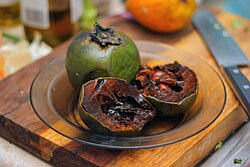
- Black sapote (Diospyros nigra: Ebenaceae),2 from eastern Mexico south to Colombia, is probably the original Aztec tzapotl.
- White sapote (Casimiroa edulis: Rutaceae)2 is native to northern and central Mexico, Costa Rica, El Salvador and Guatemala.9
- South American sapote (Quararibea cordata: Malvaceae)6 is native to the Amazon rainforests of Brazil, Venezuela, Colombia, Ecuador, and Peru.
- Sun sapote (Moquilea platypus: Chrysobalanaceae) is native to southern Mexico south to Colombia.
-
 Casimiroa edulis, white sapote
 -
 Quararibea cordata, South American sapote
See also
See also
- Chapote (Diospyros texana: Ebenaceae) is native to the lower Rio Grande valley region in Texas and Mexico
References
References
- "zapote". Merriam-Webster.com Dictionary. Merriam-Webster. OCLC 1032680871.
- "sapote". Merriam-Webster.com Dictionary. Merriam-Webster. OCLC 1032680871.
- "sapote". WordReference.com Dictionary of English. Retrieved 26 March 2024.
- "sapote". Oxford English Dictionary (Online ed.). Oxford University Press. doi:10.1093/OED/3396265629. Retrieved 2024-03-26. (Subscription or participating institution membership required.)
- Watson, George (April 1938). "Nahuatl Words in American English". American Speech. 13 (2): 113–114. doi:10.2307/451954. JSTOR 451954.
tropical evergreen tree Achras sapota [...] sapote [...] derivative from Nahuatl tzapotl. The Spanish diminutive form gave English sapodilla in the same sense
- Morton, Julia F. (1987). Chupa-Chupa. Miami, FL. pp. 291–292. ISBN 978-1626549722. Retrieved 26 March 2024 – via Purdue University Horticulture & Landscape Architecture.
{{cite book}}: CS1 maint: location missing publisher (link) - Small, Ernest (2011). Top 100 Exotic Food Plants. Boca Raton, Louisiana, USA: CRC Press. ISBN 9781439856888.
- Alia-Tejacal, I.; Villanueva-Arce, R.; Pelayo-Zaldívar, C.; Colinas-León, M.T.; López-Martínez, V.; Bautista-Baños, S. (2007). "Postharvest physiology and technology of sapote mamey fruit (Pouteria sapota (Jacq.) H.E. Moore & Stearn)". Postharvest Biology and Technology. 45 (3): 285–297. doi:10.1016/j.postharvbio.2006.12.024.
- "Casimiroa edulis". Germplasm Resources Information Network. Agricultural Research Service, United States Department of Agriculture. Retrieved 2009-03-26.