| Saperion Temporal range:
| |
|---|---|
| |
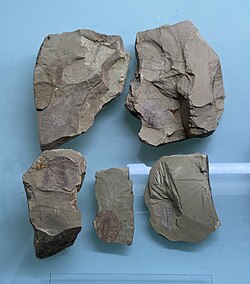
| Fossil of Saperion glumaceum in Yuxi Museum | |
Scientific classification 
| |
| Kingdom: | Animalia |
| Phylum: | Arthropoda |
| Clade: | †Artiopoda |
| Subclass: | †Conciliterga |
| Order: | †Helmetiida |
| Family: | †Tegopeltidae |
| Genus: | †Saperion Hou, Ramsköld & Bergström, 1991 |
| Type species | |
| Saperion glumaceum Hou, Ramsköld & Bergström, 1991
| |
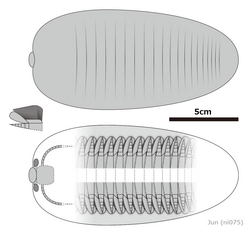
Saperion is an extinct genus of trilobite-like arthropod. It lived during the late Atdabanian stage,1 which lasted from 521 to 514 million years ago during the early part of the Cambrian Period. It was found in the Maotianshan Shales of Yunnan, China.2 Similar to the closely related Skioldia and Tegopelte, the head shield and trunk tergites were fused into a single plate. There are about 19 furrows indicating the original trunk segments. a small anterior sclerite articulated to the front of its head.3 A pair of antennae and lateral eyes located ventrally behind the anterior sclerite, lateral to the hypostome.4 Saperion reached 151 mm in length and had nearly 25 pairs of biramous limbs for walking.5
References
References
- Sepkoski, Jack (2002). "A compendium of fossil marine animal genera (Trilobita entry)". Bulletins of American Paleontology. 364: 560. Retrieved 2008-01-12.
- Xianguang, Hou; Ramskold, Lars; Bergstrom, Jan (October 1991). "Composition and preservation of the Chengjiang fauna -a Lower Cambrian soft-bodied biota". Zoologica Scripta. 20 (4): 395–411. doi:10.1111/j.1463-6409.1991.tb00303.x. ISSN 0300-3256. S2CID 85077111.
- Hou, Xianguang; Bergström, Jan (1997). Arthropods of the Lower Cambrian Chengjiang fauna, southwest China. Fossils and Strata. Oslo: Scandinavian Univ. Press. ISBN 978-82-00-37693-4.
- Edgecombe, Gregory D.; Ramsköld, Lars (March 1999). "Relationships of Cambrian Arachnata and the systematic position of Trilobita". Journal of Paleontology. 73 (2): 263–287. Bibcode:1999JPal...73..263E. doi:10.1017/S0022336000027761. ISSN 0022-3360. S2CID 84029615.
- Nicholas J. Minter, M. Gabriela Mángano & Jean-Bernard Caron (2011). "Skimming the surface with Burgess Shale arthropod locomotion". Proceedings of the Royal Society B: Biological Sciences. 279 (1733): 1613–1620. doi:10.1098/rspb.2011.1986. PMC 3282348. PMID 22072605.