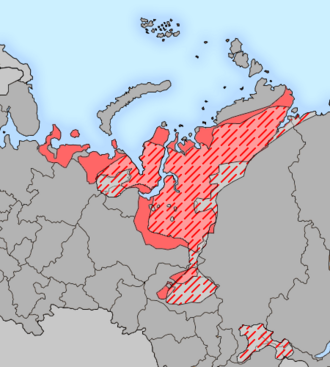
The Samoyedic peoples (sometimes Samodeic peoples)a are a group of closely related peoples who speak Samoyedic languages, which are part of the Uralic family. They are a linguistic, ethnic, and cultural grouping. The name derives from the obsolete term Samoyed used in the Russian Empire for some of the indigenous peoples of Siberia.
Peoples
Contemporary
| People | Language | Numbers1 | Most important territory | Other traditional territories |
|---|---|---|---|---|
| Nenets | Nenets | 45,000 | Yamalo-Nenets Autonomous Okrug | Khanty-Mansi Autonomous Okrug |
| Enets | Enets | 200–300 | Krasnoyarsk Krai | |
| Nganasans | Nganasan | 900–1000 | Krasnoyarsk Krai | |
| Selkups | Selkup | 3,700 | Tomsk Oblast | Krasnoyarsk Krai |
| Kamasins | Kamassian (extinct) | 202b | Krasnoyarsk Krai |
Extinct
Classification
Traditionally, Samoyedic languages and peoples have been divided into two major areal groups: Northern Samoyedic (Nenets, Yurats, Enets, Nganasans), and Southern Samoyedic (Selkups) with a further subgroup of Sayan-Samoyedic (Kamasins, Mators) named after the Sayan Mountains. This classification does not reflect linguistic relations, being purely geographical.
The most numerous of the Samoyedic peoples are the Nenets, who mainly live in two autonomous districts of Russia: Yamalo-Nenetsia and Nenetsia. Some of the Nenets and most of the Enets and Nganasans used to live in the Taymyrsky Dolgano-Nenetsky District. Most of the Selkups live in Yamalo-Nenetsia, but there is also a significant population in Tomsk Oblast.
Gallery
Historical pictures
-
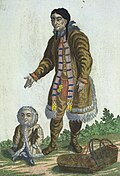 Samoyed in summer dress, in 1781, by Johann Gottlieb Georgi
 -
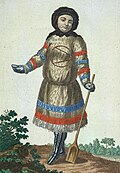 Samoyed in 1781 by Johann Gottlieb Georgi
 -
![Habit of a Samoyed woman and child in 1768, by Jean-Baptiste Chappe d'Auteroche[4]](/weird-wikipedia/img/c/2f/2f844b52f54ed76d.jpg) Habit of a Samoyed woman and child in 1768, by Jean-Baptiste Chappe d'Auteroche4
Habit of a Samoyed woman and child in 1768, by Jean-Baptiste Chappe d'Auteroche4 -
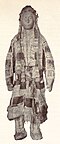 Samoyed winter dress (before 1906)
 -
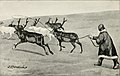 A reindeer herd in Kolguyev Island in 1895.
Modern
-
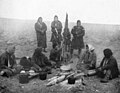 Yenisei Samoyedes (Enets people) around a campfire (1914)
 -
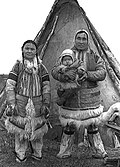 Nganasans, 1927
 -
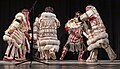 Nganasan folkloric group, 2018
 -
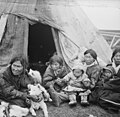 Nenets group, 1913
 -
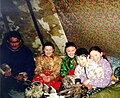 Nenets family
 -
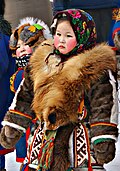 Nenets children, 2016
 -
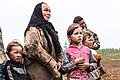 Northern Selkups, 2012
 -
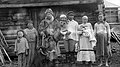 Kamasin family, 1925
Notes
Notes
- Some ethnologists use the term 'Samodeic peoples' instead of 'Samoyedic', see Balzer, Marjorie (1999). The Tenacity of Ethnicity. Princeton University Press. p. 241. ISBN 978-0-691-00673-4.
- 0,2% of the population of Sayansky District (21 ppl) are declared as Kamasins and their descendants by the district administration in the official tourist guide (2021).
References
References
- Demoskop Weekly No 543-544
- "Администрация Саянского района. Унифицированный туристский паспорт. Саянский район Красноярского края". Retrieved 2023-01-04.
- Unesco Red Book on Endangered Languages
- "Habit of a Samoyede woman and child subject to Russia in 1768. Femme Samoyèd". New York Public Library Digital Collections website.