Saissac | |
|---|---|
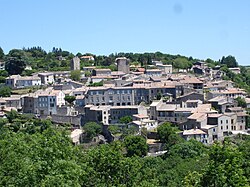 A general view of Saissac | |
 Coat of arms | |
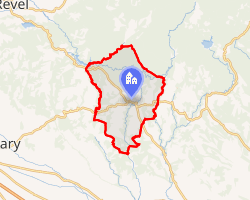 Location of Saissac | |
Saissac Saissac | |
| Coordinates: 43°21′42″N 2°10′10″E / 43.3617°N 2.1694°E / 43.3617; 2.1694 | |
| Country | France |
| Region | Occitania |
| Department | Aude |
| Arrondissement | Carcassonne |
| Canton | La Malepère à la Montagne Noire |
| Government | |
| • Mayor (2020–2026) | Eric Beteille1 |
Area 1 | 57.03 km2 (22.02 sq mi) |
| Population (2023)2 | 904 |
| • Density | 15.9/km2 (41.1/sq mi) |
| Time zone | UTC+01:00 (CET) |
| • Summer (DST) | UTC+02:00 (CEST) |
| INSEE/Postal code | 11367 /11310 |
| Elevation | 166–742 m (545–2,434 ft) (avg. 500 m or 1,600 ft) |
| 1 French Land Register data, which excludes lakes, ponds, glaciers > 1 km2 (0.386 sq mi or 247 acres) and river estuaries. | |
Saissac (French pronunciation: [sɛsak] ⓘ) is a commune in the Aude department in southern France.
Geography
The village is perched in the foothills of the Montagne Noire (Black Mountain) at an altitude of 467 m and has views of the Vernassonne Gorge as well as the valley plain which stretches between Carcassonne and Castelnaudary.
History
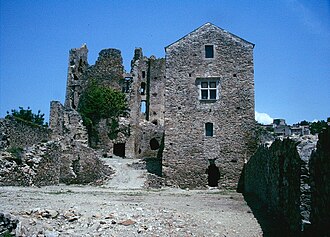
The name of the village first appeared in the 10th century and originates from the Gallo-Romain Saxiago. The history of the village is strongly linked to the Château built in the 10th century.
Population
| Year | Pop. | ±% p.a. |
|---|---|---|
| 1968 | 705 | — |
| 1975 | 652 | −1.11% |
| 1982 | 709 | +1.20% |
| 1990 | 867 | +2.55% |
| 1999 | 923 | +0.70% |
| 2007 | 1,007 | +1.09% |
| 2012 | 918 | −1.83% |
| 2017 | 929 | +0.24% |
| 2023 | 904 | −0.45% |
| Source: INSEE3 | ||
Sights
Near Saissac, there is a transmitter for broadcasting messages to submerged submarines, the La Regine Transmitter. Its mast was built in 1973 and is 330 metres tall – as tall as the Eiffel Tower.
References
References
- "Répertoire national des élus: les maires" (in French). data.gouv.fr, Plateforme ouverte des données publiques françaises. 13 September 2022.
- "Populations de référence 2023" (in French). National Institute of Statistics and Economic Studies. 18 December 2025.
- Population municipale entre 1968 et 2023, INSEE