Sabetha, Kansas | |
|---|---|
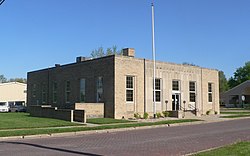 US Post Office in Sabetha (2015) | |
 Seal | |
 Location within Nemaha County and Kansas | |
 | |
| Coordinates: 39°54′46″N 95°47′29″W / 39.91278°N 95.79139°W / 39.91278; -95.791391 | |
| Country | United States |
| State | Kansas |
| Counties | Brown, Nemaha |
| Founded | 1854 |
| Incorporated | 1874 |
| Named after | Sabbath |
| Area | |
• Total | 3.20 sq mi (8.30 km2) |
| • Land | 3.19 sq mi (8.26 km2) |
| • Water | 0.012 sq mi (0.03 km2) |
| Elevation | 1,273 ft (388 m) |
| Population | |
• Total | 2,545 |
| • Density | 798/sq mi (308/km2) |
| Time zone | UTC−6 (CST) |
| • Summer (DST) | UTC−5 (CDT) |
| ZIP Code | 66534 |
| Area code | 785 |
| FIPS code | 20-62025 |
| GNIS ID | 4856481 |
| Website | cityofsabetha.com |
Sabetha is a city in Brown and Nemaha counties in the U.S. state of Kansas.1 As of the 2020 census, its population was 2,545.3
History

The town's settlement began c. 1854, with a name reportedly derived from the word "Sabbath", the day the first settler arrived.4 Sabetha was incorporated as a city in 1874.5
On the evening of June 13, 1998, an F2 tornado damaged much of the downtown, but no casualties were reported. The downtown area received little warning, as the tornado struck less than 1 minute after the tornado siren began to sound.6 The tornado, which touched down half a mile west of the Sabetha City Hall, caused serious damage to two blocks of the town, with 18 buildings in the downtown area being damaged, five (including the city hall building) to near "the point of loss". The tornado lifted about half a mile east of City Hall. Damage to the city hall building amounted to $2 million, and additional damage to homes and vehicles away from downtown occurred due to tornado-toppled trees and branches away from the tornado's center along with strong, straight-line winds.7
Geography
According to the United States Census Bureau, the city has a total area of 3.47 square miles (8.99 km2), of which 0.01 sq mi (0.03 km2) is covered by water.8
Demographics
| Census | Pop. | Note | %± |
|---|---|---|---|
| 1880 | 849 | — | |
| 1890 | 1,368 | 61.1% | |
| 1900 | 1,646 | 20.3% | |
| 1910 | 1,768 | 7.4% | |
| 1920 | 2,003 | 13.3% | |
| 1930 | 2,332 | 16.4% | |
| 1940 | 2,241 | −3.9% | |
| 1950 | 2,173 | −3.0% | |
| 1960 | 2,318 | 6.7% | |
| 1970 | 2,376 | 2.5% | |
| 1980 | 2,297 | −3.3% | |
| 1990 | 2,341 | 1.9% | |
| 2000 | 2,589 | 10.6% | |
| 2010 | 2,571 | −0.7% | |
| 2020 | 2,545 | −1.0% | |
| U.S. Decennial Census | |||
2020 census
As of the 2020 census, Sabetha had a population of 2,545. The median age was 40.1 years; 24.8% of residents were under 18 and 24.1% were 65 or older. For every 100 females, there were 99.6 males, and for every 100 females 18 and over, there were 93.1 males 18 and over.91011
None of the residents lived in urban areas, while 100.0% lived in rural areas.11
Of the 1,045 households in Sabetha, 28.0% had children under 18 living in the, 47.6% were married-couple households, 21.1% were households with a male householder and no spouse or partner present, and 25.2% were households with a female householder and no spouse or partner present. About 36.5% of all households were made up of individuals, and 19.9% had someone living alone who was 65 or older.9
The city had 1,168 housing units, of which 10.5% were vacant. The homeowner vacancy rate was 2.8% and the rental vacancy rate was 9.8%.9
| Race | Number | Percent |
|---|---|---|
| White | 2,336 | 91.8% |
| Black or African American | 38 | 1.5% |
| American Indian and Alaska Native | 20 | 0.8% |
| Asian | 31 | 1.2% |
| Native Hawaiian and other Pacific Islander | 2 | 0.1% |
| Some other race | 10 | 0.4% |
| Two or more races | 108 | 4.2% |
| Hispanic or Latino (of any race) | 61 | 2.4% |
2010 census
As of the census12 of 2010, 2,571 people, 1,090 households, and 645 families were living in the city. The population density was 743.1 inhabitants per square mile (286.9/km2). There were 1,230 housing units at an average density of 355.5 per square mile (137.3/km2). The racial makeup of the city was 96.6% White, 0.9% African American, 0.5% Native American, 0.1% Asian, 0.1% Pacific Islander, 0.5% from other races, and 1.3% from two or more races. Hispanics or Latinoss of any race were 1.0% of the population.
Of the 1,090 households, 27.4% had children under 18 living with them, 49.4% were married couples living together, 6.6% had a female householder with no husband present, 3.1% had a male householder with no wife present, and 40.8% were not families. Of all households, 37.2% were made up of individuals, and 20.5% had someone living alone who was 65 or older. The average household size was 2.24, and the average family size was 2.97.
The median age in the city was 42.8 years; the age distribution was 25% under 18, 5.4% from 18 to 24, 22.3% from 25 to 44, 23.1% from 45 to 64; and 24.2% were 65 or older. The gender makeup of the city was 47.5% male and 52.5% female.
2000 census
As of the census13 of 2000, 2,589 people, 958 households, and 611 families lived in the city. The population density was 798.8 inhabitants per square mile (308.4/km2). The 1,049 housing units had an average density of 323.6 per square mile (124.9/km2). The racial makeup of the city was 97.76% White, 0.93% African American, 0.15% Native American, 0.19% Asian, 0.04% Pacific Islander, 0.19% from other races, and 0.73% from two or more races. Hispanics or Latinos of any race were 0.31% of the population.
Of the 958 households, 30.1% had children under 18 living with them, 55.7% were married couples living together, 5.7% had a female householder with no husband present, and 36.2% were not families. About 34.0% were made up of individuals, and 19.1% had someone living alone who was 65 or older. The average household size was 2.33, and the average family size was 3.01.
In the city, the age distribution was 23.4% under 18, 6.4% from 18 to 24, 22.8% from 25 to 44, 17.3% from 45 to 64, and 30.2% who were 65 or older. The median age was 43 years. For every 100 females, there were 85.3 males. For every 100 females 18 and over, there were 82.4 males.
The median income in the city for a household was $36,450 and for a family was $45,000. Males had a median income of $31,958 versus $21,458 for females. The per capita income for the city was $22,126. About 3.7% of families and 7.0% of the population were below the poverty line, including 8.8% of those under 18 and 7.3% of those 65 or over.
Economy
Sabetha has more jobs than residents, due in part to the large Wenger Manufacturing plant that produces extruders and related equipment. Coperion (formerly MAC Equipment) is also a large employer in the area, manufacturing bulk material-handling and air-filtration equipment. KSi Conveyors and USC are other notable employers in the area. The city managers estimate that the city has a poll factor of two to one, meaning that the city has nearly 5000 jobs, while only having 2500 residents. Many of the small neighboring cities are bedroom communities for the many people who commute to work in Sabetha.
Education
The community is served by Prairie Hills USD 113 public school district,14 a public school district formed in 2010 by the merger of Sabetha USD 441 and Axtell USD 488.15
Notable people
- Wilbur Bestwick (1911–1972), the first sergeant major of the United States Marine Corps
- Arthur Schabinger (1889–1972), basketball coach and administrator, member of the Basketball Hall of Fame
- Krishna Shenoy, neuroscientist and neuroengineer who was a professor at Stanford University
References
References
- U.S. Geological Survey Geographic Names Information System: Sabetha, Kansas
- "2019 U.S. Gazetteer Files". United States Census Bureau. Retrieved July 24, 2020.
- "Profile of Sabetha, Kansas in 2020". United States Census Bureau. Archived from the original on June 10, 2022. Retrieved June 9, 2022.
- Hrnicek, Alice (15 September 1982). Business, farming strengthen town, St. Joseph Gazette, pg. C1.
- Blackmar, Frank Wilson (1912). Kansas: A Cyclopedia of State History, Volume 2. Standard Publishing Company. pp. 617.
- (15 June 1998). Twister rips up downtown Sabetha, Lawrence Journal-World, Page 1B
- Kansas Event Report: F2 Tornado (Report). National Centers for Environmental Information. 1998. Retrieved February 25, 2017.
- "US Gazetteer files 2010". United States Census Bureau. Archived from the original on January 25, 2012. Retrieved July 6, 2012.
- "2020 Decennial Census Demographic Profile (DP1)". United States Census Bureau. 2021. Retrieved April 29, 2026.
- "2020 Decennial Census Redistricting Data (Public Law 94-171)". United States Census Bureau. 2021. Retrieved April 29, 2026.
- "2020 Decennial Census Demographic and Housing Characteristics (DHC)". United States Census Bureau. 2023. Retrieved April 29, 2026.
- "U.S. Census website". United States Census Bureau. Retrieved July 6, 2012.
- "U.S. Census website". United States Census Bureau. Retrieved January 31, 2008.
- "USD 273 Map" (PDF). Kansas Department of Transportation. Retrieved April 29, 2020.
- "School consolidations in Kansas for past decade". The Topeka Capital-Journal. July 24, 2011. Retrieved April 26, 2020.