| Rytiodus Temporal range:
| |
|---|---|
| |
Scientific classification 
| |
| Kingdom: | Animalia |
| Phylum: | Chordata |
| Class: | Mammalia |
| Infraclass: | Placentalia |
| Order: | Sirenia |
| Family: | Dugongidae |
| Subfamily: | Dugonginae |
| Genus: | †Rytiodus |
| Species | |
| |
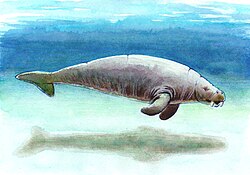
Rytiodus (meaning Rytina, "wrinkled", an old name for Steller's sea cow)1 is an extinct genus of sirenian, whose fossils have been discovered in France, Europe and Libya.
Description
With a length of 6 m (20 ft), Rytiodus was about twice the size as modern sirenians, surpassed only by Steller's sea cow, which was up to 8–9 m (26–30 ft) long. Like its closest modern relatives, the dugongs, Rytiodus had a pair of flippers, a streamlined body and a tail fin. Its flattened snout allowed it to feed in shallow coastal waters. Rytiodus had short tusks which it may have used to extract food from the sand.2
References
References
- Dixon, Dougal (2008). World Encyclopedia of Dinosaurs & Prehistoric Creatures. New York: Lorenz Books. pp. 475. ISBN 978-0-7548-1730-7.
- Palmer, D., ed. (1999). The Marshall Illustrated Encyclopedia of Dinosaurs and Prehistoric Animals. London: Marshall Editions. p. 229. ISBN 1-84028-152-9.
- Barry Cox, Colin Harrison, R.J.G. Savage, and Brian Gardiner. (1999): The Simon & Schuster Encyclopedia of Dinosaurs and Prehistoric Creatures: A Visual Who's Who of Prehistoric Life., Simon & Schuster.
- David Norman. (2001): The Big Book Of Dinosaurs. Pg.347-348, Welcome Books.