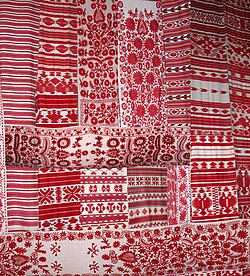
A rushnyk or rushnik (Ukrainian: рушник [rʊʃˈnɪk] ⓘ; Belarusian: ручнік [rut͡ʂˈnʲik] ⓘ; Russian: ручник, рушник [rʊtɕˈnʲik], [rʊʂˈnʲik]; Rusyn: ручник), ręcznik ludowy, ręcznik obrzędowy, ręcznik paradny (in Polish), ștergar (in Romanian) is a decorative and ritual cloth. Made of linen or cotton it usually represents woven or embroidered designs, symbols and cryptograms of the ancient world.1 They have been used in sacred East Slavic rituals, religious services and ceremonial events such as weddings and funerals.2 Each region has its own designs and patterns with hidden meaning, passed down from generation to generation and studied by ethnographers. In Polish folk culture, such towels are used primarily for decorative and ceremonial purposes. In Romanian folk culture they are embroidered decorative cloth traditionally used in rural homes, religious settings, and folk ceremonies. They are also used by Slavic Rodnovers.
There are many rushnyk collections in ethnographic museums. In Ukraine, the Rushnyk Museum is located in Pereiaslav, Ukraine as part of The Museum of Folk Architecture and Way of Life of Central Naddniprianshchyna. A Russian rushnyk collection is housed at the Hermitage Museum.
Meaning

The rectangular shape of the fabric indicates a life's journey and the ornamentation captures the cultural ancestral memory of the region.3 The material used is either linen or hemp. The act of spinning thread and the process of weaving linen embodies spiritual power dating back to the ancient deity Mokosh who is often represented in embroidery. The needle has its own energy, an idea similar to acupuncture, and the color of the thread has sacred meaning. Red represents life and is the main color used. A rushnyk is given to a baby at birth, it follows the person throughout life and is used in the funeral service after death.
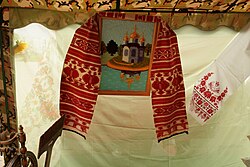
Uses in East Slavic culture
A Rushnyk has many uses. The very basic rushnik is colloquially called the utyralnyk or wiper and serves as a towel. The utyralnyk either has no designs on it or it has very narrow strip on the edges. In contrast, a nabozhnyk is a highly decorated Rushnyk composing of embroidery and of lace. Nabozhnyks, also called nabraznyks or nakutnyks are used to decorate icons and icon corners in homes.
Uses in Polish culture
In Polish folk culture they are called "ręczniki ludowe", "ręczniki obrzędowe", "ręczniki paradne". Ręczniki ludowe were not used for drying or cleaning, but instead served primarily decorative and ceremonial functions. In western and central Poland they formed part of interior decoration and also they were used during the welcoming of guests with bread and salt (the bread was carried on them). Richly embroidered towels were hung or laid down in the representative part of the house, known as ''izba paradna'', that is, the room designated for receiving guests. For this reason, they were also referred to as ''ręczniki paradne'', for example in Opoczno.4567 Both older and younger women prepared embroidered towels as a demonstration of their skills, while young women also made them as part of the household furnishings they would bring into their future homes after marriage.
In addition, in eastern Poland and among Poles who lived in the former Eastern Borderlands and were resettled in the Recovered Territories after the Second World War, these towels were also used to decorate religious images and icons in both Polish Catholic and Orthodox homes.
Towels intended for decorating religious images were usually narrower, whereas those used all over Poland for decorating the home and for welcoming guests with bread and salt were often wider on average, but not always. Both types were most often embroidered and usually finished with lace, tassles, or fringes.
Uses in Romanian culture
In Romanian folk culture, they are called ''ștergare'', they served both ornamental and ceremonial functions. Richly woven or embroidered, they were commonly displayed in the interior of traditional homes, where they adorned walls, icons, crosses, and household furnishings.
Ștergare also played a role in important life-cycle events, particularly weddings, where they could be used as ceremonial gifts, elements of bridal attire, or decorations for ritual objects.
Like similar textiles found elsewhere in Eastern Europe, Romanian ''ștergare'' were often decorated with embroidery and finished with lace, tassels, or fringes.
Wedding rushnyks and motifs in Orthodoxy
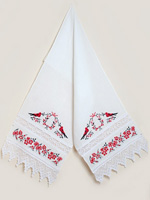
Colour plays a very important symbolic role in traditional Slavic embroidery. Red is the colour of life, the sun, fertility and health. The majority of rushnyks are embroidered with red threads. The very word "red" means "beautiful" and "splendid" in Old Russian and Ruthenian: a red girl, a red sun or a red spring. The phrase Krasnaya devitsa in Old Russian language for example is an old idiomatic expression which means beautiful girl, the word Krasnaya translates in Russian language also into red.8 The diamond-shaped design of the rushnyk is an ancient agricultural symbol, which means a sown field, or the sun, and expresses the idea of fertility and protection against evil. Ducks, in the centre of the rushnyk, symbolize the element of life-giving water. In wedding folklore a duck and a drake symbolize a bride and a groom, in other words a pair of ducks is a symbol of family life. Another common symbol on rushniks are birds.9
During a wedding ceremony, the bride and groom stand on a Rushnyk called a pidnozhnyk, which translates as step-on towel. What happens to the pidnozhnyk is that the bride will drag the towel behind her, and her bridesmaids follow behind her. Tradition has it that when the bridesmaids follow behind the pidnozhnyk, they are following the path of the bride and will hopefully be married.
Etymology
In Eastern Slavic culture (Belarusian, Ukrainian, Russian, Rusyn):
Words with the common suffix "-nyk" ("-nik"), denoting agent nouns, indicate a general association of the new word with the base one.
- Rushnyk: from ruka, hand
- Na-: a prefix meaning "on", i.e., the thing is supposed to be put onto something
- Pidnozhnyk: from pid (=under) and nohy (=feet)
In Romanian culture:
The Romanian word ștergar (plural ștergare) is related to the Romanian verb a șterge ("to wipe", "to clean", "to erase")L
- ștergar ← Romanian a șterge ("to wipe"). The noun originally meant "a cloth used for wiping" or "a towel."
In Polish culture:
Ręcznik ludowy ("folk towel"):
- ręcznik derives from the noun ręka ("hand").
- The suffix -nik forms nouns denoting objects associated with a particular function.
- ludowy means "of the folk", "of the people", or "traditional rural", from lud ("people", "folk").
- Thus, ręcznik ludowy literally means "folk towel" or "traditional folk towel".
Ręcznik obrzędowy ("ceremonial/ritual towel"):
- obrzędowy derives from obrzęd ("rite", "ceremony", "ritual"). The adjective means "ritual", "ceremonial", or "used in rites". Ręcznik obrzędowy therefore literally means "ritual towel" or "ceremonial towel".
Ręcznik paradny ("ceremonial/display/parade towel"):
- paradny means "for ceremonial presentation/representation", "representational", "for display", "for show", or “fit for display or ceremony”. It derives from parada ("parade", "display", "show"). In traditional Polish culture, an izba paradna was the representative room used to receive guests and display the household's finest possessions. Ręcznik paradny can be translated as "display towel" or "parade towel".
See also
See also
Related references
Embroidery in other cultures
References
References
- A Language of Their Own Rushnyky are mirrors of a nation's cultural ancestral memory. The ritual ornaments on rushnyky preserved archaic magical signs, symbolism of colors and artistic folk styles, Kozak baroque and rococo as well as classicism, all of which continue to amaze us and are cherished to this day. They have a language of their own — cryptograms that have been forgotten but not lost.[1]
- Yakiv Bystrov, Marcin Kleban, Anna Niżegorodcew (2011). Developing Intercultural Competence through English: Focus. Jagiellonian University. p. 94. ISBN 9788323384366.
- Rushnyky: Ukrainian Ritual Cloths, archived from the original on 2016-05-22
- "Rozmawiała igła z nitką – znamy laureatów konkursu" [The Needle Spoke with the Thread]. Stowarzyszenie Twórców Ludowych (in Polish). Zarząd Główny Stowarzyszenia Twórców Ludowych.
- "Maria Madej". Opoczyński Szlak Rzemiosła (in Polish).
- "Łódzkie Full of Tradition: Opoczno Embroidery and Paper Flowers Remain in Fashion". Łódzkie.pl (in Polish). Marshal's Office of the Łódź Voivodeship.
- "Marianna Jobczyk". Opoczyński Szlak Rzemiosła (in Polish).
- "Is red beautiful?". Grammarphobia. 2017-01-02. Retrieved 2018-11-05.
- "Рушники. Традиции русской народной свадьбы". document.wikireading.ru. Retrieved 2019-07-08.
External links
External links
- Media related to Rushnyk at Wikimedia Commons
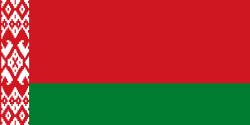
- Virtual Guide to Belarus - Belarusian Rushniks