Article · Wikipedia archive · Last revised Jul 28, 2026

Running gear (rail transport)

In railway terminology the term running gear refers to those components of a railway vehicle that run passively on the rails, unlike those of the driving gear. Traditionally these are the wheels, axles, axle boxes, springs and vehicle frame of a railway locomotive or wagon. The running gear of a modern railway vehicle comprises, in most instances, a bogie frame with two wheelsets. However there are also wagons with single axles and even individual wheels. Since in modern times, locomotives no longer require separate driving and carrying axles, as was formerly common with steam locomotives, but usually have bogies where all axles are driven, the term running gear is (inaccurately) superseding the term 'driving gear' in some parts of the world.

Last revised
Jul 28, 2026
Read time
≈ 1 min
Length
157 w
Citations
1
Source
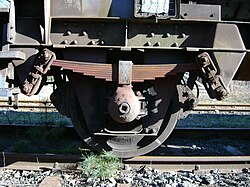
Single-axle running gear on a self-discharging hopper source ↗

In railway terminology the term running gear refers to those components of a railway vehicle that run passively on the rails, unlike those of the driving gear. Traditionally these are the wheels, axles, axle boxes, springs and vehicle frame of a railway locomotive or wagon.1 The running gear of a modern railway vehicle comprises, in most instances, a bogie frame with two wheelsets. However there are also wagons with single axles (fixed or movable) and even individual wheels. Since in modern times, locomotives no longer require separate driving and carrying axles (see wheel arrangement), as was formerly common with steam locomotives, but usually have bogies where all axles are driven, the term running gear is (inaccurately) superseding the term 'driving gear' in some parts of the world.

References

References

  1. Jackson, Alan A. (2006). The Railway Dictionary (4th ed.). Sutton Publishing Ltd. p. 257. ISBN 0-7509-4218-5.
See also

See also