| G.I, G.II and G.III | |
|---|---|
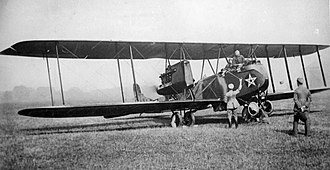 Rumpler G.III | |
| General information | |
| Type | Bomber aircraft |
| National origin | Germany |
| Manufacturer | Rumpler |
| Primary user | Luftstreitkräfte |
| Number built | c. 222 |
| History | |
| First flight | 1915 |
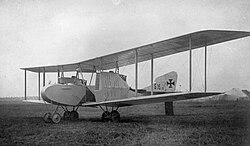
The Rumpler G.I was a bomber aircraft produced in Germany during World War I, together with refined versions known as the G.II and G.III.1
Design and development
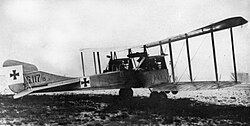
Based on a prototype with the factory designation 4A15, the G.I and its successors were built to a conventional bomber design for their time, two-bay biplanes with unstaggered wings of unequal span.2 The pilot sat in an open cockpit just forward of the wings, and open positions were provided in the nose and amidships for a gunner and observer. The engines were mounted pusher-fashion in nacelles atop the lower wings and enclosed in streamlined cowlings.2 Fixed tricycle undercarriage was fitted, with dual wheels on each unit.2
The G.II version was almost identical, but featured more powerful engines and carried a second 7.92 mm (.312 in) machine gun and increased bombload.2 The G.III was again similar, but had engine nacelles that were now mounted on short struts clear of the lower wing.2
Variants
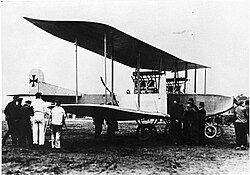
- 4A15 - prototype with Benz Bz.III engines3
- 5A15 - G.I production version with single machine gun and Benz Bz.III or Mercedes D.III engines4 (c. 60 built)2
- 5A16 - G.II production version with Benz Bz.IV engines and two machine guns5 (c. 72 built)6
- 6G2 - G.III production version with Mercedes D.IVa engines and two machine guns7 (c. 90 built)6
Specifications (G.III)
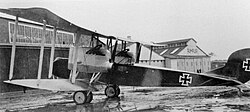
Data from Kroschel & Stützer 1994, p.140
General characteristics
- Crew: Three
- Length: 12.00 m (39 ft 4 in)
- Wingspan: 19.30 m (63 ft 4 in)
- Height: 4.50 m (19 ft 2 in)
- Wing area: 73.0 m2 (785 sq ft)
- Empty weight: 2,365 kg (5,203 lb)
- Gross weight: 3,620 kg (7,964 lb)
- Powerplant: 2 × Mercedes D.IVa , 190 kW (260 hp) each
Performance
- Maximum speed: 165 km/h (103 mph, 90 kn)
- Range: 700 km (440 mi, 380 nmi)
- Service ceiling: 5,000 m (16,000 ft)
Armament
- 1 × trainable 7.92 mm (.312 in) Parabellum MG14 machine gun in nose
- 1 × trainable 7.92 mm (.312 in) Parabellum MG14 machine gun in dorsal position
- 250 kg (550 lb) of bombs
Notes
Notes
- Taylor 1989, p.772
- The Illustrated Encyclopedia of Aircraft, p.2834
- Gray & Thetford 1962, p.529
- Gray & Thetford 1962, p.530
- Gray & Thetford 1962, p.531
- Kroschel & Stützer 1994, p.140
- Gray & Thetford 1962, p.532
References
References
- Gray, Peter; Owen Thetford (1962). German Aircraft of the First World War. London: Putnam.
- Herris, Jack (2014). Rumpler Aircraft of WWI: A Centennial Perspective on Great War Airplanes. Great War Aviation Centennial Series. Vol. 11. n.p.: Aeronaut Books. ISBN 978-1-935881-21-6.
- The Illustrated Encyclopedia of Aircraft. London: Aerospace Publishing.
- Kroschel, Günter; Helmut Stützer (1994). Die Deutschen Militärflugzeuge 1910–1918. Herford: Verlag E.S. Mittler & Sohn.