| Rubus niveus | |
|---|---|
| |
Scientific classification 
| |
| Kingdom: | Plantae |
| Clade: | Embryophytes |
| Clade: | Tracheophytes |
| Clade: | Spermatophytes |
| Clade: | Angiosperms |
| Clade: | Eudicots |
| Clade: | Rosids |
| Order: | Rosales |
| Family: | Rosaceae |
| Genus: | Rubus |
| Subgenus: | Rubus subg. Idaeobatus |
| Species: | R. niveus
|
| Binomial name | |
| Rubus niveus Thunb. 1813 (not Wall. ex G. Don 1832)
| |
| Synonyms12 | |
|
Synonymy
| |
Rubus niveus (Mysore raspberry, Ceylon raspberry and hill raspberry) is a species of Rubus native to southern Asia.
Description
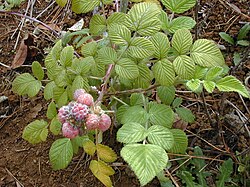
Rubus niveus is a shrub growing to 1–2.5 metres (3+1⁄2–8 ft) tall, the stems whitish, tomentose (densely covered with short, matted hairs) at first, later becoming glabrous green to purple. The leaves are pinnate with 5–11 leaflets (mostly 7 or 9) that are 2.5–8 centimetres (1–3+1⁄8 in) long and 1–4 cm (3⁄8–1+5⁄8 in) wide. The leaflets are dark green above and densely pale grey to white tomentose beneath.3
The flowers are about 1 cm in diameter, with five dark pink to red petals. The fruit is 8–12 cm (3+1⁄4–4+3⁄4 in) in diameter, densely grey tomentose, and dark red at first, ripening black.3
Taxonomy
The species was first published in 1813 by Carl Peter Thunberg in De Rubo: 9.1
- Rubus niveus var. micranthus (D.Don) H.Hara
- Rubus niveus var. niveus
The species is commonly known as 'Mysore raspberry',4 'Ceylon raspberry'4 (after the former name of Sri Lanka) and 'hill raspberry'.4 Local native names include Chinese: 红泡刺藤, and Hindi: काला हिसालू, romanized: kala hinsalu.5
Distribution and habitat
It is native to southern Asia; from Afghanistan, east through India—covering the Himalayas, Assam, Nepal, Pakistan, and Sri Lanka—and across to Tibet, southern and north-central China and Taiwan, and south to Indo-China (Laos, Myanmar, Thailand and Vietnam) and Malesia (in Java).361
It has been introduced into various countries and regions including; south America (in Bolivia, southern Brazil, Ecuador, El Salvador, Guatemala, Nicaragua, Trinidad and Tobago), United States (in the states of Florida and Hawaii), Africa (Ethiopia, Galápagos, Kenya, Malawi, Tanzania, Zambia and Zimbabwe) and South Africa (in the Cape Provinces, the Northern Provinces and Swaziland).
It has become naturalised and invasive in Hawaii and the Galápagos Islands.7
It grows in temperate regions.
Uses
Rubus niveus is cultivated for its edible fruit, which potentially have gastroprotective, antioxidative, and nutraceutical properties.8
References
References
- "Rubus niveus Thunb". Plants of the World Online. Kew Science. Retrieved 30 October 2023.
- The Plant List, Rubus niveus Thunb.
- Flora of China: Rubus niveus
- "Rubus niveus". Germplasm Resources Information Network. Agricultural Research Service, United States Department of Agriculture. Retrieved 2 January 2018.
- University of Melbourne: Sorting Rubus names
- "Rubus niveus". Plants for a Future.
- Pacific Island Ecosystems at Risk: Rubus niveus
- Pancholi, B.; Rana, A.C. (2020). "Traditional uses, phytochemistry and pharmacological aspects of Rubus niveus thumb plant-A review". The Journal of Phytopharmacology. 9 (6): 438–444. doi:10.31254/phyto.2020.9610.