| Rubus canadensis | |
|---|---|
| |

| |
| 1909 Fitch illustration1 | |
Scientific classification 
| |
| Kingdom: | Plantae |
| Clade: | Embryophytes |
| Clade: | Tracheophytes |
| Clade: | Spermatophytes |
| Clade: | Angiosperms |
| Clade: | Eudicots |
| Clade: | Rosids |
| Order: | Rosales |
| Family: | Rosaceae |
| Genus: | Rubus |
| Species: | R. canadensis
|
| Binomial name | |
| Rubus canadensis L. 1753 not Torr. 1824
| |
| Synonyms | |
|
Synonymy
| |
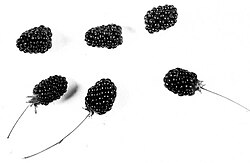
Rubus canadensis is a North American species of flowering plant in the rose family known by the common names smooth blackberry,2 Canadian blackberry, thornless blackberry and smooth highbush blackberry.3
Description
This rhizomatous shrub forms thickets up to 2 to 3 meters (6+1⁄2 to 10 ft) tall. The plant reproduces by seed, by sprouting up from the rhizome, and by layering. The stems can grow 1 m (3+1⁄2 ft) in height in under two months. The leaves are deciduous and alternately arranged, each measuring 10 to 20 centimeters (4 to 8 inches) long.
The inflorescence is a cluster of up to 25 flowers. The fruit is an aggregate of many small drupes, each of which contains a tiny nutlet.43
Distribution and habitat
It is native to central and eastern Canada (from Newfoundland to Ontario) and the eastern United States (New England, the Great Lakes region, and the Appalachian Mountains).45 It has also been sparingly recorded in Great Britain, in which it is often confused for the many other native blackberry species.6 Rubus canadensis grows in many types of forested habitat, as well as on disturbed sites.
Ecology
Associated plants may include Acer spicatum (mountain maple), Amelanchier spp. (serviceberry), Viburnum alnifolium (hobblebush), Sambucus pubens (scarlet elder), Rubus allegheniensis (common blackberry), Corylus cornuta (beaked hazel), Vaccinium erythrocarpum (southern mountain cranberry), Menziesia pilosa (minnie-bush), and Rhododendron catawbiense (rosebay).4
Many types of animals feed on the fruits and foliage of this shrub. The thickets provide cover and nesting sites.4
Uses
The fruits of this plant provided food for Native American groups, who also used parts of the plant medicinally at times.7
References
References
- illustration from Curtis's Botanical Magazine, London., vol. 135 [= ser. 4, vol. 5]: plate 8264, lithograph by J.N.Fitch
- NRCS. "Rubus canadensis". PLANTS Database. United States Department of Agriculture (USDA). Retrieved 24 October 2015.
- Flora of North America, Rubus canadensis Linnaeus, 1753. Canadian or smooth highbush blackberry, ronce du Canada
- Coladonato, Milo. 1994. Rubus canadensis. In: Fire Effects Information System, [Online]. U.S. Department of Agriculture, Forest Service, Rocky Mountain Research Station, Fire Sciences Laboratory.
- Biota of North America Program 2014 county distribution map
- "Brambles of the British Isles - Rubus canadensis".
- Rubus canadensis. University of Michigan Ethnobotany.
External links
External links
- Media related to Rubus canadensis at Wikimedia Commons
- Data related to Rubus canadensis at Wikispecies
- The Nature Conservancy
- "Rubus canadensis". Plants for a Future.
- "Rubus pergratus". Plants for a Future.