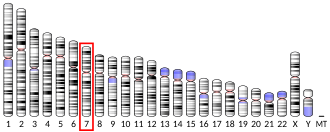
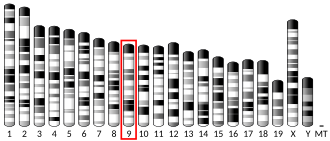
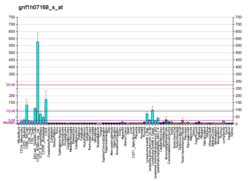
Retinitis pigmentosa 9 (autosomal dominant), also known as RP9 or PAP-1, is a protein which in humans is encoded by the RP9 gene.5
Function
The removal of introns from nuclear pre-mRNAs occurs on a complex called a spliceosome, which is made up of 4 small nuclear ribonucleoprotein (snRNP) particles and an undefined number of transiently associated splicing factors. The exact role of PAP-1 in splicing is not fully understood, but it is thought that PAP-1 localizes in nuclear speckles containing the splicing factor SRSF2 and interacts directly with another splicing factor, U2AF35.6
Clinical significance
Mutations in PAP1 underlie autosomal dominant retinitis pigmentosa mapped to the RP9 gene locus.7
Interactions
RP9 has been shown to interact with U2 small nuclear RNA auxiliary factor 1.6
References
References
- GRCh38: Ensembl release 89: ENSG00000164610 – Ensembl, May 2017
- GRCm38: Ensembl release 89: ENSMUSG00000032239 – Ensembl, May 2017
- "Human PubMed Reference:". National Center for Biotechnology Information, U.S. National Library of Medicine.
- "Mouse PubMed Reference:". National Center for Biotechnology Information, U.S. National Library of Medicine.
- "Entrez Gene: RP9 retinitis pigmentosa 9 (autosomal dominant)".
- Maita H, Kitaura H, Keen TJ, Inglehearn CF, Ariga H, Iguchi-Ariga SM (November 2004). "PAP-1, the mutated gene underlying the RP9 form of dominant retinitis pigmentosa, is a splicing factor". Exp. Cell Res. 300 (2): 283–96. doi:10.1016/j.yexcr.2004.07.029. PMID 15474994.
- Keen TJ, Hims MM, McKie AB, Moore AT, Doran RM, Mackey DA, Mansfield DC, Mueller RF, Bhattacharya SS, Bird AC, Markham AF, Inglehearn CF (April 2002). "Mutations in a protein target of the Pim-1 kinase associated with the RP9 form of autosomal dominant retinitis pigmentosa". Eur. J. Hum. Genet. 10 (4): 245–9. doi:10.1038/sj.ejhg.5200797. PMID 12032732.
Further reading
Further reading
- Inglehearn C, Keen TJ, al-Maghtheh M, Bhattacharya S (1994). "Loci for autosomal dominant retinitis pigmentosa and dominant cystoid macular dystrophy on chromosome 7p are not allelic". Am. J. Hum. Genet. 55 (3): 581–2. PMC 1918416. PMID 8079997.
- Inglehearn CF, Carter SA, Keen TJ, et al. (1993). "A new locus for autosomal dominant retinitis pigmentosa on chromosome 7p". Nat. Genet. 4 (1): 51–3. doi:10.1038/ng0593-51. PMID 8513323. S2CID 33087284.
- Maita H, Harada Y, Nagakubo D, et al. (2000). "PAP-1, a novel target protein of phosphorylation by pim-1 kinase". Eur. J. Biochem. 267 (16): 5168–78. doi:10.1046/j.1432-1327.2000.01585.x. PMID 10931201.
- Keen TJ, Hims MM, McKie AB, et al. (2002). "Mutations in a protein target of the Pim-1 kinase associated with the RP9 form of autosomal dominant retinitis pigmentosa". Eur. J. Hum. Genet. 10 (4): 245–9. doi:10.1038/sj.ejhg.5200797. PMID 12032732.
- Strausberg RL, Feingold EA, Grouse LH, et al. (2003). "Generation and initial analysis of more than 15,000 full-length human and mouse cDNA sequences". Proc. Natl. Acad. Sci. U.S.A. 99 (26): 16899–903. Bibcode:2002PNAS...9916899M. doi:10.1073/pnas.242603899. PMC 139241. PMID 12477932.
- Scherer SW, Cheung J, MacDonald JR, et al. (2003). "Human chromosome 7: DNA sequence and biology". Science. 300 (5620): 767–72. Bibcode:2003Sci...300..767S. doi:10.1126/science.1083423. PMC 2882961. PMID 12690205.
- Maita H, Kitaura H, Keen TJ, et al. (2004). "PAP-1, the mutated gene underlying the RP9 form of dominant retinitis pigmentosa, is a splicing factor". Exp. Cell Res. 300 (2): 283–96. doi:10.1016/j.yexcr.2004.07.029. PMID 15474994.
- Gerhard DS, Wagner L, Feingold EA, et al. (2004). "The status, quality, and expansion of the NIH full-length cDNA project: the Mammalian Gene Collection (MGC)". Genome Res. 14 (10B): 2121–7. doi:10.1101/gr.2596504. PMC 528928. PMID 15489334.
- Maita H, Kitaura H, Ariga H, Iguchi-Ariga SM (2005). "Association of PAP-1 and Prp3p, the products of causative genes of dominant retinitis pigmentosa, in the tri-snRNP complex". Exp. Cell Res. 302 (1): 61–8. doi:10.1016/j.yexcr.2004.08.022. PMID 15541726.
- Kuroda TS, Maita H, Tabata T, et al. (2004). "A novel nucleolar protein, PAPA-1, induces growth arrest as a result of cell cycle arrest at the G1 phase". Gene. 340 (1): 83–98. doi:10.1016/j.gene.2004.05.025. PMID 15556297.
- Maita H, Kitaura H, Ariga H, Iguchi-Ariga SM (2005). "CIR, a corepressor of CBF1, binds to PAP-1 and effects alternative splicing". Exp. Cell Res. 303 (2): 375–87. doi:10.1016/j.yexcr.2004.10.012. PMID 15652350.