| Set of rotundas | |
|---|---|
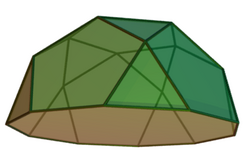 Example: pentagonal rotunda | |
| Faces | 1 n-gon 1 2n-gon n pentagons 2n triangles |
| Edges | 7n |
| Vertices | 4n |
| Symmetry group | Cnv, [n], (*nn), order 2n |
| Rotation group | Cn, [n]+, (nn), order n |
| Properties | convex |
In geometry, a rotunda is any member of a family of cyclic-symmetric polyhedra. They are similar to a cupola but, instead of alternating squares and triangles, they alternate pentagons and triangles around an axis. The pentagonal rotunda is a Johnson solid.
Other forms can be generated with dihedral symmetry and distorted equilateral pentagons.
Examples
| 3 | 4 | 5 | 6 | 7 | 8 |
|---|---|---|---|---|---|
 triangular rotunda |
 square rotunda |
 pentagonal rotunda |
 hexagonal rotunda |
 heptagonal rotunda |
 octagonal rotunda |
Star-rotunda
| 5 | 7 | 9 | 11 |
|---|---|---|---|
 Pentagrammic rotunda |
 Heptagrammic rotunda |
 Enneagrammic rotunda |
 Hendecagrammic rotunda |
References
References
- Norman W. Johnson, "Convex Solids with Regular Faces", Canadian Journal of Mathematics, 18, 1966, pages 169–200. Contains the original enumeration of the 92 solids and the conjecture that there are no others.
- Victor A. Zalgaller (1969). Convex Polyhedra with Regular Faces. Consultants Bureau. No ISBN. The first proof that there are only 92 Johnson solids.