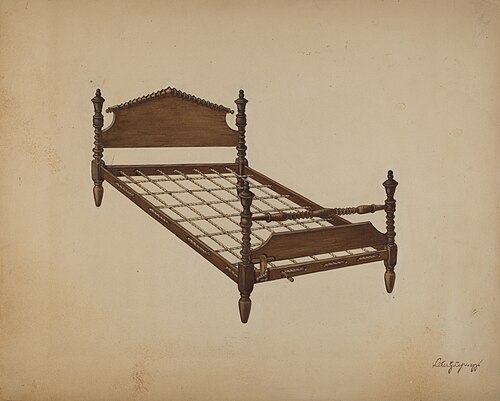
A rope bed is a type of platform bed in which the sleeper (and mattress) is supported by a lattice of rope, rather than wooden slats.
In cold climates, a rope bed would be topped with one or more insulating paillasses or bedticks, which would traditionally be stuffed with straw, chaff, or down feathers. It might also have a canopy hung with warm curtains.12 Modernly, they may be topped by a thin futon (a form of bedtick) or other roll-up mattress3 (see mattress topper).
In the sixteenth century (England?), bedmats of woven or plaited rush were often laid on the widely-spaced ropes, and the bedticks were laid on the mats. This stopped them from bulging between the ropes.4
Rope beds need to be tightened regularly (with a bed wrench, and sometimes with wedges) as they sag. They must also be re-strung occasionally; re-stringing reduces sag and evens out wear.536 When fully or partly unstrung, rope beds can be packed flat for transport.3 The need to tighten bedcords has been said to be the origin of the English phrase "sleep tight",4 but some etymologists disagree.7
-
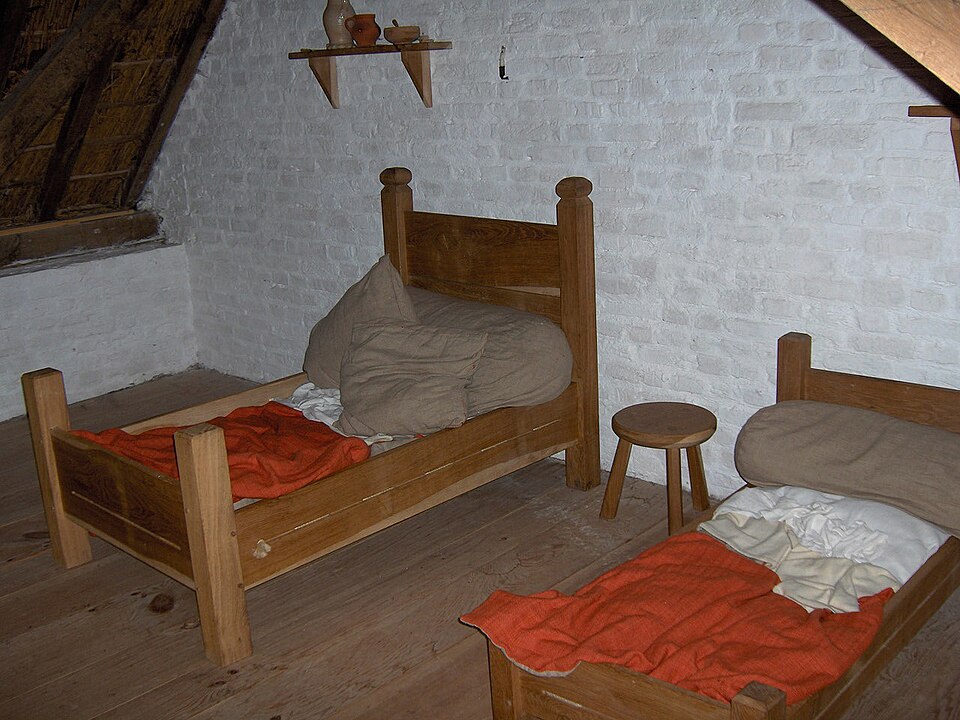 Medieval-reconstruction rope beds (circa 1465); note loops of rope protruding from side boards
 -
 A rope bedframe thought to have belonged to William Shakespeare
 -
 Bedclothes pulled back to show the bedcords of the 1590s Great Bed of Ware
 -
![Touchable museum samples illustrating the layers of the Great Bed of Ware: the bedcords, a plaited-rush[8] bedmat, a flockbed and then a featherbed in dun ticking, a downbed in striped ticking, and the bedlinen.[4] Flock is unspun fibers, in this case probably wool. The bedticks stuffed with the softest fillings are laid topmost.](/api/ext/img?url=https%3A%2F%2Fupload.wikimedia.org%2Fwikipedia%2Fcommons%2Fthumb%2F5%2F51%2FWikimania_2014_-_Victoria_and_Albert_Museum_-_The_Great_Bed_of_Ware221398.jpg%2F500px-Wikimania_2014_-_Victoria_and_Albert_Museum_-_The_Great_Bed_of_Ware221398.jpg) Touchable museum samples illustrating the layers of the Great Bed of Ware: the bedcords, a plaited-rush8 bedmat, a flockbed and then a featherbed in dun ticking, a downbed in striped ticking, and the bedlinen.4 Flock is unspun fibers, in this case probably wool. The bedticks stuffed with the softest fillings are laid topmost.
Touchable museum samples illustrating the layers of the Great Bed of Ware: the bedcords, a plaited-rush8 bedmat, a flockbed and then a featherbed in dun ticking, a downbed in striped ticking, and the bedlinen.4 Flock is unspun fibers, in this case probably wool. The bedticks stuffed with the softest fillings are laid topmost.
See also
See also


- Charpai (warm-climate version)
- Bedtick
- Platform bed
- Murphy bed; some are rope (or wire) beds
Media related to Rope bedframes at Wikimedia Commons
References
References
- Karstensen, Rebecca (2018-01-18). Graves, Jean (ed.). "Sleep Tight, Don't Let the Bed Bugs Bite – A Myth Debunked". libraries.indiana.edu.
- "Canopy beds and rope beds". Greydragon Furniture collection. (includes links to plans and information on tightening and use)
- Devin, Harold. "Making a Rope Bed" (PDF).
- Vredeman de Vries, Hans (September 28, 1998). "Great Bed of Ware". Victoria and Albert Museum: Explore the Collections. V&A Explore The Collections. Victoria and Albert Museum.
- Wright, Bryan. "Colonial Sense: How-To Guides: Interior: Bed Roping". Colonial Sense.
- "The Stamford Historical Society, A virtual tour through the Hoyt-Barnum House". www.stamfordhistory.org.
- "What Is The Origin Of The Phrase "Sle... | Lexico.com". Lexico Dictionaries. Archived from the original on April 10, 2017.
- "East Anglian rush", probably actually Scirpus, a sedge[1]