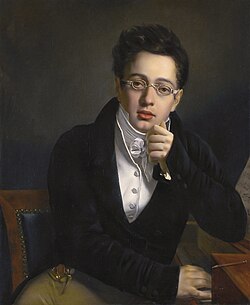
The Rondo for Violin and Strings, D 438, is a composition in A major by Franz Schubert. He wrote the rondo in 1816. Like the roughly contemporary Adagio and Rondo concertante in F major, D 487, the work is a concertante piece designed to highlight the skills of the violin soloist.
Background
Schubert composed the piece in 1816, along with a number of other works featuring a violin soloist including the three sonatinas (D 384/385 & D 408) and the Konzertstück in D major, D 345. It is believed that the work was composed with the intent that either the composer himself or his brother Ferdinand would take the soloist's part.12
The piece was unpublished during the composer's lifetime, not seeing publication until 1897, when Breitkopf & Härtel published it in an edition edited by Eusebius Mandyczewski.31
Structure
The composition, which is written for a violin soloist and an accompanying group made up of violins, violas & cellos,a is structured as a single multi-tempo movement divided into two sections, the Introduction (Marked: Adagio) and the Rondo (Marked: Allegro giusto). It takes around 13 – 15 minutes to perform.
References
References
- Notes
- This accompanying group can be as small as a standard string quartet.
- (Dearling 1996, p. 3)
- (Markow 2007)
- (Simon 2008)
- Sources
- Castillo, Patrick (2013). "Concert Program VIII: The Solo Voice" (PDF). Menlo School. Retrieved 20 November 2016.
- Dearling, Robert (1996). Mysliveček, Viotti & Spohr: Violin Concertos (PDF) (CD). Hyperion Records. CDA66840.
- Markow, Robert (2007). "Concert Program Notes - Rondo in A major for Violin and Strings, D. 438 (1816)". National Arts Centre of Canada. Retrieved 17 September 2016.
- Sheppard Skærved, Peter (23 November 2013). "Franz Schubert –A Major Rondo for Violin & Strings D438-Some Unmusical Considerations". Peter-Sheppard-Skaerved.com. Retrieved 17 September 2016.
- Simon, Benjamin (2008). "Program Notes - Virtuosi, January 2008". San Francisco Chamber Orchestra. Retrieved 17 September 2016.
{{cite web}}: CS1 maint: deprecated archival service (link)
External links
External links
- Rondo in A major for Violin and Strings, D438: Scores at the International Music Score Library Project
- "Rondo in A major for Violin and Strings, D 487 (In version for Soloist and String Quartet)". YouTube. 16 June 2014.
- "Rondo in A major for Violin and Strings, D 487 (In version for Soloist and String Orchestra)". YouTube. 29 July 2012.