| Ringold Formation | |
|---|---|
| Stratigraphic range: Late Miocene-Pliocene, 8.5–3 Ma | |
 The Columbia River flowing through the Ringold Formation. | |
| Type | Formation |
| Underlies | Deposits from Missoula Floods |
| Overlies | Columbia River Basalt Group |
| Thickness | 1,000 feet (300 m)1 |
| Location | |
| Coordinates | 46°40′01″N 119°26′10″W / 46.667°N 119.436°W / 46.667; -119.4362 |
| Region | Washington (state) |
| Country | United States |
| Type section | |
| Named for | Ringold Post Office3 |
| Named by | John C. Merriam, John P. Buwalda4 |
The Ringold Formation is a geological formation in Eastern Washington, United States. The formation consists of sediment laid down by the Columbia River following the flood basalt eruptions of the Columbia River Basalt Group, and reaches up to 1,000 feet (300 m) thick in places.51 It preserves fossils dating back to the late Miocene and Pliocene epochs of the Neogene period.6
Exposures of the Ringold Formation can be found from Hanford Reach National Monument north to the Moses Lake area.4 Large portions of the formation are buried by other sediment deposits, extending as far as Wallula Gap southeast of Kennewick.7 In recent years, irrigation water entering the groundwater system has destabilized some Ringold Formation slopes and cliffs, causing landslides.8 The formation was named in 1917 for a school of the same name that existed at the time. Ringold School was located on the Franklin County side of the Columbia River to the south of Savage Island.39
Geology
During the flood basalt eruptions before the sediments were laid down, the Columbia River followed a different route than it does today, taking it near the present-day sites of Yakima and Goldendale. North-to-south compression of the Columbia Plateau caused anticline folds like Rattlesnake Mountain and the Horse Heaven Hills to rise.
These ridges provided geographic barriers, rerouting the river eastward toward the Tri-Cities with it eventually flowing through Wallula Gap. During part of this period, the Columbia River was completely dammed leading to the development of a large lake covering the Yakima Valley and southern Columbia Basin. The Ringold Formation is the sediment laid down during the period of the lake's existence and while the route of the river was changing.10
Some of the sediments found as part of the formation may have been sourced from ancestral versions of other Pacific Northwest rivers like the Clearwater and Pend Oreille.1 Layers of volcanic ash can also be found, with thicknesses ranging from being barely noticeable to 4 feet (1.2 m) thick.7
Stratigraphy
The Ringold Formation represents sand and gravel placed by the Columbia River between around 8.5 and 3 million years ago. These deposits overlay cooled lava erupted as part of the Columbia River Basalt Group, a type of volcanic eruption known as flood basalts erupting from fissures across eastern Washington and Oregon that were unrelated to the Cascade Range.11 It is covered in places by deposits from the Missoula Floods.
Regional uplift caused the Columbia to erode parts of the Ringold Formation. The White Bluffs on Hanford Reach National Monument are a significant example of this.5
Recent landslides

Landslides along the Columbia River have increased in recent years due to irrigation around Basin City and Othello. Irrigation water enters and flows through the groundwater system toward the river easily through deposits left by the Missoula Floods. This destabilizes Ringold Formation features like the White Bluffs, causing the landslides.8 Landslides did not occur frequently before 1960. Rapid changes in river flow caused by the Priest Rapids Dam upstream may also contribute to slope destabilization.12
The largest landslide in the White Bluffs portion of the formation is adjacent to Locke Island. This complex, initiated in the 1970s, has rerouted the Columbia River. As a result of the change, critical salmon spawning habitat has been destroyed. The landslide restricts the flow of the river on the east side of the river and as a result, large portions of Locke Island are being removed by the Columbia River. Movement of this landslide is ongoing, but the primary factor behind the continued movement is destabilization by the Columbia River eroding the fallen material. Blown sand from this landslide is the primary source material for sand dunes atop the bluffs near the island.138
The Locke Island slide is the northernmost slide along the White Bluffs. There are at least five other major slides into the Columbia River, with the southernmost one being across the river from Pacific Northwest National Laboratory in north Richland, which occurred in 2008. At least one slide has occurred in nearby coulees.12
Paleobiota
Color key
|
Notes Uncertain or tentative taxa are in small text; |
Mammals
The mammal fossils of the Ringold Formation are divided into several local faunas, from youngest to oldest:
- Taunton local fauna (Blancan III NALMA, chron C2An.1r of the mid-Pliocene, ~3.05 million years old)14
- Blufftop local fauna (Blancan II NALMA, mid-Pliocene, ~4.3 million years old)1415
- White Bluffs local fauna (Blancan I NALMA, chrons C3n.3r or C3n.2r of the early Pliocene, 4.98–4.62 million years old)141617
- River Road local fauna (late Hemphillian NALMA, latest Miocene or earliest Pliocene)1418
Artiodactyla
| Artiodactyls of the Ringold Formation | ||||
|---|---|---|---|---|
| Genus / Taxon | Species | Local fauna | Notes | Images |
| Antilocapridae | White Bluffs17 | Indeterminate pronghorns. | ||
| † Bretzia19 | † B. pseudalces19 | White Bluffs | A very common capreoline deer with palmate antlers similar to moose. One of the earliest deer in North America.192017 | |
| † Camelops | † C. sp. | Taunton21 | A large camel. | |
| † Capromeryx | † C. tauntonensis21 | Taunton | An antilocaprid (pronghorn). Later Capromeryx species were quite small, but this early species was only slightly smaller than living pronghorns.21 | |
| Cervidae | Blufftop,18 Taunton21 | Indeterminate deer. Some Taunton fossils are similar to Odocoileus (mule deer and kin) and Rangifer (reindeer).21 | ||
| † Hemiauchenia | † H. blancoensis | White Bluffs,2217 Taunton21 | A common lamine camelid (related to llamas, alpacas, and kin). | |
| † Megatylopus | † M. sp. aff. M. gigas | River Road,22 | A common large camel, either M. gigas17 or M. cochrani.22 | |
| † Platygonus | † P. pearcei | White Bluffs2217 | A common flat-headed peccary. | |
| † P. sp. | Taunton21 | |||
Carnivora
| Carnivorans of the Ringold Formation | ||||
|---|---|---|---|---|
| Genus / Taxon | Species | Local fauna | Notes | Images |
| Bassariscus | B. astutus | White Bluffs,16 Taunton16 | The living ringtail, a species of procyonid (raccoon-like mammals). | 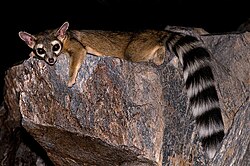 |
| † Borophagus | † B. diversidens | Taunton2123 | A very large borophagine (bone-crushing dog). | |
| † B. hilli | White Bluffs222317 | |||
| † Buisnictis | † B. cf. breviramus | Taunton2115 | A skunk. | |
| Canis | † C. lepophagus | Taunton2115 | A coyote-like canine. | |
| † Chasmaporthetes | † C. ossifragus | White Bluffs17 | A long-limbed hyena. | |
| † Dinofelis | cf. † D. paleoonca | Taunton21 | A possible machairodontine (saber-toothed cat). | |
| † Eucyon | † E. davisi | White Bluffs2217 | A coyote-like canine, previously classified as a species of Canis. | |
| "Felis" | F. sp.2217 | White Bluffs, Taunton21 | A cougar-sized cat, probably the same as Puma lacustris or "Lynx rexroadensis".15 | |
| cf. † Homotherium | cf. † H. sp. | White Bluffs2217 | A relatively small machairodontine (saber-toothed cat).22 | |
| † Huracan24 | † H. cf. schneideri | White Bluffs25 | A large ailuropodine (panda-like) bear, previously considered a species of Agriotherium.25 One of the last surviving ailuropodine bears in North America.24 | |
| Lynx | L. cf. rufus | Taunton21 | A possible bobcat. |  |
| Mustela | † M. cf. rexroadensis | Taunton2115 | A weasel. | |
| † Parailurus | † P. sp. | Taunton2621 | A large ailurid (red panda-like mammal). | |
| † Plionarctos | † P. harroldorum27 | White Bluffs2715 | A tremarctine (short-faced bear) which was probably ancestral to later tremarctines.27 Fossils of this species were previously identified as Ursus abstrusus or Tremarctos floridanus.222127 | |
| † P. cf. harroldorum | Taunton27 | |||
| † Pliotaxidea | † P. sp. | White Bluffs17 | An American badger-like mustelid. | |
| Procyon? | P.? sp. | Taunton21 | A possible raccoon. | |
| † Satherium | † S. piscinarium | Taunton2115 | An otter. | |
| Spilogale | S. sp. | Taunton21 | A spotted skunk. | |
| Taxidea | T. sp. | Taunton2115 | An American badger. | |
| † Trigonictis | † T. cookii | White Bluffs,2215 Taunton21 | An ictonychine (grison-like mustelid). T. cookii may represent small individuals of T. macrodon.17 | |
Lagomorpha
| Lagomorphs of the Ringold Formation | ||||
|---|---|---|---|---|
| Genus / Taxon | Species | Local fauna | Notes | Images |
| † Alilepus | † A. vagus | Taunton2128 | A rabbit. | |
| † Hypolagus | † H. edensis | Taunton2128 | A rabbit. | |
| † H. furlongi | Taunton2128 | |||
| † H. gidleyi | Taunton2128 | |||
| † H. ringoldensis22 | White Bluffs,2217 Taunton21 | |||
| Leporidae | Blufftop18 | An indeterminate rabbit or hare. | ||
| † Nekrolagus | † N. progressus | White Bluffs2217 | A rabbit. | |
| † N.? sp. | Taunton28 | |||
Perissodactyla
| Perissodactyls of the Ringold Formation | ||||
|---|---|---|---|---|
| Genus / Taxon | Species | Local fauna | Notes | Images |
| † Aphelops | † A. cf. mutilus | An aceratheriine rhinoceros, the oldest mammal in the formation.29 | ||
| Equus | † Equus francescana | White Bluffs17 | A zebra-like horse similar to the Hagerman horse.22 Sometimes classified as Dolichohippus or Plesippus. | |
| † Equus simplicidens | Taunton21 | A zebra-like Hagerman horse.22 Sometimes classified as Dolichohippus or Plesippus. |  | |
| Tapirus | T. sp. | White Bluffs17 | A tapir. | |
| † Teleoceras | † T. hicksi | River Road,3022 White Bluffs2917 | A teleoceratin aceratheriine rhinoceros. | |
Pilosa
| Pilosans of the Ringold Formation | ||||
|---|---|---|---|---|
| Genus / Taxon | Species | Local fauna | Notes | Images |
| † Megalonyx | † M. leptostomus | Taunton2115 | A megalonychid ground sloth. | |
| † M. rohrmanni | White Bluffs22 | A fairly common megalonychid ground sloth.22 | ||
Proboscidea
| Proboscideans of the Ringold Formation | ||||
|---|---|---|---|---|
| Genus / Taxon | Species | Local fauna | Notes | Images |
| † Mammut | † M. americanum | White Bluffs2217 | The oldest known fossils of the American mastodon. |  |
Rodentia
| Rodents of the Ringold Formation | ||||
|---|---|---|---|---|
| Genus / Taxon | Species | Local fauna | Notes | Images |
| Ammospermophilus | † A. hanfordi22 | White Bluffs22 | An antelope squirrel. | |
| Castor | † C. californicus | White Bluffs,2217 Taunton21 | A beaver. | |
| † Dipoides | † D. rexroadensis | White Bluffs22 | A very large beaver. | |
| † Mimomys | † M. meadensis | Taunton31 | A microtine vole. Some fossils of this species were previously known as Ophiomys taylori.1831 | |
| † M. sawrockensis | White Bluffs3117 | A microtine vole. Some fossils of this species were previously known as Ophiomys mcknighti.2231 | ||
| † M. sawrockensis-taylori | White Bluffs,31 Blufftop31 | A microtine vole, intermediate between M. sawrockensis and M. taylori. Some fossils of this population were previously known as Ophiomys mcknighti.221831 | ||
| Neotoma (Paraneotoma) | † N. (P.) cf. fossilis | Taunton21 | A woodrat. | |
| † N. (P.) cf. quadriplicatus | White Bluffs22 | |||
| † Paenemarmota | † P. sp. | White Bluffs2217 | A very large marmot. | |
| Perognathus | P. sp. | Taunton21 | A pocket mouse. | |
| Peromyscus | † P. nosher22 | White Bluffs22 | A deer mouse. | |
| Ondatra (Pliopotamys) | † O. (P.) minor | Taunton2115 | A muskrat. | |
| † Procastoroides | † P. cf. idahoensis | Taunton21 | A beaver. | |
| † Prodipodomys | † P. sp. | Taunton21 | A heteromyid with similarities to Dipodomys (kangaroo rats).15 | |
| Spermophilus | † S. cf. howelli | Taunton21 | A ground squirrel. | |
| † S.? russelli22 | White Bluffs22 | |||
| † S.? cf. russelli | Taunton21 | |||
| Thomomys | † T. cf. gidleyi | White Bluffs,2217 Taunton21 | A smooth-toothed pocket gopher. | |
Soricomorpha
| Soricomorphs of the Ringold Formation | ||||
|---|---|---|---|---|
| Genus / Taxon | Species | Local fauna | Notes | Images |
| † Paracryptotis | † P. rex | Blufftop18 | A shrew. | |
| Scapanus | S. sp. | White Bluffs2217 | A broad-footed mole. | |
| Sorex | † S. cf. meltoni | Taunton21 | A long-tailed shrew. | |
| † S. powersi | Blufftop18 | |||
| S. sp. | Taunton21 | |||
Birds
| Birds of the Ringold Formation | ||||
|---|---|---|---|---|
| Genus / Taxon | Species | Local fauna | Notes | Images |
| Aechmophorus | A. sp. | Taunton21 | A grebe. | |
| Anas | A. sp. | Taunton21 | A teal-like duck. | |
| Aythya | A. sp. | Taunton21 | A scaup-like duck. | |
| Branta | B. sp. | Taunton21 | A black goose. | |
| Dendragapus | D. sp. | Taunton21 | A grouse. | |
| Fulica | F. sp. | Taunton21 | A coot. | |
| Podiceps | P. sp. | Taunton21 | A grebe. | |
Reptiles
| Reptiles of the Ringold Formation | ||||
|---|---|---|---|---|
| Genus / Taxon | Species | Local fauna | Notes | Images |
| Charina | C. bottae | Taunton32 | The living rubber boa. |  |
| Chelonia | White Bluffs,2217 Taunton21 | Indeterminate turtles and tortoises. | ||
| Chrysemys? | C.? sp. | White Bluffs2217 | A painted turtle. | |
| Clemmys | C. marmorata | White Bluffs2217 | The living Western pond turtle. |  |
| Coluber / Masticophis | C. sp. / M. sp. | Taunton32 | A racer or whip snake. | |
| Crotalus | C. sp. | Taunton32 | A rattlesnake. | |
| Elaphe | † E. pliocenica | Taunton32 | A rat snake. | |
| E. vulpina | Taunton32 | The living Eastern foxsnake. |  | |
| Lampropeltis | L. getula | Taunton32 | The living common kingsnake. | 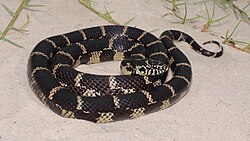 |
| Pituophis | P. catenifer | Taunton32 | The living Western gopher snake. |  |
| Squamata | White Bluffs,2217 Taunton21 | Indeterminate snakes and lizards. | ||
| † Tauntonophis32 | † T. morganorum | Taunton32 | A colubrine colubrid snake. | |
| Testudo / Geochelone | T. sp. / G. sp. | White Bluffs2217 | A tortoise. | |
| Thamnophis | T. sp. | Taunton | A garter snake. | |
Amphibians
Indeterminate frog or toad bones are known from the White Bluffs local fauna.2217
Fish
| Fish of the Ringold Formation | ||||
|---|---|---|---|---|
| Genus / Taxon | Species | Local fauna | Notes | Images |
| Acipenser | A. transmontanus | White Bluffs, Blufftop, Taunton33 | The living white sturgeon. | 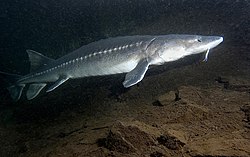 |
| Acrocheilus | † A. latus | Taunton33 | A chiselmouth. | |
| Ameiurus | † A. reticulatus | White Bluffs, Blufftop, Taunton33 | A bullhead catfish. | |
| Archoplites | † A. molarus | White Bluffs, Blufftop, Taunton33 | A freshwater sunfish. | |
| Catostomus | C. macrocheilus | Blufftop, Taunton33 | The living largescale sucker. | |
| Chasmistes | † C. sp. cf. batrachops | White Bluffs, Blufftop, Taunton33 | A sucker. | |
| Esox | † E. columbianus | White Bluffs, Blufftop, Taunton33 | A large pike. | |
| † Klamathella | † K. milleri | Taunton33 | A chub. | |
| Lavinia | † L. hibbardi | Taunton33 | A hitch. | |
| Mylocheilus | † M. heterodon33 | White Bluffs, Blufftop, Taunton33 | A peamouth chub. | |
| Oncorhynchus | † O. rastrosus | River Road33 | A giant tusked salmon. | |
| Ptychocheilus | † P. arciferus | Blufftop, Taunton33 | A pikeminnow. | |
Invertebrates
Several species of freshwater snails are known from the White Bluffs local fauna.2217
Plants and climate
Pollen has been sampled from the lower Ringold Formation (8.5–5.5 Ma, late Miocene) near Hanford, as well as the upper Ringold Formation (4.5–2.8 Ma) at White Bluffs. The lower Ringold flora is similar to moist eastern ecosystems such as the Mississippi lowland forests, where cypress and broadleaf hardwoods coexist in close proximity. Pollen from White Bluffs corresponds to semi-arid grassland plants such as grasses (Poaceae), saltbush-type plants (Amaranthaceae), and sunflower-type plants (Asteraceae), alongside rare pine pollen.34
Warm-water fish and tortoises suggest that the fossil-rich Pliocene portion of the formation probably had hot summers (>27 °C (81 °F)) and mild winters. In warmer parts of the Pliocene, winters may have been entirely frost-free. Pike and sturgeon may indicate the presence of deep, persistent streams (rainfall >80 cm/year (31 in/year)).33 Other studies estimate a yearly rainfall not exceeding 40 cm/year (16 in/year), still much greater than the modern Columbia Plateau. Riverside floodplain environments were far more common than today, supporting a greater diversity of mammals and wetland inhabitants.17
See also
See also
References
References
- "Paleontology - Hanford Reach". United States Fish and Wildlife Service. Retrieved 2024-11-01.
- David Hagen. "White Bluffs South". Washington Trails Association. Retrieved 2019-12-19.
- John C. Merriam; John P. Buwalda (1917). Age of strata referred to the Ellensburgh formation in the White Bluffs of the Columbia River. University of California.
- J. ERIC SCHUSTER; CHARLES W. GULICK; STEPHEN P. REIDEL; KARL R. FECHT; STEPHANIE ZURENKO (1997). "Geologic Map of Washington - Southeast Quadrant" (PDF). Washington State Department of Natural Resources. Retrieved 2019-12-20.
- "Columbia River". United States Fish and Wildlife Service. Retrieved 2019-12-19.
- Various Contributors to the Paleobiology Database. "Fossilworks: Gateway to the Paleobiology Database". Archived from the original on 25 March 2022. Retrieved 17 December 2021.
- R. C. Newcomb (1958). "RINGOLD FORMATION OF PLEISTOCENE AGE IN TYPE LOCALITY, THE WHITE BLUFFS, WASHINGTON" (PDF). Washington State Department of Natural Resources. Retrieved 2019-12-20.
- "A Geological Paradise". Reach Museum. Archived from the original on December 20, 2019. Retrieved 2019-12-19.
- C.P. McKinley (1922). Hanford Quadrangle (Map). 1:62,500. United States Geological Survey. Retrieved 2019-12-20.
- Staisch, Lydia M.; O'Connor, Jim E.; Cannon, Charles M.; Holm-Denoma, Chris; Link, Paul K.; Lasher, John; Alexander, Jeremy A. (2021). "Major reorganization of the Snake River modulated by passage of the Yellowstone Hotspot" (PDF). GSA Bulletin. Geological Society of America.
- "Columbia River Basalt Group Stretches from Oregon to Idaho". United States Geological Survey. Archived from the original on 2020-01-13. Retrieved 2019-12-19.
- Bruce N. Bjornstad; Robert E. Peterson. "Hydrogeologic Controls and Impacts of Quaternary Landslides Along the White Bluffs of the Columbia River, South-Central Washington" (PDF). Pacific Northwest National Laboratory. Retrieved 2019-12-20.
- B. N. Bjornstad (2006). "Past, Present, Future Erosion at Locke Island" (PDF). Pacific Northwest National Laboratory. Retrieved 2019-12-20.
- Bell, Christopher J.; Lundelius, Ernest L.; Barnosky, Anthony D.; Graham, Russell W.; Lindsay, Everett H.; Ruez, Dennis R.; Semken, Holmes A.; Webb, S. David; Zakrzewski, Richard J. (2004-04-21). "7. The Blancan, Irvingtonian, and Rancholabrean Mammal Ages". In Woodburne, Michael O. (ed.). Late Cretaceous and Cenozoic Mammals of North America: Biostratigraphy and Geochronology. Columbia University Press. pp. 232–314. doi:10.7312/wood13040-009. ISBN 978-0-231-50378-5.
- Ruez, Dennis R. (2009). "Revision of the Blancan (Pliocene) mammals from Hagerman Fossil Beds National Monument, Idaho". Journal of the Idaho Academy of Sciences. 45 (1): 1–143.
- Gustafson, Eric Paul (May 2015). "Bassariscus from the Early Pliocene of Washington". Northwest Science. 89 (2): 129–135. doi:10.3955/046.089.0204. ISSN 0029-344X.
- Gustafson, Eric Paul (2015). "An early Pliocene North American deer: Bretzia pseudalces, its osteology, biology, and place in cervid history". Bulletin of the Museum of Natural and Cultural History, University of Oregon. 25.
- Gustafson, Eric Paul (1985). "Soricids (Mammalia, Insectivora) from the Blufftop Local Fauna, Blancan Ringold Formation of Central Washington, and the correlation of Ringold Formation faunas". Journal of Vertebrate Paleontology. 5 (1): 88–92. doi:10.1080/02724634.1985.10011846. ISSN 0272-4634.
- Fry, Willis E.; Gustafson, Eric Paul (1974). "Cervids from the Pliocene and Pleistocene of Central Washington". Journal of Paleontology. 48 (2): 375–386. JSTOR 1303258.
- Gustafson, Eric Paul (1985). "Antlers of Bretzia and Odocoileus (Mammalia, Cervidae) and the Evolution of New World Deer". Transactions of the Nebraska Academy of Sciences. 8: 83–92.
- Morgan, James K.; Morgan, Neil H. (1995-03-14). "A New Species of Capromeryx (Mammalia: Artiodactyla) From the Taunton Local Fauna of Washington, and the Correlation with Other Blancan Faunas of Washington and Idaho". Journal of Vertebrate Paleontology. 15 (1): 160–170. doi:10.1080/02724634.1995.10011215. ISSN 0272-4634. JSTOR 4523614.
- Gustafson, Eric Paul (1978). "The Vertebrate Faunas of the Pliocene Ringold Formation, South-Central Washington". Bulletin of the Museum of Natural History, University of Oregon. 23.
- Wang, Xiaoming; Tedford, Richard R.; Taylor, Beryl E. (1999). "Phylogenetic Systematics of the Borophaginae (Carnivora: Canidae)". Bulletin of the American Museum of Natural History. 243.
- Jiangzuo, Qigao; Flynn, John J.; Wang, Shiqi; Hou, Sukuan; Deng, Tao (2023-03-14). "New Fossil Giant Panda Relatives (Ailuropodinae, Ursidae): A Basal Lineage of Gigantic Mio-Pliocene Cursorial Carnivores". American Museum Novitates. 2023 (3996). doi:10.1206/3996.1. ISSN 0003-0082.
- Martin, James E. (2013). "A late occurrence of the bear Agriotherium from the Blancan ringold formation in southeastern Washington" (PDF). Proceedings of the South Dakota Academy of Science. 92: 123–126.
- Tedford, R. H.; Gustafson, E. P. (1977). "First North American record of the extinct panda Parailurus". Nature. 265 (5595): 621–623. doi:10.1038/265621a0. ISSN 1476-4687.
- Tedford, Richard H.; and Martin, James (2001-07-20). "Plionarctos, a tremarctine bear (Ursidae: Carnivora) from western North America". Journal of Vertebrate Paleontology. 21 (2): 311–321. doi:10.1671/0272-4634(2001)021[0311:PATBUC]2.0.CO;2. ISSN 0272-4634. JSTOR 20061955.
- White, John A.; Morgan, Neil H. (1995-06-13). "The Leporidae (Mammalia, Lagomorpha) from the Blancan (Pliocene) Taunton Local Fauna of Washington". Journal of Vertebrate Paleontology. 15 (2): 366–374. doi:10.1080/02724634.1995.10011235. ISSN 0272-4634. JSTOR 4523636.
- Gustafson, Eric P. (2012). "New records of rhinoceroses from the Ringold Formation of central Washington and the Hemphillian-Blancan boundary". Journal of Vertebrate Paleontology. 32 (3): 727–731. doi:10.1080/02724634.2012.658481. ISSN 0272-4634.
- Gustafson, Eric Paul (1977). "First record of Teleoceras (Rhinocerotidae) from the Ringold Formation, Pliocene of Washington". PaleoBios. 27: 1–4.
- Repenning, Charles A. (2003). "Chapter 17: Mimomys in North America". Bulletin of the American Museum of Natural History. 279: 469–512. doi:10.1206/0003-0090(2003)279<0469:C>2.0.CO;2. ISSN 0003-0090.
- Parmley, Dennis; Walker, Don (2003). "Snakes of the Pliocene Taunton Local Fauna of Adams County, Washington with the Description of a New Colubrid". Journal of Herpetology. 37 (2): 235–244. JSTOR 1566138.
- Smith, Gerald R.; Morgan, Neil; Gustafson, Eric (2000). "Fishes of the Mio-Pliocene Ringold Formation, Washington: Pliocene Capture of the Snake River by the Columbia River". University of Michigan Papers on Paleontology. 32.
- Mustoe, George E.; Leopold, Estella B. (2014). "Paleobotanical evidence for the post-Miocene uplift of the Cascade Range". Canadian Journal of Earth Sciences. 51 (8): 809–824. doi:10.1139/cjes-2013-0223. ISSN 0008-4077.