| Jawless leeches | |
|---|---|

| |
| Branchellion parkeri | |
Scientific classification 
| |
| Kingdom: | Animalia |
| Phylum: | Annelida |
| Clade: | Pleistoannelida |
| Clade: | Sedentaria |
| Class: | Clitellata |
| Subclass: | Hirudinea |
| Infraclass: | Euhirudinea |
| Order: | Rhynchobdellida Blanchard, 1893 |
| Families | |
| |
Rhynchobdellida (from the Greek rhynchos, mouth, and bdellein, sucking),1 the jawless leeches2 or freshwater leeches,3 are an order of aquatic leeches.45 Despite the common name "freshwater leeches", species are found in both sea and fresh water. They are defined by the presence of a protrusible proboscis instead of jaws, and having colourless blood.678 They move by "inchworming"9 and are found worldwide. The order contains 110 species, divided into 41 genera and three families.9 Members of the order range widely in length, usually between 7 and 40 mm.3 They are hermaphrodite.3 The order is not monophyletic.10
Appearance and eating habits

Instead of jaws and teeth, Rhynchobdellidae have protrusible proboscises, which they use to penetrate the host's skin.311 Mouths of Rhynchobdellidae species are small holes from which the proboscis can be protruded.11 The proboscis then sucks out the desired bodily fluid from the host: usually blood or coelomic fluid in the case of invertebrate victims.10
Rhynchobdellidae are either sanguivorous or predatory. Sanguivorous species usually feed on a variety of other animals, using their proboscis to host's skin. They generate anticoagulants (like mosquitoes) and natural anaesthesia to help the feeding.3 Predatory Rhynchobdellidae have digestive enzymes that help break down their prey, which usually consists of small invertebrates such as insect larvae or amphipods.3
Families
Glossiphoniidae (Freshwater jawless leeches)

The Glossiphoniidae, the freshwater jawless leeches, or leaf leeches (due to their shape)12 are freshwater leeches, flattened, and with a poorly defined anterior sucker.3 The family Glossiphoniidae contains one of the world's largest species of leech, the giant Amazon leech, which can grow up to 45 cm in length.13 Many species show extended parental care, keeping eggs in nests or pouches and caring for and feeding the young.314 They feed on both vertebrate and invertebrate animals.5
Piscicolidae (Fish leeches)
The Piscicolidae occur in both freshwater and seawater, have cylindrical bodies, and a usually well-marked, bell-shaped, anterior sucker.35 They are parasites of fish.125 The family was originally divided into three subfamilies based on species' pulsatile vesicles, but the subfamilies were disbanded in 2006.5
Ozobranchidae (Turtle leeches)
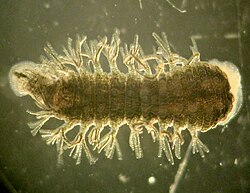
Ozobranchidae are primarily parasitic on marine turtles, and are sometimes merged with the Piscicolidae.35
References
References
- Mehlhorn, Heinz, ed. (2008), "Rhynchobdellida", Encyclopedia of Parasitology, Berlin, Heidelberg: Springer, p. 1249, doi:10.1007/978-3-540-48996-2_2723, ISBN 978-3-540-48996-2, retrieved 2022-11-27
- "Taxonomy browser; Rhynchobdellida". www.ncbi.nlm.nih.gov. Retrieved 2025-10-19.
- "Order Rhynchobdellida". keys.lucidcentral.org. Retrieved 2022-11-27.
- "Explore the Taxonomic Tree". FWS.gov. Retrieved 2022-11-27.
- Gulf of Mexico Origins, Waters, and Biota | Volume I: Biodiversity. Harte Research Institute. 2009. pp. 789–790. ISBN 9781603442695.
- "Rhynchobdellida | leech order | Britannica". www.britannica.com. Retrieved 2022-11-27.
- "Rhynchobdellida | Encyclopedia.com". www.encyclopedia.com. Retrieved 2022-11-27.
- "Definition of RHYNCHOBDELLIDA". www.merriam-webster.com. Retrieved 2022-11-27.
- "Rhynchobdellida - Encyclopedia of Life". eol.org. Retrieved 2022-11-27.
- Borda, Elizabeth; Sidall, Mark (2004-12-30). "Review of the evolution of life history strategies and phylogeny of the Hirudinida (Annelida: Oligochaeta)". Lauterbornia. 52: 7–15 – via ResearchGate.
- Rogers, D. Christopher; Thorp, James H. (2019-03-31). Thorp and Covich's Freshwater Invertebrates: Volume 4: Keys to Palaearctic Fauna. Academic Press. ISBN 978-0-12-385025-6.
- Thompson, Gerald; Coldrey, Jennifer; Bernard, George (1984). The pond. William Collins. pp. 116–118.
- "Amazon Giant Leech (Haementeria ghilianii) | Invertebrate Zoology". 2018-08-31. Archived from the original on 2018-08-31. Retrieved 2022-11-27.
- Rohde, Klaus (2005-09-13). Marine Parasitology. Csiro Publishing. ISBN 978-0-643-09927-2.