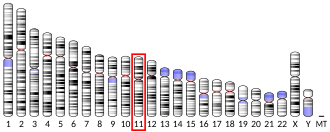
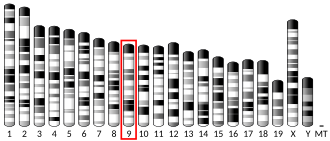
REX2, RNA exonuclease 2 homolog (S. cerevisiae), also known as REXO2, is an enzyme which in humans is encoded by the REXO2 gene.567
Function
Nucleases are components of DNA and RNA metabolism that carry out functions in DNA repair, replication, and recombination and in RNA processing and degradation. SFN is a homolog of Orn, a 3-prime-to-5-prime exoribonuclease of E. coli that attacks the free 3-prime hydroxyl group on single-stranded RNA, releasing 5-prime mono-nucleotides in a sequential manner.5
References
References
- GRCh38: Ensembl release 89: ENSG00000076043 – Ensembl, May 2017
- GRCm38: Ensembl release 89: ENSMUSG00000032026 – Ensembl, May 2017
- "Human PubMed Reference:". National Center for Biotechnology Information, U.S. National Library of Medicine.
- "Mouse PubMed Reference:". National Center for Biotechnology Information, U.S. National Library of Medicine.
- "Entrez Gene: REXO2 REX2, RNA exonuclease 2 homolog (S. cerevisiae)".
- Lai CH, Chou CY, Ch'ang LY, Liu CS, Lin W (May 2000). "Identification of novel human genes evolutionarily conserved in Caenorhabditis elegans by comparative proteomics". Genome Res. 10 (5): 703–13. doi:10.1101/gr.10.5.703. PMC 310876. PMID 10810093.
- Nguyen LH, Erzberger JP, Root J, Wilson DM (August 2000). "The human homolog of Escherichia coli Orn degrades small single-stranded RNA and DNA oligomers". J. Biol. Chem. 275 (34): 25900–6. doi:10.1074/jbc.M002672200. PMID 10851236.
Further reading
Further reading
- Maruyama K, Sugano S (1994). "Oligo-capping: a simple method to replace the cap structure of eukaryotic mRNAs with oligoribonucleotides". Gene. 138 (1–2): 171–4. doi:10.1016/0378-1119(94)90802-8. PMID 8125298.
- Suzuki Y, Yoshitomo-Nakagawa K, Maruyama K, et al. (1997). "Construction and characterization of a full length-enriched and a 5'-end-enriched cDNA library". Gene. 200 (1–2): 149–56. doi:10.1016/S0378-1119(97)00411-3. PMID 9373149.
- Lai CH, Chou CY, Ch'ang LY, et al. (2000). "Identification of novel human genes evolutionarily conserved in Caenorhabditis elegans by comparative proteomics". Genome Res. 10 (5): 703–13. doi:10.1101/gr.10.5.703. PMC 310876. PMID 10810093.
- Nguyen LH, Erzberger JP, Root J, Wilson DM (2000). "The human homolog of Escherichia coli Orn degrades small single-stranded RNA and DNA oligomers". J. Biol. Chem. 275 (34): 25900–6. doi:10.1074/jbc.M002672200. PMID 10851236.
- Hartley JL, Temple GF, Brasch MA (2001). "DNA cloning using in vitro site-specific recombination". Genome Res. 10 (11): 1788–95. doi:10.1101/gr.143000. PMC 310948. PMID 11076863.
- Wiemann S, Weil B, Wellenreuther R, et al. (2001). "Toward a catalog of human genes and proteins: sequencing and analysis of 500 novel complete protein coding human cDNAs". Genome Res. 11 (3): 422–35. doi:10.1101/gr.GR1547R. PMC 311072. PMID 11230166.
- Simpson JC, Wellenreuther R, Poustka A, et al. (2001). "Systematic subcellular localization of novel proteins identified by large-scale cDNA sequencing". EMBO Rep. 1 (3): 287–92. doi:10.1093/embo-reports/kvd058. PMC 1083732. PMID 11256614.
- Strausberg RL, Feingold EA, Grouse LH, et al. (2003). "Generation and initial analysis of more than 15,000 full-length human and mouse cDNA sequences". Proc. Natl. Acad. Sci. U.S.A. 99 (26): 16899–903. Bibcode:2002PNAS...9916899M. doi:10.1073/pnas.242603899. PMC 139241. PMID 12477932.
- Ota T, Suzuki Y, Nishikawa T, et al. (2004). "Complete sequencing and characterization of 21,243 full-length human cDNAs". Nat. Genet. 36 (1): 40–5. doi:10.1038/ng1285. PMID 14702039.
- Ito S, Kita K, Zhai L, et al. (2006). "Involvement of human small fragment nuclease in the resistance of human cells to UV-C-induced cell death". Photochem. Photobiol. 80 (2): 281–5. doi:10.1562/2004-01-21-RA-051. PMID 15362935.
- Gerhard DS, Wagner L, Feingold EA, et al. (2004). "The status, quality, and expansion of the NIH full-length cDNA project: the Mammalian Gene Collection (MGC)". Genome Res. 14 (10B): 2121–7. doi:10.1101/gr.2596504. PMC 528928. PMID 15489334.
- Wiemann S, Arlt D, Huber W, et al. (2004). "From ORFeome to biology: a functional genomics pipeline". Genome Res. 14 (10B): 2136–44. doi:10.1101/gr.2576704. PMC 528930. PMID 15489336.
- Rush J, Moritz A, Lee KA, et al. (2005). "Immunoaffinity profiling of tyrosine phosphorylation in cancer cells". Nat. Biotechnol. 23 (1): 94–101. doi:10.1038/nbt1046. PMID 15592455. S2CID 7200157.
- Mehrle A, Rosenfelder H, Schupp I, et al. (2006). "The LIFEdb database in 2006". Nucleic Acids Res. 34 (Database issue): D415–8. doi:10.1093/nar/gkj139. PMC 1347501. PMID 16381901.