| Renfe Class 130 Talgo 250 | |
|---|---|
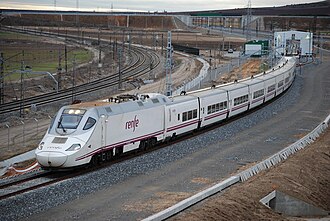 Renfe Class 130 at the Valdestillas gauge changer | |
| Stock type | High-speed variable-gauge electric trainset |
| In service | 2007–present |
| Manufacturer | Talgo / Bombardier |
| Assembly | Las Matas |
| Built at | Talgo Rivabellosa and Las Matas II Bombardier Kassel |
| Family name | Talgo 250 |
| Entered service | 29 October 2007 |
| Number built | 45 |
| Formation | 13 cars: 2 power cars and 11 Talgo Series 7 passenger trailers |
| Capacity | 299 seats: 236 standard and 63 first class |
| Operator | Renfe Operadora |
| Specifications | |
| Car body construction | Aluminium alloy |
| Train length | 184.158 m (604 ft 2.3 in) |
| Car length |
|
| Width |
|
| Height |
|
| Floor height | 760 mm (30 in) |
| Platform height | 550 mm (22 in) or 760 mm (30 in) |
| Doors | 16 sliding access doors, 8 per side |
| Maximum speed |
|
| Weight | 312 t (307 long tons; 344 short tons) |
| Axle load | 18 t (18 long tons; 20 short tons) per motor axle |
| Traction system | Water-cooled IGBT |
| Traction motors | 8 × three-phase asynchronous motors |
| Power output |
|
| Tractive effort |
|
| Auxiliaries | Static converters in the end first-class and standard cars; 380 V, 50 Hz auxiliary supply |
| Electric systems | Overhead catenary: 25 kV 50 Hz AC AC 3 kV DC |
| Current collection | Pantograph; 2 per power car |
| Wheels driven | 16 |
| Bogies | 4 motor bogies and 12 Talgo wheelsets; 20 axles total |
| Braking systems | Regenerative, rheostatic and pneumatic disc brakes; ABS on motor-axle pneumatic brakes |
| Safety systems | ETCS/ERTMS levels 1 and 2, LZB STM, ATP Edicab, ASFA |
| Coupling system | Scharfenberg coupler |
| Track gauge |
|
| Notes/references | |
| Uses Talgo RD gauge changing equipment.1 | |
The Renfe Class 130 or S-1302 (Spanish: Serie 130 de Renfe, manufacturer's designation Talgo 250) is a top and tail high-speed dual-gauge, dual-voltage trainset consisting of 11 Talgo VII tilting coaches and two power cars, used on Alvia and Euromed services.345 The class have been nicknamed patitos (ducklings), due to the shape of the train nose.6
Background and design
The trainsets are designed for high-speed services on Iberian gauge (1,668 mm (5 ft 5+21⁄32 in)) and high-speed (1,435 mm (4 ft 8+1⁄2 in)) lines; they can change gauge at low speed without stopping using Talgo's RD variable gauge system.7 The carriages are constructed from aluminium and incorporate the Talgo Pendular passive pendulum tilting system,8 are sealed against pressure differences for tunnel travel,9 and have underframe air conditioning, individual audio systems and video displays, rotating and reclining seats and power outlets.10
Capacity in standard class is 36 seated, in first class 26 seats, end coaches have lower capacity, one coach is typically used for restaurant/sales services.9
The power cars use AC traction motors controlled by IGBT inverters which include integrated auxiliary inverters. Signalling systems can include ETCS Level 2, LZB, ASFA and Ebicab900TBS.11
Operations and services
As of January 2010 they operated from Gijón/Oviedo via León, Palencia, Valladolid to Madrid with some trains extended to Alicante via Albacete;1213 Santander via Palencia and Valladolid to Madrid, sometimes extended to Alicante;1314 Madrid to Bilbao via Valladolid and Burgos;1315 Madrid to San Sebastian/Irun via Valladolid, Burgos and Vitoria;1316 Madrid to Alicante;1317 Huelva and Cádiz and Madrid to Murcia.
Since January 2020 Renfe Class 130 operate on the Figueres–Alicante route via Girona, Barcelona, Camp de Tarragona, Castellón de la Plana and Valencia for the Euromed services.5
On services such as Gijón–Madrid they have been replaced by Renfe Class 120 trainsets (2011).6
Developments
Renfe Class 730
In order to extend high-quality services to parts of Spain not on the high-speed network Renfe acquired hybrid trains with both electric and diesel power18 for delivery in 2012 for use from Madrid to Murcia and Galicia, built by Talgo and Bombardier, at a cost of 78 million euro.19 The new trains based on the S-130 were initially coded S130H, later S730;
Fifteen sets S-130 units will be converted to hybrid operation.2021 with two generator cars per set using MTU 12V 4000 R43L engines (1.8MW each). The top speed in diesel mode is 180 km/h (112 mph). Testing of the trains took place in 2011 with introduction into service expected in 2012.22
250km/h+ prototype train
A gauge-changing train capable of over 250 km/h (155 mph) is in development and is based on the S-130.23
Uzbekistan trainset order
A version of the S130 for Uzbekistan Temir Yollari was ordered in 2009 for use on a Tashkent–Samarkand high-speed line.24 Deliveries of the order of two trains began in July 2011.25
Two more sets were constructed in 2017, following expansion of the service.26
See also
See also
References
References
- "S-130". Renfe Group. Retrieved 2026-06-02.
- From Serie 130 de Renfe
- Trayectos y Servicios - clase preferente www.renfe.es
- Trayectos y Servicios - clase turista www.renfe.es
- "El trayecto en tren entre Barcelona y València se reducirá más de media hora". La Vanguardia. 2 January 2020. Retrieved 9 May 2023.
- "Los nuevos Alvia no convencen", www.lavozdeasturias.es (in Spanish), 11 February 2011
- “Talgo RD” Variable Gauge System: A solution to eliminate barriers in the transport of goods and passengers between East and West Rail Tech Russis, inter-nation conference, June 2007, conference.europoint.eu
- The Talgo Pendular Coaches Archived 2011-07-16 at the Wayback Machine www.talgoamerica.com
- Talgo 250 Archived 2016-03-04 at the Wayback Machine www.talgo.de
- High speed trainsets - subsection Passenger Car Features Archived 2010-03-28 at the Wayback Machine Talgo Series VII Passenger Coaches www.talgoamerica.com
- The Talgo Pendular Coaches Archived 2011-07-16 at the Wayback Machine POWER HEAD TALGO 250, Page 7, www.talgoamerica.com
- Alvia service : Gijon-Alicante www.renfe.es Archived April 3, 2010, at the Wayback Machine
- Nuestros Trenes . Alvia Serie 130 www.renfe.com
- Alvia service : Santander-Alicante www.renfe.es Archived December 16, 2009, at the Wayback Machine
- Alvia service : Madrid-Bilbao www.renfe.es Archived April 3, 2010, at the Wayback Machine
- Alvia service : Madrid-Irun www.renfe.es
- Alvia service : Madrid-Alicante www.renfe.es Archived December 16, 2009, at the Wayback Machine
- Un ´supertren´ conectará las ciudades gallegas en la mitad de tiempo en 2012 26/6/2009, www.laopinioncoruna.es
- Renfe invertirá 78 millones de euros en adaptar quince trenes AVE a vías sin electrificar 29/12/2009, www.europapress.es
- Adquiridos los nuevos trenes híbridos para la línea convencional Madrid-Murcia en 2012 2/1/2010 www.europapress
- Serie 730 de Renfe, el tren dual de Talgo todo terreno 6/10/2011 via libre
- "High speed electro-diesel trainset on test", www.railwaygazette.com, Railway Gazette International, 21 September 2011
- Talgo ha comenzado la construcción de un prototipo de tren de ancho variable a 300 km/h www.vialibre-ffe.com
- Uzbekistan Temir Yollari, Patentes Talgo S.A. sign 38m euro contract www.usdaily.com
- "Talgo 250 arrives in Toshkent", www.railwaygazette.com, Railway Gazette International, 26 July 2011
- "Talgo 250 — List of the vehicles".
Other sources
- Talgo 250 information sheet www.talgo.es
- Information on the crash absorption and coupling module of the S130 powerheads www.esytech.de