| Red-cheeked squirrels Temporal range: Early Pleistocene to Recent
| |
|---|---|
| |
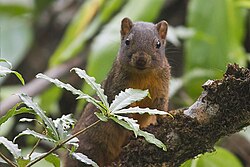
| Orange-bellied Himalayan squirrel (Dremomys lokriah) | |
Scientific classification 
| |
| Kingdom: | Animalia |
| Phylum: | Chordata |
| Class: | Mammalia |
| Infraclass: | Placentalia |
| Order: | Rodentia |
| Family: | Sciuridae |
| Subfamily: | Callosciurinae |
| Genus: | Dremomys Heude, 1898 |
| Type species | |
| Sciurus pernyi A. Milne-Edwards, 1867
| |
| Species | |
|
D. gularis (Osgood, 1932)1 | |
Red-cheeked squirrels are species of squirrels in the genus Dremomys in the subfamily Callosciurinae.2 The six species which are all found only in Asia are listed as "Least Concern" by the IUCN.345678
- The red-throated squirrel (Dremomys gularis) is distributed in parts of southeastern Asia, in areas of the Red River Valley of northern Vietnam and southern central Yunnan in China.8 It is sympatric with another member of the same genus, D. rufigenis, but lives at higher attitudes1 - 2,500 to 3,000 metres (1.6 to 1.9 mi) in the case of the type specimen.8
- The orange-bellied Himalayan squirrel (Dremomys lokriah) is found in Bangladesh, China, India, Myanmar, Nepal and Bhutan.
- Perny's long-nosed squirrel (Dremomys pernyi) is found in China, India, Myanmar, Taiwan, and Vietnam.
- The red-hipped squirrel (Dremomys pyrrhomerus) is found in China and Vietnam.
- The Asian red-cheeked squirrel (Dremomys rufigenis) is found in Cambodia, China, India, Laos, Malaysia, Myanmar, Thailand, and Vietnam.9
The Bornean mountain ground squirrel (Dremomys everetti), found in Indonesia and Malaysia, was moved from this genus to Sundasciurus.
References
References
- Wilson, D. E.; Reeder, D. M., eds. (2005). "Dremomys gularis". Mammal Species of the World: A Taxonomic and Geographic Reference (3rd ed.). Baltimore: Johns Hopkins University Press. ISBN 978-0-8018-8221-0. OCLC 62265494.
- Wilson, D. E.; Reeder, D. M., eds. (2005). "Genus Dremomys". Mammal Species of the World: A Taxonomic and Geographic Reference (3rd ed.). Baltimore: Johns Hopkins University Press. ISBN 978-0-8018-8221-0. OCLC 62265494.
- Duckworth, J.W. (2017). "Dremomys rufigenis". IUCN Red List of Threatened Species. 2017 e.T6824A22256057. doi:10.2305/IUCN.UK.2017-2.RLTS.T6824A22256057.en. Retrieved 12 November 2021.
- Smith, A.T.; Johnston, C.H. (2017) [errata version of 2016 assessment]. "Dremomys pyrrhomerus". IUCN Red List of Threatened Species. 2016 e.T6823A115084598. doi:10.2305/IUCN.UK.2016-3.RLTS.T6823A22255933.en. Retrieved 6 October 2025.
- Lunde, D.; Molur, S. (2017) [errata version of 2016 assessment]. "Dremomys pernyi". IUCN Red List of Threatened Species. 2016 e.T6822A115084426. doi:10.2305/IUCN.UK.2016-3.RLTS.T6822A22255797.en. Retrieved 6 October 2025.
- Molur, S. (2017) [errata version of 2016 assessment]. "Dremomys lokriah". IUCN Red List of Threatened Species. 2016 e.T6821A115084234. doi:10.2305/IUCN.UK.2016-3.RLTS.T6821A22255622.en. Retrieved 6 October 2025.
- Tizard, R.J (2016). "Dremomys everetti". IUCN Red List of Threatened Species. 2016 e.T6820A22255505. doi:10.2305/IUCN.UK.2016-2.RLTS.T6820A22255505.en. Retrieved 12 November 2021.
- Laginha Pinto Correia, D. (2019). "Dremomys gularis". IUCN Red List of Threatened Species. 2019 e.T136313A22255420. doi:10.2305/IUCN.UK.2019-1.RLTS.T136313A22255420.en. Retrieved 6 October 2025.
- Wilson, D. E.; Reeder, D. M., eds. (2005). "Dremomys rufigenis". Mammal Species of the World: A Taxonomic and Geographic Reference (3rd ed.). Baltimore: Johns Hopkins University Press. p. 780. ISBN 978-0-8018-8221-0. OCLC 62265494.