| Observation data Epoch J2000 Equinox ICRS | |
|---|---|
| Constellation | Musca |
| Right ascension | 12h 42m 05.02561s2 |
| Declination | −69° 24′ 27.1966″2 |
| Apparent magnitude (V) | 5.93 - 6.733 |
| Characteristics | |
| Spectral type | F7 Ib4 - G23 |
| B−V color index | 0.750±0.0205 |
| Variable type | δ Cep3 |
| Astrometry | |
| Radial velocity (Rv) | +3.8±2.96 km/s |
| Proper motion (μ) | RA: −4.1802 mas/yr Dec.: −2.1272 mas/yr |
| Parallax (π) | 1.0002±0.0291 mas2 |
| Distance | 3,260 ± 90 ly (1,000 ± 30 pc) |
| Absolute magnitude (MV) | -3.627 |
| Details | |
| Radius | 652 R☉ |
| Luminosity | 2,5412 L☉ |
| Surface gravity (log g) | 2.0±0.18 cgs |
| Temperature | 5,985±547 K |
| Metallicity [Fe/H] | +0.10±0.058 dex |
| Other designations | |
| R Mus, AAVSO 1236-68, CD−68°1119, HD 110311, HIP 61981, HR 4820, SAO 2519969 | |
| Database references | |
| SIMBAD | data |

R Muscae is a yellow-white hued variable star in the southern constellation of Musca. It has a nominal apparent visual magnitude of 6.31,5 which is near the lower limit of visibility to the naked eye. The distance to this star, as determined from its annual parallax shift of 1.00 mas,2 is around 3,260 light years.
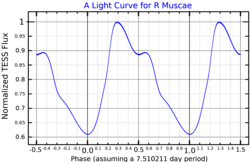
This is an F-type supergiant star with a baseline stellar classification of F7 Ib.4 It is a Classical Cepheid variable ranging from apparent magnitude 5.93 to 6.7310 over 7.51 days,7 while varying between spectral types F7 Ib and G2.10 The star was suspected of having a detectable companion,11 but this finding was later disputed.12 Gaia and HST observations have shown that there is a companion, a 15th-magnitude star 7″ away.1314 There is an X-ray source with a luminosity of 6.3×1029 erg s−1 located at an angular separation of 1.9″ from R Muscae.15
References
References
- "MAST: Barbara A. Mikulski Archive for Space Telescopes". Space Telescope Science Institute. Retrieved 8 December 2021.
- Brown, A. G. A.; et al. (Gaia collaboration) (August 2018). "Gaia Data Release 2: Summary of the contents and survey properties". Astronomy & Astrophysics. 616. A1. arXiv:1804.09365. Bibcode:2018A&A...616A...1G. doi:10.1051/0004-6361/201833051.
- Samus', N. N; Kazarovets, E. V; Durlevich, O. V; Kireeva, N. N; Pastukhova, E. N (2017). "General catalogue of variable stars: Version GCVS 5.1". Astronomy Reports. 61 (1): 80. Bibcode:2017ARep...61...80S. doi:10.1134/S1063772917010085. S2CID 125853869.
- Houk, Nancy; Cowley, A. P. (1979). Michigan catalogue of two-dimensional spectral types for the HD stars. Vol. 1. Ann Arbor, Michigan: Dept. of Astronomy, University of Michigan. Bibcode:1978mcts.book.....H.
- Anderson, E.; Francis, Ch. (2012). "XHIP: An extended hipparcos compilation". Astronomy Letters. 38 (5): 331. arXiv:1108.4971. Bibcode:2012AstL...38..331A. doi:10.1134/S1063773712050015. S2CID 119257644.
- de Bruijne, J. H. J.; Eilers, A.-C. (October 2012). "Radial velocities for the HIPPARCOS-Gaia Hundred-Thousand-Proper-Motion project". Astronomy & Astrophysics. 546: 14. arXiv:1208.3048. Bibcode:2012A&A...546A..61D. doi:10.1051/0004-6361/201219219. S2CID 59451347. A61.
- Luck, R. E.; et al. (August 2011). "The Distribution of the Elements in the Galactic Disk. II. Azimuthal and Radial Variation in Abundances from Cepheids". The Astronomical Journal. 142 (2): 12. arXiv:1106.0182. Bibcode:2011AJ....142...51L. doi:10.1088/0004-6256/142/2/51. S2CID 119288363. 51.
- Soubiran, Caroline; et al. (2016). "The PASTEL catalogue: 2016 version". Astronomy & Astrophysics. 591: A118. arXiv:1605.07384. Bibcode:2016A&A...591A.118S. doi:10.1051/0004-6361/201628497. S2CID 119258214.
- "DU Lyncis". SIMBAD. Centre de données astronomiques de Strasbourg. Retrieved 3 September 2018.
- BSJ (4 January 2010). "R Muscae". AAVSO Website. American Association of Variable Star Observers. Retrieved 21 December 2013.
- Lloyd Evans, T. (June 1982). "Cepheid binaries. II. New southern examples". Monthly Notices of the Royal Astronomical Society. 199 (4): 925–941. Bibcode:1982MNRAS.199..925L. doi:10.1093/mnras/199.4.925.
- Eichendorf, W.; et al. (May 1982). "UV, optical and IR observations of the Cepheid R MUSCAE". Astronomy and Astrophysics. 109 (2): 274–278. Bibcode:1982A&A...109..274E.
- Kervella, Pierre; Gallenne, Alexandre; Remage Evans, Nancy; Szabados, Laszlo; Arenou, Frédéric; Mérand, Antoine; Proto, Yann; Karczmarek, Paulina; Nardetto, Nicolas; Gieren, Wolfgang; Pietrzynski, Grzegorz (2019). "Multiplicity of Galactic Cepheids and RR Lyrae stars from Gaia DR2. I. Binarity from proper motion anomaly". Astronomy and Astrophysics. 623: A116. arXiv:1903.03632. Bibcode:2019A&A...623A.116K. doi:10.1051/0004-6361/201834210. S2CID 119226246.
- Evans, Nancy Remage; Pillitteri, Ignazio; Wolk, Scott; Karovska, Margarita; Tingle, Evan; Guinan, Edward; Engle, Scott; Bond, Howard E.; Schaefer, Gail H.; Mason, Brian D. (2016). "Resolved Companions of Cepheids: Testing the Candidates with X-Ray Observations". The Astronomical Journal. 151 (4): 108. arXiv:1602.01797. Bibcode:2016AJ....151..108E. doi:10.3847/0004-6256/151/4/108. S2CID 118500551.
- Evans, Nancy Remage; et al. (April 2016). "Resolved Companions of Cepheids: Testing the Candidates with X-Ray Observations". The Astronomical Journal. 151 (4): 9. arXiv:1602.01797. Bibcode:2016AJ....151..108E. doi:10.3847/0004-6256/151/4/108. S2CID 118500551. 108.