| Daimyo oak | |
|---|---|
| |
Scientific classification 
| |
| Kingdom: | Plantae |
| Clade: | Embryophytes |
| Clade: | Tracheophytes |
| Clade: | Spermatophytes |
| Clade: | Angiosperms |
| Clade: | Eudicots |
| Clade: | Rosids |
| Order: | Fagales |
| Family: | Fagaceae |
| Genus: | Quercus |
| Subgenus: | Quercus subg. Quercus |
| Section: | Quercus sect. Quercus |
| Species: | Q. dentata
|
| Binomial name | |
| Quercus dentata | |
| Subspecies2 | |
| |
| Synonyms2 | |
|
List
| |
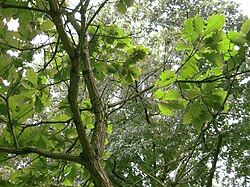
Quercus dentata, also called Japanese emperor oak, daimyo oak, or Korean oak3 (Japanese: 柏, kashiwa; traditional Chinese: 柞櫟; simplified Chinese: 柞栎; pinyin: zuòlì; Korean: 떡갈나무, tteokgalnamu), is a species of oak native to East Asia, including north-central and southern China, Japan, Korea, the Russian Far East (Khabarovsk and Primorsky krais and the Kuril Islands), Manchuria, Mongolia, and Taiwan.2 The name of the tree is often translated as "sweet oak" in English to distinguish it from Western varieties.4 It is placed in section Quercus.5
Description
Quercus dentata is a deciduous tree growing up to 20–25 metres (66–82 feet) tall, with a trunk up to 1 m (3 ft 3 in) in diameter. Its foliage is remarkable for its size, among the largest of all oaks, consisting of a short hairy petiole, 1–1.5 centimetres (3⁄8–5⁄8 inch) long, and a blade 10–40 cm (4–15+1⁄2 in) long and 15–30 cm (6–12 in) broad, with a shallowly lobed margin; the form is reminiscent of an enormous pedunculate oak leaf. The leaves are often retained dead on the tree into winter. Both sides of the leaf are initially downy with the upper surface becoming smooth.4
The flowers are produced in May; the male flowers are pendulous catkins. The female flowers are sessile, growing near the tips of new shoots, producing acorns 1.2–2.3 cm long and 1.2–1.5 cm broad, in broad, bushy-scaled cups; the acorns mature in September to October.4
Ecology
Quercus dentata (Qd) cannot tolerate the extreme cold of northern Hokkaido, but Quercus crispula (Qc) can. In more southerly parts of Hokkaido, Q. dentata lives in coastal areas while Q. crispula tends to live more inland. In the more northern parts of the island, these two species have experienced introgression and they are interfertile, producing shoots that grow and can reproduce; resulting in a coastal Qc ecotype with Qd-like traits. The coastal Qc are intermediary between the two parent species in genotypes and phenotypes.6
Cultivation outside East Asia
Quercus dentata was introduced to the British Isles in 1830, where it is occasionally grown in botanical gardens. It is usually smaller in cultivation than in the wild, growing to a small angular tree or large irregular shrub. Notable specimens include one at Osterley Park, 14 m (46 ft) tall and 1.5 m girth, and the largest, 18 m (59 ft) tall, at Avondale Forest Park, County Wicklow, Ireland.789
Culinary uses
In Korean cuisine, its acorns (in Hangul: 도토리, dotori) have been used since the Three Kingdoms. A notable food is dotorimuk.
In Japanese cuisine, its leaves are used as a wrapping for kashiwa mochi.10
Gallery
-
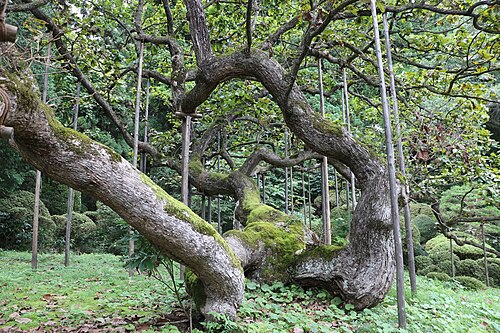 Large emperor oak at Shogen-in Temple in Iwate Prefecture
 -
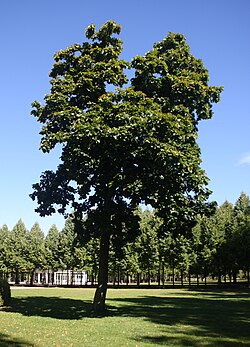 At Schwerin Castle in Germany
 -
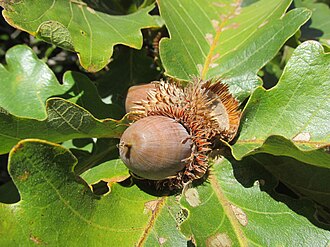 Acorn
Acorn -
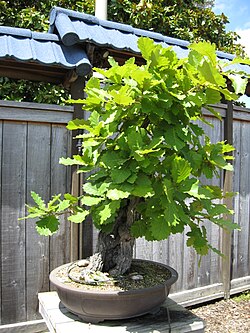 Emperor oak as bonsai
 -
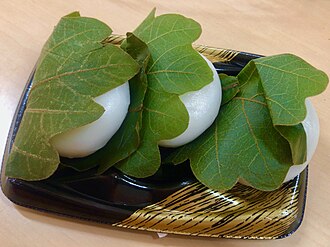 Kashiwa-mochi, Japanese rice cakes wrapped in oak leaves
 -
 Japanese mon (family crest) depicting three kashiwa leaves
References
References
- Carrero, C. (2020). "Quercus dentata". IUCN Red List of Threatened Species. 2020 e.T31294A2803789. doi:10.2305/IUCN.UK.2020-3.RLTS.T31294A2803789.en. Retrieved 7 July 2026.
- "Quercus dentata subsp. yunnanensis (Franch.) Menitsky". Plants of the World Online. Royal Botanic Gardens, Kew. Retrieved 7 July 2026.
- English Names for Korean Native Plants (PDF). Pocheon: Korea National Arboretum. 2015. p. 599. ISBN 978-89-97450-98-5. Archived from the original (PDF) on 25 May 2017. Retrieved 16 December 2016 – via Korea Forest Service.
- Huang, Chengjiu; Zhang, Yongtian; Bartholomew, Bruce. "Quercus dentata". Flora of China. Vol. 4. Retrieved March 3, 2016 – via eFloras.org, Missouri Botanical Garden, St. Louis, MO & Harvard University Herbaria, Cambridge, MA.
- Denk, Thomas; Grimm, Guido W.; Manos, Paul S.; Deng, Min & Hipp, Andrew L. (2017-11-02). "Appendix 2.1: An updated infrageneric classification of the oaks" (xls). figshare. doi:10.6084/m9.figshare.5547622.v1. Retrieved 2023-02-17.
- Nagamitsu, Teruyoshi; et al. (2020). "Environment-Dependent Introgression from Quercus Dentata to a Coastal Ecotype of Quercus Mongolica var.Crispula in Northern Japan". The New Phytologist. 226 (4): 1018–1028. JSTOR 26914604.
- Mitchell, A. F. (1974). "Field Guide to Trees in Britain and Europe." Collins.
- Phillips, R. (1978). "Trees in Britain, Europe and North America." Ward Lock.
- Lancaster, R. (1981). 'Hillier's Manual of Trees & Shrubs," 5th ed. Hillier and Sons.
- Quercus dentata, with photos (pdf file; in Japanese)