| Pyrausta sanguinalis | |
|---|---|
| |
| |
Scientific classification 
| |
| Kingdom: | Animalia |
| Phylum: | Arthropoda |
| Clade: | Pancrustacea |
| Class: | Insecta |
| Order: | Lepidoptera |
| Family: | Crambidae |
| Genus: | Pyrausta |
| Species: | P. sanguinalis
|
| Binomial name | |
| Pyrausta sanguinalis | |
| Synonyms | |
| |
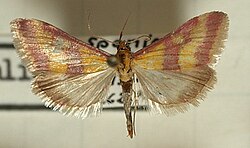
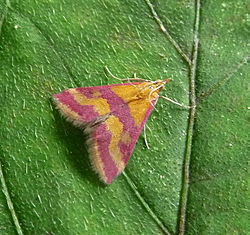
Pyrausta sanguinalis, the scarce crimson and gold, is a moth of the family Crambidae. The species was first described by Carl Linnaeus in his 1767 12th edition of Systema Naturae.
The wingspan is 14–18 mm. The forewings are brownish ochreous, basal and dorsal areas deep yellow, disc yellow mixed; markings purple-crimson; a streak along costa to 3/4; a fascia before middle; an oblong discal spot, connected above with costal streak, and sometimes beneath with preceding fascia; a subterminal fascia. Hindwings in male light grey, darker terminally, in female grey; termen crimson in middle. The larva is greenish-grey, reddish tinged; subdorsal and spiracular lines whitish; head brown.1
The moth flies from June to August depending on the location.
The larvae feed on common sage, rosemary and thyme.
References
References
- Meyrick, E., 1895 A Handbook of British Lepidoptera MacMillan, London pdf This article incorporates text from this source, which is in the public domain. Keys and description
Further reading
Further reading
- Mark Parsons, Sean Clancy, David Wilson A Guide to the Pyralid and Crambid Moths of Britain and Ireland: Atropos, England. ISBN 9780955108648
External links
External links
- Lepiforum.de
- "Pyrausta sanguinalis (Linnaeus, 1767)". Catalogue of the Lepidoptera of Belgium. Archived from the original on 1 April 2012.
- Kimber, Ian. "63.004 BF1364 Pyrausta sanguinalis (Linnaeus, 1767)". UKMoths. Retrieved 10 December 2020.
- https://maps.biodiversityireland.ie/Species/79259, accessed 15 June 2021