| Pyramimonas | |
|---|---|

| |
| Pyramimonas tetrarhynchus | |
Scientific classification 
| |
| Kingdom: | Plantae |
| Division: | Chlorophyta |
| Class: | Pyramimonadophyceae |
| Order: | Pyramimonadales |
| Family: | Pyramimonadaceae |
| Genus: | Pyramimonas Schmarda, 1849 |
| Type species | |
| Pyramimonas tetrarhynchus Schmarda, 18491
| |
| Species | |
| |
Pyramimonas is a genus of green algae in the order Pyramimonadales.2 Phototropic euglenids inherited their plastids from a close relative of Pyramimonas which was an endosymbiont inside phagotrophic eukaryovorous euglenids.3
Description
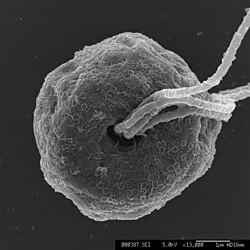
Pyramimonas is a unicellular organism consisting of cells with at least four flagella which emerge from the anterior end. The cell is shaped like an inverse pyramid, and is square or rounded in cross section. The anterior end of the cell has a depression from which usually four (in a few species eight, one species 16) flagella emerge.1
The cell contains one cup-shaped chloroplast which is divided at the anterior into four or eight lobes. The posterior (base) of the chloroplast has one pyrenoid. One or two eyespots are present at the anterior, middle, or posterior of the cell depending on the species.1 One species, Pyramimonas cyrtoptera, differs from all other species in having two chloroplasts, two eyespots, and two pairs of eyespots of unequal size.4
References
References
- Guiry, M.D.; Guiry, G.M. "Pyramimonas Schmarda, 1849". AlgaeBase. University of Galway. Retrieved 2026-05-09.
- "Pyramimonas". NCBI. Data extracted from the "NCBI taxonomy resources". National Center for Biotechnology Information. Retrieved 2007-03-19.
- Zakryś, B; Milanowski, R; Karnkowska, Anna (2017). "Evolutionary Origin of Euglena". Euglena: Biochemistry, Cell and Molecular Biology. Advances in Experimental Medicine and Biology. Vol. 979. pp. 3–17. doi:10.1007/978-3-319-54910-1_1. ISBN 978-3-319-54908-8. PMID 28429314.
- Daugbjerg, Niels; Moestrup, Øjvind (1992). "Ultrastructure of Pyramimonas cyrtoptera sp.nov. (Prasinophyceae), a species with 16 flagella from northern Foxe Basin, Arctic Canada, including observations on growth rates". Canadian Journal of Botany. 70 (6): 1259–1273. doi:10.1139/b92-159.