| Pyoderma | |
|---|---|
 | |
| Pyodermia of parasitic origin | |
| Specialty | Dermatology  |
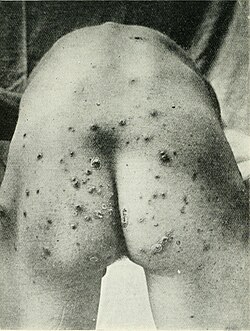
Pyoderma means any skin disease that is pyogenic (has pus). These include superficial bacterial infections such as impetigo, impetigo contagiosa, ecthyma, folliculitis, Bockhart's impetigo, furuncle, carbuncle, tropical ulcer, etc.12 Autoimmune conditions include pyoderma gangrenosum. Pyoderma affects more than 111 million children worldwide, making it one of the three most common skin disorders in children along with scabies and tinea.1
References
References
- Andrews RM, McCarthy J, Carapetis JR, Currie BJ (December 2009). "Skin disorders, including pyoderma, scabies, and tinea infections". Pediatr. Clin. North Am. 56 (6): 1421–40. doi:10.1016/j.pcl.2009.09.002. PMID 19962029.
- Page 348 in: Fisher, Bruce; Harvey, Richard P.; Champe, Pamela C. (2007). Lippincott's Illustrated Reviews: Microbiology (Lippincott's Illustrated Reviews Series). Hagerstown, MD: Lippincott Williams & Wilkins. ISBN 978-0-7817-8215-9.