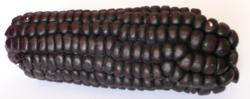
Purple corn (Spanish: maíz morado) or purple maize is group of flint maize varieties (Zea mays indurata) originating in South America, descended from a common ancestral variety termed "kʼculli" in Quechua.1 It is most commonly grown in the Andes of Peru, Bolivia and Ecuador.
Uses
Common in Peru, purple corn is used in chicha morada, a drink made by boiling ground purple corn kernels with pineapple, cinnamon, clove, and sugar, and in mazamorra, a type of pudding".2 In Bolivia, purple corn "Kuli" is used in Api, a smoothie served hot.3
Color chemistry: anthocyanins
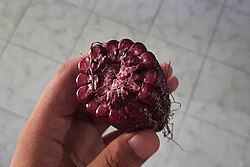
The pigment giving purple corn its vivid color derives from an exceptional content of a class of polyphenols called anthocyanins. Cyanidin 3-O-glucoside, also called chrysanthemin, is the major anthocyanin in purple corn kernels, comprising about 73% of all anthocyanins present.456 Other anthocyanins identified are pelargonidin 3-O-β-D-glucoside, peonidin 3-O-β-D-glucoside, cyanidin 3-O-β-D-(6-malonyl-glucoside), pelargonidin 3-O-β-D-(6-malonyl-glucoside) and peonidin 3-O-β-D-(6-malonyl-glucoside).456 Similar results for anthocyanin content were found from a variety of purple corn grown in China.7
Evaluating growing conditions for anthocyanin and total polyphenol content, one research group found that field location was an important determinant, whereas seedling density and soil potassium content were not.8
For ease of extractions, scientists have explored components of the purple corn plant for yield, such as kernels, cob and husk, possibly allowing use of a plentiful, non-edible residual biomass in cobs or husks. Husks of the purple corn plant contain about ten times higher content of anthocyanins than do kernels.6
References
References
- Corral, Marta (6 November 2020). "Maíz morado: propiedades y beneficios del 'elixir' inca de la eterna juventud" [Purple corn: properties and benefits of the Inca 'elixir' of eternal youth]. El Español (in Spanish). Retrieved 30 January 2023.
- Perich, Tatiana (14 September 2011). "De Arequipa a Mistura: Api, una mazamorra bebible hecha con maíz morado" [From Arequipa to Mistura: Api, a drinkable mazamorra made with purple corn]. El Comercio Peru (in Spanish). Retrieved 21 February 2013.
- La diversidad del maíz nativo en Bolivia [The Diversity of Native Maize in Bolivia] (in Spanish). Ministerio de Medio Ambiente y Agua/ Organización de las Naciones Unidas para la Alimentación y la Agricultura - FAO. pp. 160 pp.
- Aoki, Hiromitsu; Kuze, Noriko; Kato, Yoshiaki (April 2002). "Anthocyanins isolated from purple corn (Zea mays L.)" (PDF). Foods Food Ingred J Jpn. pp. 41–45. ISSN 0919-9772. OCLC 5171199616. S2CID 53073818. Archived from the original (PDF) on 29 October 2013. Retrieved 19 June 2014.
- Cuevas Montilla, E; Hillebrand, S; Antezana, A; Winterhalter, P (2011). "Soluble and bound phenolic compounds in different Bolivian purple corn ( Zea mays L.) cultivars". Journal of Agricultural and Food Chemistry. 59 (13): 7068–74. Bibcode:2011JAFC...59.7068C. doi:10.1021/jf201061x. PMID 21639140.
- Li, C. Y.; Kim, H. W.; Won, S. R.; et al. (2008). "Corn husk as a potential source of anthocyanins". Journal of Agricultural and Food Chemistry. 56 (23): 11413–6. Bibcode:2008JAFC...5611413L. doi:10.1021/jf802201c. PMID 19007127.
- Zhao, X; Corrales, M; Zhang, C; Hu, X; Ma, Y; Tauscher, B (2008). "Composition and thermal stability of anthocyanins from chinese purple corn ( Zea mays L.)". Journal of Agricultural and Food Chemistry. 56 (22): 10761–6. Bibcode:2008JAFC...5610761Z. doi:10.1021/jf8025056. PMID 18950186.
- Jing, P; Noriega, V; Schwartz, S. J.; Giusti, M. M. (2007). "Effects of growing conditions on purple corncob (Zea mays L.) anthocyanins". Journal of Agricultural and Food Chemistry. 55 (21): 8625–9. Bibcode:2007JAFC...55.8625J. doi:10.1021/jf070755q. PMID 17880157.