| PTPRZ1 |
|---|
|
|
| Identifiers |
|---|
| Aliases | PTPRZ1, HPTPZ, HPTPzeta, PTP-ZETA, PTP18, PTPRZ, PTPZ, R-PTP-zeta-2, RPTPB, RPTPbeta, phosphacan, protein tyrosine phosphatase, receptor type Z1, protein tyrosine phosphatase receptor type Z1 |
|---|
| External IDs | OMIM: 176891; MGI: 97816; HomoloGene: 2136; GeneCards: PTPRZ1; OMA:PTPRZ1 - orthologs |
|---|
|
|
| RNA expression pattern |
|---|
| Bgee | | Human | Mouse (ortholog) |
|---|
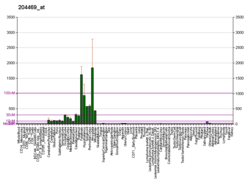
| Top expressed in | - ventricular zone
- ganglionic eminence
- endothelial cell
- amygdala
- Region I of hippocampus proper
- optic nerve
- caudate nucleus
- nucleus accumbens
- corpus callosum
- external globus pallidus
|
| | Top expressed in | - vestibular membrane of cochlear duct
- Rostral migratory stream
- mammillary body
- median eminence
- ventromedial nucleus
- lobe of cerebellum
- arcuate nucleus
- cerebellar vermis
- lateral septal nucleus
- anterior amygdaloid area
|
| | More reference expression data |
|
|---|
| BioGPS | |
|---|
|
|
|
| Wikidata |
|
Receptor-type tyrosine-protein phosphatase zeta also known as phosphacan is an enzyme that in humans is encoded by the PTPRZ1 gene.567
Function
This gene is a member of the receptor tyrosine phosphatase family and encodes a single-pass type I membrane protein with two cytoplasmic tyrosine-protein phosphatase domains, an alpha-carbonic anhydrase domain and a fibronectin type III domain. Alternative splice variants that encode different protein isoforms have been described but their full-length nature has not been determined.7
Clinical significance
Expression of this gene is induced in gastric cancer cells, in the remyelinating oligodendrocytes of multiple sclerosis lesions, and in human embryonic kidney cells under hypoxic conditions. Both the protein and transcript are overexpressed in glioblastoma cells, promoting their haptotactic migration.7
References
References
- GRCh38: Ensembl release 89: ENSG00000106278 – Ensembl, May 2017
- GRCm38: Ensembl release 89: ENSMUSG00000068748 – Ensembl, May 2017
- "Human PubMed Reference:". National Center for Biotechnology Information, U.S. National Library of Medicine.
- "Mouse PubMed Reference:". National Center for Biotechnology Information, U.S. National Library of Medicine.
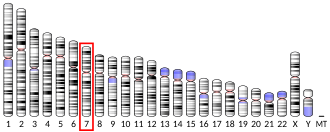
- Ariyama T, Hasegawa K, Inazawa J, Mizuno K, Ogimoto M, Katagiri T, et al. (Jun 1995). "Assignment of the human protein tyrosine phosphatase, receptor-type, zeta (PTPRZ) gene to chromosome band 7q31.3". Cytogenetics and Cell Genetics. 70 (1–2): 52–54. doi:10.1159/000133990. PMID 7736789.
- Levy JB, Canoll PD, Silvennoinen O, Barnea G, Morse B, Honegger AM, et al. (Jun 1993). "The cloning of a receptor-type protein tyrosine phosphatase expressed in the central nervous system". The Journal of Biological Chemistry. 268 (14): 10573–10581. doi:10.1016/S0021-9258(18)82237-2. PMID 8387522.
- "Entrez Gene: PTPRZ1 protein tyrosine phosphatase, receptor-type, Z polypeptide 1".
Further reading
Further reading
- Krueger NX, Saito H (1992). "A human transmembrane protein-tyrosine-phosphatase, PTP zeta, is expressed in brain and has an N-terminal receptor domain homologous to carbonic anhydrases". Proceedings of the National Academy of Sciences of the United States of America. 89 (16): 7417–7421. Bibcode:1992PNAS...89.7417K. doi:10.1073/pnas.89.16.7417. PMC 49721. PMID 1323835.
- Kaplan R, Morse B, Huebner K, Croce C, Howk R, Ravera M, et al. (1990). "Cloning of three human tyrosine phosphatases reveals a multigene family of receptor-linked protein-tyrosine-phosphatases expressed in brain". Proceedings of the National Academy of Sciences of the United States of America. 87 (18): 7000–7004. Bibcode:1990PNAS...87.7000K. doi:10.1073/pnas.87.18.7000. PMC 54670. PMID 2169617.
- Krueger NX, Streuli M, Saito H (1990). "Structural diversity and evolution of human receptor-like protein tyrosine phosphatases". The EMBO Journal. 9 (10): 3241–3252. doi:10.1002/j.1460-2075.1990.tb07523.x. PMC 552056. PMID 2170109.
- Morton SM, Veile RA, Helms C, Lee M, Kuo WL, Gray J, et al. (1998). "Subregional localization of 21 chromosome 7-specific expressed sequence tags (ESTs) by FISH using newly identified YACs and P1s". Genomics. 46 (3): 491–494. doi:10.1006/geno.1997.5051. PMID 9441757.
- Onyango P, Lubyova B, Gardellin P, Kurzbauer R, Weith A (1998). "Molecular cloning and expression analysis of five novel genes in chromosome 1p36". Genomics. 50 (2): 187–198. doi:10.1006/geno.1997.5186. PMID 9653645.
- Sanger Centre T, Washington University Genome Sequencing Cente T (November 1998). "Toward a complete human genome sequence". Genome Research. 8 (11): 1097–1108. doi:10.1101/gr.8.11.1097. PMID 9847074.
- Maeda N, Ichihara-Tanaka K, Kimura T, Kadomatsu K, Muramatsu T, Noda M (1999). "A receptor-like protein-tyrosine phosphatase PTPzeta/RPTPbeta binds a heparin-binding growth factor midkine. Involvement of arginine 78 of midkine in the high affinity binding to PTPzeta". The Journal of Biological Chemistry. 274 (18): 12474–12479. doi:10.1074/jbc.274.18.12474. PMID 10212223.
- Kawachi H, Tamura H, Watakabe I, Shintani T, Maeda N, Noda M (1999). "Protein tyrosine phosphatase zeta/RPTPbeta interacts with PSD-95/SAP90 family". Brain Research. Molecular Brain Research. 72 (1): 47–54. doi:10.1016/S0169-328X(99)00204-1. PMID 10521598.
- Meng K, Rodriguez-Peña A, Dimitrov T, Chen W, Yamin M, Noda M, et al. (2000). "Pleiotrophin signals increased tyrosine phosphorylation of beta beta-catenin through inactivation of the intrinsic catalytic activity of the receptor-type protein tyrosine phosphatase beta/zeta". Proceedings of the National Academy of Sciences of the United States of America. 97 (6): 2603–2608. Bibcode:2000PNAS...97.2603M. doi:10.1073/pnas.020487997. PMC 15975. PMID 10706604.
- Kawachi H, Fujikawa A, Maeda N, Noda M (2001). "Identification of GIT1/Cat-1 as a substrate molecule of protein tyrosine phosphatase zeta /beta by the yeast substrate-trapping system". Proceedings of the National Academy of Sciences of the United States of America. 98 (12): 6593–6598. Bibcode:2001PNAS...98.6593K. doi:10.1073/pnas.041608698. PMC 34398. PMID 11381105.
- Thomaidou D, Coquillat D, Meintanis S, Noda M, Rougon G, Matsas R (2001). "Soluble forms of NCAM and F3 neuronal cell adhesion molecules promote Schwann cell migration: identification of protein tyrosine phosphatases zeta/beta as the putative F3 receptors on Schwann cells". Journal of Neurochemistry. 78 (4): 767–778. doi:10.1046/j.1471-4159.2001.00454.x. PMID 11520897. S2CID 24682985.
- Harroch S, Furtado GC, Brueck W, Rosenbluth J, Lafaille J, Chao M, et al. (2002). "A critical role for the protein tyrosine phosphatase receptor type Z in functional recovery from demyelinating lesions". Nature Genetics. 32 (3): 411–414. doi:10.1038/ng1004. PMID 12355066. S2CID 19800079.
- Müller S, Kunkel P, Lamszus K, Ulbricht U, Lorente GA, Nelson AM, et al. (2003). "A role for receptor tyrosine phosphatase zeta in glioma cell migration". Oncogene. 22 (43): 6661–6668. doi:10.1038/sj.onc.1206763. PMID 14555979.
- Bonora E, Lamb JA, Barnby G, Sykes N, Moberly T, Beyer KS, et al. (2005). "Mutation screening and association analysis of six candidate genes for autism on chromosome 7q". European Journal of Human Genetics. 13 (2): 198–207. doi:10.1038/sj.ejhg.5201315. PMID 15523497.
- Polykratis A, Katsoris P, Courty J, Papadimitriou E (2005). "Characterization of heparin affin regulatory peptide signaling in human endothelial cells". The Journal of Biological Chemistry. 280 (23): 22454–22461. doi:10.1074/jbc.M414407200. PMID 15797857.
- Wang V, Davis DA, Haque M, Huang LE, Yarchoan R (2005). "Differential gene up-regulation by hypoxia-inducible factor-1alpha and hypoxia-inducible factor-2alpha in HEK293T cells". Cancer Research. 65 (8): 3299–3306. doi:10.1158/0008-5472.CAN-04-4130. PMID 15833863.
- Lu KV, Jong KA, Kim GY, Singh J, Dia EQ, Yoshimoto K, et al. (2005). "Differential induction of glioblastoma migration and growth by two forms of pleiotrophin". The Journal of Biological Chemistry. 280 (29): 26953–26964. doi:10.1074/jbc.M502614200. PMID 15908427.