Pterocarpus macrocarpus, commonly known as Burma padauk or Burmese padauk,1 is a species of tree in the family Fabaceae. It is an important timber tree and is celebrated as a national symbol in Myanmar.
| Burma padauk | |
|---|---|
| |
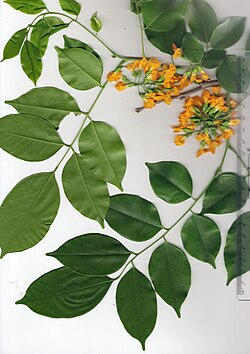
| Foliage and flowers of P. macrocarpus | |
Scientific classification 
| |
| Kingdom: | Plantae |
| Clade: | Embryophytes |
| Clade: | Tracheophytes |
| Clade: | Spermatophytes |
| Clade: | Angiosperms |
| Clade: | Eudicots |
| Clade: | Rosids |
| Order: | Fabales |
| Family: | Fabaceae |
| Subfamily: | Faboideae |
| Genus: | Pterocarpus |
| Species: | P. macrocarpus
|
| Binomial name | |
| Pterocarpus macrocarpus | |
| Synonyms43 | |
|
List
| |
Description
Pterocarpus macrocarpus is a medium-sized tree growing to 10–30 m (rarely to 39 m) tall, with a trunk up to 1.7 m diameter; it is deciduous in the dry season. The bark is flaky, grey-brown; if cut, it secretes a red gum. The leaves are 200–350 mm long, pinnate, with 9–11 leaflets. The flowers are yellow, produced in racemes 50–90 mm long. The fruit is a pod surrounded by a round wing 45–70 mm diameter, containing two or three seeds.56
The wood is durable and resistant to termites; it is important, used for furniture, construction timber, cart wheels, tool handles, and posts;6 though not a true rosewood it is sometimes traded as such. The seasonal padauk flowers bloom annually around Thingyan (April) and is considered one of the national symbols7 of Myanmar (formerly Burma).
-
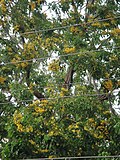 Padauk flowers during Thingyan
 -
 Padauk seeds
 -
 Displayed Padauk wood
Distribution and habitat
The species is native to the seasonal tropical forests of mainland Southeast Asia, including Myanmar, Thailand, Laos, Cambodia, and Vietnam.4 It has been naturalized in parts of India and the Caribbean.5 It typically grows in dry deciduous forests, often associated with teak and bamboo.
Uses
The timber is very durable and resistant to termites. It is heavy, hard, and has a fine-grained, reddish-brown appearance. It is highly valued for high-end furniture, flooring, tool handles, and traditional musical instruments. Padauk is often traded as "Amboyna wood" when it features burls.6
Culture
In Myanmar, the padauk flower is a national symbol and is closely associated with the Thingyan (Burmese New Year) festival. The flowers typically bloom once a year in April after the first spring rains. It is regarded as a symbol of strength and durability.8
Status
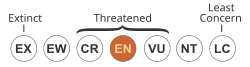
The species is currently listed as Endangered on the IUCN Red List due to over-exploitation for its timber and habitat loss across its native range.2
References
References
- NRCS. "Pterocarpus macrocarpus". PLANTS Database. United States Department of Agriculture (USDA). Retrieved 15 October 2015.
- Barstow, M. (2019). "Pterocarpus macrocarpus". IUCN Red List of Threatened Species. 2019 e.T32308A2813424. doi:10.2305/IUCN.UK.2019-1.RLTS.T32308A2813424.en. Retrieved 2 February 2023.
- "Pterocarpus macrocarpus". International Legume Database & Information Service (ILDIS). Retrieved 3 July 2017.
- "Pterocarpus macrocarpus Kurz". Plants of the World Online. The Trustees of the Royal Botanic Gardens, Kew. n.d. Retrieved June 7, 2025.
- "Pterocarpus macrocarpus" (PDF). Danida Forest Seed Centre. Archived from the original (PDF) on 31 March 2010. Retrieved 3 July 2017.
- "Pterocarpus macrocarpus". International Institute of Tropical Forestry. Archived from the original on 16 January 2009. Retrieved 3 July 2017.
- Australia, Australian National Botanic Gardens, Parks. "Floral Emblems of the world - Australian Plant Information". www.anbg.gov.au. Retrieved 2016-04-14.
{{cite web}}: CS1 maint: multiple names: authors list (link) - Minahan, James (2009). The Complete Guide to National Symbols and Emblems. Greenwood Press. p. 115.
External links
External links
- Media related to Pterocarpus macrocarpus at Wikimedia Commons
- Data related to Pterocarpus macrocarpus at Wikispecies