  | |
| Observation data Epoch J2000.0 Equinox J2000.0 (ICRS) | |
|---|---|
| Constellation | Taurus |
| Right ascension | 04h 07m 00.45695s1 |
| Declination | +29° 00′ 04.7093″1 |
| Apparent magnitude (V) | +5.222 |
| Characteristics | |
| Evolutionary stage | main sequence1 |
| Spectral type | F1 V3 |
| U−B color index | −0.012 |
| B−V color index | +0.342 |
| Astrometry | |
| Radial velocity (Rv) | +9.15±0.424 km/s |
| Proper motion (μ) | RA: −91.6611 mas/yr Dec.: +8.0961 mas/yr |
| Parallax (π) | 35.9320±0.1055 mas1 |
| Distance | 90.8 ± 0.3 ly (27.83 ± 0.08 pc) |
| Absolute magnitude (MV) | 3.015 |
| Details | |
| Mass | 1.595 M☉ |
| Radius | 1.41 R☉ |
| Luminosity | 5.21 L☉ |
| Surface gravity (log g) | 4.36±0.145 cgs |
| Temperature | 6,8561 K |
| Metallicity [Fe/H] | −0.206 dex |
| Rotational velocity (v sin i) | 45.4±2.37 km/s |
| Age | 1.4355 Gyr |
| Other designations | |
| ψ Tau, 42 Tau, BD+28°619, FK5 2295, HD 25867, HIP 19205, HR 1269, SAO 764618 | |
| Database references | |
| SIMBAD | data |
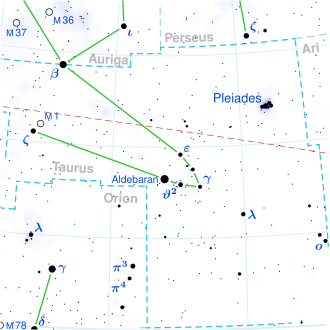
Psi Tauri, which is Latinized from ψ Tauri, is a solitary9 star in the zodiac constellation of Taurus. It has a yellow-white hue and is visible to the naked eye with an apparent visual magnitude of +5.22.2 The distance to this system, as determined using an annual parallax shift of 36.2 mas as seen from the Earth,10 is 91 light years. It is drifting further away with a radial velocity of +9 km/s.
This object is an F-type main sequence star with a stellar classification of F1 V,3 which indicates it is undergoing core hydrogen fusion. It is about 1.4 billion years old and is spinning with a projected rotational velocity of 45 km/s.7 The star has 1.6 times the mass of the Sun5 and 1.4 times its radius.1 It is radiating 4.8 times the Sun's luminosity from its photosphere at an effective temperature of 7,088 K.5
References
References
- Vallenari, A.; et al. (Gaia collaboration) (2023). "Gaia Data Release 3. Summary of the content and survey properties". Astronomy and Astrophysics. 674: A1. arXiv:2208.00211. Bibcode:2023A&A...674A...1G. doi:10.1051/0004-6361/202243940. S2CID 244398875. Gaia DR3 record for this source at VizieR.
- Landolt, A. U. (October 1967), "Photoelectric UBV sequences in Taurus", Astronomical Journal, 72: 1012–1018, Bibcode:1967AJ.....72.1012L, doi:10.1086/110377.
- Cowley, Anne; Fraquelli, Dorothy (February 1974), "MK Spectral Types for Some Bright F Stars", Publications of the Astronomical Society of the Pacific, 86 (509): 70, Bibcode:1974PASP...86...70C, doi:10.1086/129562.
- Brown, A. G. A.; et al. (Gaia collaboration) (August 2018). "Gaia Data Release 2: Summary of the contents and survey properties". Astronomy & Astrophysics. 616. A1. arXiv:1804.09365. Bibcode:2018A&A...616A...1G. doi:10.1051/0004-6361/201833051. Gaia DR2 record for this source at VizieR.
- David, Trevor J.; Hillenbrand, Lynne A. (2015), "The Ages of Early-Type Stars: Strömgren Photometric Methods Calibrated, Validated, Tested, and Applied to Hosts and Prospective Hosts of Directly Imaged Exoplanets", The Astrophysical Journal, 804 (2): 146, arXiv:1501.03154, Bibcode:2015ApJ...804..146D, doi:10.1088/0004-637X/804/2/146, S2CID 33401607.
- Holmberg, J.; et al. (July 2009), "The Geneva-Copenhagen survey of the solar neighbourhood. III. Improved distances, ages, and kinematics", Astronomy and Astrophysics, 501 (3): 941–947, arXiv:0811.3982, Bibcode:2009A&A...501..941H, doi:10.1051/0004-6361/200811191, S2CID 118577511.
- Ammler-von Eiff, Matthias; Reiners, Ansgar (June 2012), "New measurements of rotation and differential rotation in A-F stars: are there two populations of differentially rotating stars?", Astronomy & Astrophysics, 542: A116, arXiv:1204.2459, Bibcode:2012A&A...542A.116A, doi:10.1051/0004-6361/201118724, S2CID 53666672.
- "psi Tau". SIMBAD. Centre de données astronomiques de Strasbourg. Retrieved 2017-06-30.
- Eggleton, P. P.; Tokovinin, A. A. (September 2008), "A catalogue of multiplicity among bright stellar systems", Monthly Notices of the Royal Astronomical Society, 389 (2): 869–879, arXiv:0806.2878, Bibcode:2008MNRAS.389..869E, doi:10.1111/j.1365-2966.2008.13596.x, S2CID 14878976.
- van Leeuwen, F. (2007), "Validation of the new Hipparcos reduction", Astronomy and Astrophysics, 474 (2): 653–664, arXiv:0708.1752, Bibcode:2007A&A...474..653V, doi:10.1051/0004-6361:20078357, S2CID 18759600.