  | |
| Observation data Epoch J2000.0 Equinox ICRS | |
|---|---|
| Constellation | Centaurus |
| Right ascension | 14h 20m 33.43s1 |
| Declination | −37° 53′ 07.1″1 |
| Apparent magnitude (V) | +4.052 |
| Characteristics | |
| Spectral type | A0 IV3 (B9 and A2)4 |
| U−B color index | −0.113 |
| B−V color index | −0.033 |
| Variable type | eclipsing4 |
| Astrometry | |
| Radial velocity (Rv) | 1.8±0.95 km/s |
| Proper motion (μ) | RA: −63.69±0.181 mas/yr Dec.: −10.65±0.151 mas/yr |
| Parallax (π) | 13.049±0.063 mas6 |
| Distance | 250.0±1.2 ly (76.64±0.37 pc)6 |
| Absolute magnitude (MV) | −0.35±0.147 |
| Orbit6 | |
| Period (P) | 38.8121(2) d |
| Semi-major axis (a) | 0.3874±0.0017 AU |
| Eccentricity (e) | 0.550±0.001 |
| Inclination (i) | 89.20±0.13° |
| Longitude of the node (Ω) | 115.79±0.10° |
| Argument of periastron (ω) (secondary) | 19.45±0.27° |
| Semi-amplitude (K1) (primary) | 49.51±0.16 km/s |
| Semi-amplitude (K2) (secondary) | 80.48±0.33 km/s |
| Details6 | |
| ψ Cen A | |
| Mass | 3.187±0.031 M☉ |
| Radius | 3.814±0.007 R☉ |
| Luminosity | 140+17 −15 L☉ |
| Surface gravity (log g) | 3.811±0.0038 cgs |
| Temperature | 10,450±300 K |
| Metallicity [Fe/H] | +0.05±0.10 dex |
| Rotation | 1.49±0.26 d4 |
| Rotational velocity (v sin i) | 123.78 km/s |
| Age | 280±10 Myr |
| ψ Cen B | |
| Mass | 1.961±0.015 M☉ |
| Radius | 1.896±0.004 R☉ |
| Luminosity | 17.5+2.6 −2.2 L☉ |
| Surface gravity (log g) | 4.206±0.0078 cgs |
| Temperature | 8,800±300 K |
| Metallicity [Fe/H] | +0.05±0.10 dex |
| Rotational velocity (v sin i) | 126.98 km/s |
| Age | 280±10 Myr |
| Other designations | |
| ψ Cen, CD−37°9336, FK5 1373, GC 19337, HD 125473, HIP 70090, HR 5367, SAO 205453, CCDM J14206-3753, WDS J14206-37539 | |
| Database references | |
| SIMBAD | data |
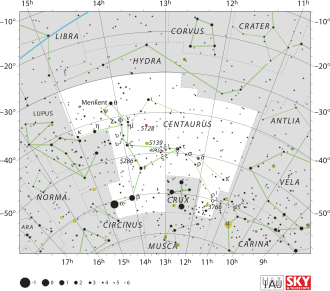
Psi Centauri is a binary star10 system in the southern constellation of Centaurus. Its name is a Bayer designation that is Latinized from ψ Centauri, and abbreviated Psi Cen or ψ Cen. This system is visible to the naked eye as a point of light with a baseline apparent visual magnitude of +4.05.2 The distance to this system is 250 light years based on parallax.6 The radial velocity is poorly constrained, but it appears to be slowly drifting away from the Sun at the rate of +2 km/s.5

This is a detached eclipsing binary system with the secondary eclipse being total.4 The pair are orbiting each other with a period of 38.81 days and an eccentricity of 0.55.6The brightness of the system dips by 0.28 and 0.16 magnitude during the two eclipses per orbit.4 The system displays an infrared excess at a wavelength of 60 μm, indicating the presence of a circumstellar debris disk with a temperature of 120 K, orbiting at a distance of 64 AU.11
The pair have a combined stellar classification of A0 IV,3 matching a white-hued A-type subgiant.2 The two components appear to be at different evolutionary stages.4 Both have high rotation rates, with projected rotational velocities over 120 km/s.8 The primary has 3.814 times the Sun's radius while the secondary is 1.896 times.6 The primary showed evidence of pulsational behavior with 1.996 and 5.127 cycles per day,4 which suggests it is a slowly pulsating B star.8 But this remains unconfirmed as of 2017,12 and the finding may instead be the result of instrumental error.8
References
References
- van Leeuwen, F. (2007), "Validation of the new Hipparcos reduction", Astronomy and Astrophysics, 474 (2): 653–664, arXiv:0708.1752, Bibcode:2007A&A...474..653V, doi:10.1051/0004-6361:20078357, S2CID 18759600. Vizier catalog entry
- Johnson, H. L.; et al. (1966), "UBVRIJKL photometry of the bright stars", Communications of the Lunar and Planetary Laboratory, 4 (99): 99, Bibcode:1966CoLPL...4...99J.
- Buscombe, W. (1962), "Spectral classification of Southern fundamental stars", Mount Stromlo Observatory Mimeogram, 4: 1, Bibcode:1962MtSOM...4....1B.
- Bruntt, H.; et al. (September 2006), "Eclipsing binaries observed with the WIRE satellite. I. Discovery and photometric analysis of the new bright A0 IV eclipsing binary ψ Centauri", Astronomy and Astrophysics, 456 (2): 651–658, arXiv:astro-ph/0606551, Bibcode:2006A&A...456..651B, doi:10.1051/0004-6361:20065628, S2CID 16701277.
- Gontcharov, G. A. (November 2006), "Pulkovo Compilation of Radial Velocities for 35495 Hipparcos stars in a common system", Astronomy Letters, 32 (11): 759–771, arXiv:1606.08053, Bibcode:2006AstL...32..759G, doi:10.1134/S1063773706110065, S2CID 119231169.
- Gallenne, A.; et al. (2019), "The Araucaria project: High-precision orbital parallax and masses of eclipsing binaries from infrared interferometry", Astronomy & Astrophysics, 632: A31, Bibcode:2019A&A...632A..31G, doi:10.1051/0004-6361/201935837, ISSN 0004-6361.
- Gerbaldi, M.; et al. (June 1999), "Search for reference A0 dwarf stars: Masses and luminosities revisited with HIPPARCOS parallaxes", Astronomy and Astrophysics Supplement, 137 (2): 273–292, Bibcode:1999A&AS..137..273G, doi:10.1051/aas:1999248.
- Mantegazza, L.; et al. (March 2010), "Spectroscopic search for g-mode pulsations in ψ Centauri", Astronomy and Astrophysics, 512: 5, Bibcode:2010A&A...512A..42M, doi:10.1051/0004-6361/200913013, A42.
- "psi Cen", SIMBAD, Centre de données astronomiques de Strasbourg, retrieved 2017-06-30
- Eggleton, P. P.; Tokovinin, A. A. (September 2008), "A catalogue of multiplicity among bright stellar systems", Monthly Notices of the Royal Astronomical Society, 389 (2): 869–879, arXiv:0806.2878, Bibcode:2008MNRAS.389..869E, doi:10.1111/j.1365-2966.2008.13596.x, S2CID 14878976.
- Rhee, Joseph H.; et al. (May 2007), "Characterization of Dusty Debris Disks: The IRAS and Hipparcos Catalogs", The Astrophysical Journal, 660 (2): 1556–1571, arXiv:astro-ph/0609555, Bibcode:2007ApJ...660.1556R, doi:10.1086/509912, S2CID 11879505.
- Liakos, Alexios; Niarchos, Panagiotis (February 2017), "Catalogue and properties of δ Scuti stars in binaries", Monthly Notices of the Royal Astronomical Society, 465 (1): 1181–1200, arXiv:1611.00200, Bibcode:2017MNRAS.465.1181L, doi:10.1093/mnras/stw2756.