| Pseudotsuga sinensis | |
|---|---|

| |
Scientific classification 
| |
| Kingdom: | Plantae |
| Clade: | Embryophytes |
| Clade: | Tracheophytes |
| Clade: | Spermatophytes |
| Clade: | Gymnosperms |
| Division: | Pinophyta |
| Class: | Pinopsida |
| Order: | Pinales |
| Family: | Pinaceae |
| Genus: | Pseudotsuga |
| Species: | P. sinensis
|
| Binomial name | |
| Pseudotsuga sinensis Dode
| |
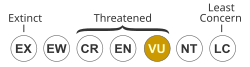
Pseudotsuga sinensis (Chinese Douglas-fir; in Chinese 黃杉, pinyin romanization: huáng shān) is a species of conifer in the family Pinaceae. It is a tree that grows up to 50 metres (160 ft) tall.2 It is found in China (in Anhui, Fujian, Guangxi, Guizhou, Hubei, Hunan, Jiangxi, Shaanxi, Sichuan, Yunnan, and Zhejiang provinces) and Taiwan,1 as well as in northernmost parts of Vietnam.3
The timber is used for construction, bridge building, furniture, and wood fiber.24
Pseudotsuga sinensis var. wilsoniana, Taiwan Douglas-fir, is sometimes treated as its own species, Pseudotsuga wilsoniana. This variety is geographically isolated (being restricted to Taiwan) but is not markedly distinct morphologically from var. sinensis of China.4
References
References
- Yang, Y.; Christian, T. (2013). "Pseudotsuga sinensis". IUCN Red List of Threatened Species. 2013 e.T42430A2979571. doi:10.2305/IUCN.UK.2013-1.RLTS.T42430A2979571.en. Retrieved 12 November 2021.
- "Pseudotsuga sinensis at Gymnosperm Database". The Gymnosperm Database.
- Luu, Nguyen Duc To; Thomas Ian, Philip (2004). Cay La Kim Vietnam / Conifers of Vietnam. Darwin Initiative. pp. 50–52. ISBN 1-872291-64-3.
- Liguo Fu; Nan Li; Thomas S. Elias & Robert R. Mill. "Pseudotsuga sinensis". Flora of China. Missouri Botanical Garden, St. Louis, MO & Harvard University Herbaria, Cambridge, MA. Retrieved 8 September 2012.