| Pseudopus Temporal range:
| |
|---|---|
| |
Scientific classification 
| |
| Kingdom: | Animalia |
| Phylum: | Chordata |
| Class: | Reptilia |
| Order: | Squamata |
| Suborder: | Anguimorpha |
| Family: | Anguidae |
| Subfamily: | Anguinae |
| Genus: | Pseudopus Merrem, 1820 |
| Type species | |
| Lacerta apoda Pallas, 1775
| |
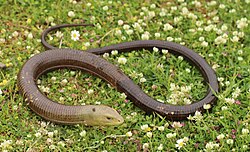
Pseudopus is a genus of anguid lizards that are native to Eurasia.1 One extant species remains, the sheltopusik,2 with four fossil species. They are the most robust members of subfamily Anguinae,13 with the largest species †P. pannonicus growing up to 2 metres in length.4 The oldest fossils of the group date to the Early Miocene, but there are possible Oligocene records.5
Classification
- Pseudopus apodus (Pallas, 1775) – sheltopusik, Pallas's glass lizard, European legless lizard, European glass lizard
- †Pseudopus ahnikoviensis
- †Pseudopus laurillardi
- †Pseudopus pannonicus
- †Pseudopus rugosus
References
References
- Klembara, Jozef; Madelaine Böhme; Michael Rummel (2010). "Revision of the anguine lizard Pseudopus laurillardi (Squamata, Anguidae) from the Miocene of Europe, with comments on paleoecology". Journal of Paleontology. 84 (2): 159–196. Bibcode:2010JPal...84..159K. doi:10.1666/09-033R1.1. S2CID 130738857.
- Pseudopus at the Reptarium.cz Reptile Database. Accessed 27 May 2014.
- Jozef Klembara (2015). "New finds of anguines (Squamata, Anguidae) from the Early Miocene of Northwest Bohemia (Czech Republic)". Paläontologische Zeitschrift. 89 (2): 171–195. Bibcode:2015PalZ...89..171K. doi:10.1007/s12542-014-0226-4. S2CID 129436097.
- Loréal, Erwan; Georgalis, Georgios L.; Čerňanský, Andrej (2025). "(Squamata), the largest known anguid lizard—Redescription of the type material and new specimens from the Neogene and Quaternary of Hungary and Poland". The Anatomical Record. 308 (1): 45–113. doi:10.1002/ar.25525. ISSN 1932-8494.
- Villa, Andrea; Delfino, Massimo (November 2019). "Fossil lizards and worm lizards (Reptilia, Squamata) from the Neogene and Quaternary of Europe: an overview". Swiss Journal of Palaeontology. 138 (2): 177–211. Bibcode:2019SwJP..138..177V. doi:10.1007/s13358-018-0172-y. ISSN 1664-2384.