| Prunus emarginata | |
|---|---|

| |
| Leaves and flowers | |
Scientific classification 
| |
| Kingdom: | Plantae |
| Clade: | Tracheophytes |
| Clade: | Angiosperms |
| Clade: | Eudicots |
| Clade: | Rosids |
| Order: | Rosales |
| Family: | Rosaceae |
| Genus: | Prunus |
| Subgenus: | Prunus subg. Cerasus |
| Species: | P. emarginata
|
| Binomial name | |
| Prunus emarginata | |

| |
| Natural range | |
| Synonyms2 | |
|
List
| |
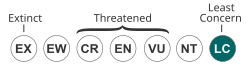
Prunus emarginata, the bitter cherry3 or Oregon cherry, is a species of Prunus native to western North America.
Taxonomy
- Prunus emarginata var. emarginata. Usually shrubby; young shoots and leaves hairless or only thinly hairy. Most of the species' range.
- Prunus emarginata var. mollis (Dougl.) Brew. A larger tree; young shoots and leaves downy. Reddish-brown bark with light horizontal bands resembling water birch.5 Oregon north to British Columbia, mainly coastal.
Description
Prunus emarginata is a deciduous shrub or small tree growing to 1–15 metres (3+1⁄2–49 feet) tall;6 west of the Cascade Range, it commonly reaches 24–30 m (80–100 ft) tall. It has a slender oval trunk and smooth gray to reddish-brown bark with horizontal lenticels. The leaves are 2–8 centimetres (3⁄4–3+1⁄8 inches) long, thin, egg-shaped,6 and yellowish-green with unevenly sized teeth on either side.
The flowers are small, 10–15 millimetres (3⁄8–5⁄8 in) diameter, with five white petals6 and numerous hairlike stamens; they are almond-scented, produced in clusters in spring, and pollinated by insects.
The fruit is a juicy red or purple cherry 7–14 mm (1⁄4–1⁄2 in) diameter, which, as the plant's English name suggests, are bitter.6 As well as reproducing by seed, it also sends out underground stems which then sprout above the surface to create a thicket.478
-
 Flowers
 -
 Pits
Pits -
 Bark
Bark
Similar species
Prunus pensylvanica, the pin cherry, is closely related.5
Distribution and habitat
It is native to western North America from British Columbia south to Baja California, and east as far as western Wyoming and New Mexico.910 It is often found in recently disturbed areas or open woods on nutrient-rich soil.1147
Ecology
Mammals, deer and livestock forage on the leaves.12 The cherries are eaten by some birds (especially cedar waxwing),13 who in turn distribute the seeds.5 The seeds have hard shells which can preserve them for decades before being released by fire.5
The tree is a larval host to the blinded sphinx, elegant sphinx, Lorquin's admiral, pale tiger swallowtail, small-eyed sphinx, spring azure, twin-spotted sphinx, and western tiger swallowtail.14
Cultivation
It has hybridized with the introduced European Prunus avium in the Puget Sound area; the hybrid has been named Prunus × pugetensis. It is intermediate between the parent species, but is nearly sterile, producing almost no cherries.15
Uses
The extremely bitter cherries are inedible to humans.13 Native Americans used the bark in basket making.5
Medicinal
Native tribes, most notably Kwakwaka'wakw, used parts of the plant for medicinal purposes, such as poultices and bark infusions.16 The isoflavone prunetin was isolated for the first time by Finnemore in 1910 from the bark of P. emarginata.17
References
References
- Pollard, R.P.; Rhodes, L. & Maxted, N. (2016). "Prunus emarginata". IUCN Red List of Threatened Species. 2016 e.T50136459A50673950. doi:10.2305/IUCN.UK.2016-2.RLTS.T50136459A50673950.en. Retrieved 9 March 2026.
- The Plant List, Prunus emarginata (Douglas ex Hook.) Walp.
- NRCS. "Prunus emarginata". PLANTS Database. United States Department of Agriculture (USDA). Retrieved 14 October 2015.
- Plants of British Columbia: Prunus emarginata
- Arno, Stephen F.; Hammerly, Ramona P. (2020) [1977]. Northwest Trees: Identifying & Understanding the Region's Native Trees (field guide ed.). Seattle: Mountaineers Books. pp. 242–245. ISBN 978-1-68051-329-5. OCLC 1141235469.
- Turner, Mark; Kuhlmann, Ellen (2014). Trees & Shrubs of the Pacific Northwest (1st ed.). Portland, OR: Timber Press. p. 252. ISBN 978-1-60469-263-1.
- Jepson Flora: Prunus emarginata
- Flora of North America, Prunus emarginata (Douglas) Eaton, Man. Bot. ed. 7. 463. 1836. Bitter cherry
- Biota of North America Program 2014 county distribution map
- SEINet, Southwestern Biodiversity, Arizona chapter photos, description, distribution map
- "Prunus emarginata". Germplasm Resources Information Network. Agricultural Research Service, United States Department of Agriculture. Retrieved 26 December 2017.
- Little, Elbert L. (1994) [1980]. The Audubon Society Field Guide to North American Trees: Western Region (Chanticleer Press ed.). Knopf. p. 467. ISBN 0394507614.
- Peattie, Donald Culross (1953). A Natural History of Western Trees. New York: Bonanza Books. p. 538.
- The Xerces Society (2016), Gardening for Butterflies: How You Can Attract and Protect Beautiful, Beneficial Insects, Timber Press.
- Jacobson, A. L. & Zika, P. F. (2007). A new hybrid cherry, Prunus × pugetensis (P. avium × emarginata, Rosaceae), from the Pacific Northwest. Madroño 54: 74–85. Abstract
- Casebeer, M. (2004). Discover California Shrubs. Sonora, California: Hooker Press. ISBN 0-9665463-1-8
- Isoflavones. III. The structure of prunetin and a new synthesis of genistein. R. L. Shriner, C. J. Hull, J. Org. Chem., 1945, 10 (4), pp 288–291