 | |
 | |
| Names | |
|---|---|
| IUPAC name
4′,5-Dihydroxy-7-methoxyisoflavone
| |
| Systematic IUPAC name
5-Hydroxy-3-(4-hydroxyphenyl)-7-methoxy-4H-1-benzopyran-4-one | |
| Other names
Prunusetin
5,4'-dihydroxy-7-methoxyisoflavone | |
| Identifiers | |
| |
3D model (JSmol)
|
|
| ChEBI | |
| ChEMBL | |
| ChemSpider |
|
| ECHA InfoCard | 100.008.199 |
| EC Number |
|
| KEGG |
|
PubChem CID
|
|
| UNII | |
CompTox Dashboard (EPA)
|
|
| |
| |
| Properties | |
| C16H12O5 | |
| Molar mass | 284.26 g/mol |
Except where otherwise noted, data are given for materials in their standard state (at 25 °C [77 °F], 100 kPa).
| |


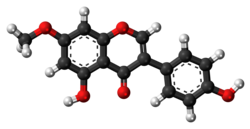
Prunetin is an O-methylated isoflavone, a type of flavonoid. It has been isolated for the first time by Finnemore in 1910 in the bark of Prunus emarginata (the Oregon cherry).1 Prunetin isolated from pea roots can act as an attractant for Aphanomyces euteiches zoospores.2 It is also an allosteric inhibitor of human liver aldehyde dehydrogenase.3
Prunetin can lower blood pressure of spontaneously hypertensive rats and relax isolated rat aortic rings through calcium channel block mechanisms in vessel smooth muscles.4
Biosynthesis
Genistein is converted to prunetin by the enzyme isoflavone 7-O-methyltransferase. The methylation reaction requires the cofactor, S-adenosyl methionine (SAM), to provide the methyl group, and was characterised from alfalfa.5 The process can be induced by attack from a pathogen, with the plant responding with the synthesis of a phytoalexin.67


Glycosides
- 8-C-glucosyl prunetin, isolated from the leaves of Dalbergia hainanensis8
References
References
- Shriner, R. L.; Hull, Clarence J. (1945). "Isoflavones. III. The Structure of Prunetin and a New Synthesis of Genistein1". The Journal of Organic Chemistry. 10 (4): 288–291. doi:10.1021/jo01180a006.
- Yokosawa, Ryozo; Kuninaga, Shiro; Sekizaki, Harua (1986). "Aphanomyces euteiches zoospore attractant isolated from pea root; prunetin". Ann. Phytopath. Soc. Japan. 52 (5): 809–816. doi:10.3186/jjphytopath.52.809.
- Sheikh, S.; Weiner, H. (1997). "Allosteric inhibition of human liver aldehyde dehydrogenase by the isoflavone prunetin". Biochemical Pharmacology. 53 (4): 471–478. doi:10.1016/s0006-2952(96)00837-4. PMID 9105397.
- Kim, Bumjung; Jo, Cheolmin; Choi, Ho-Young; Lee, Kyungjin (2018). "Prunetin Relaxed Isolated Rat Aortic Rings by Blocking Calcium Channels". Molecules. 23 (9): 2372. doi:10.3390/molecules23092372. PMC 6225200. PMID 30227625.
 This article incorporates text from this source, which is available under the CC BY 4.0 license.
- He XZ, Dixon RA (2000). "Genetic manipulation of isoflavone 7-O-methyltransferase enhances biosynthesis of 4'-O-methylated isoflavonoid phytoalexins and disease resistance in alfalfa". Plant Cell. 12 (9): 1689–702. doi:10.1105/tpc.12.9.1689. PMC 149079. PMID 11006341.
- Zubieta C, He XZ, Dixon RA, Noel JP (2001). "Structures of two natural product methyltransferases reveal the basis for substrate specificity in plant O-methyltransferases". Nat. Struct. Biol. 8 (3): 271–9. doi:10.1038/85029. PMID 11224575. S2CID 36170487.
- Christensen AB, Gregersen PL, Olsen CE, Collinge DB (1998). "A flavonoid 7-O-methyltransferase is expressed in barley leaves in response to pathogen attack". Plant Mol. Biol. 36 (2): 219–27. doi:10.1023/A:1005985609313. PMID 9484434. S2CID 23711170.
- Pei Cheng Zhang, Ying Hong Wang, Xin Liu, Xiang Yi, Ruo Yun Chen and De Quan Yu (2002). "Conformational Study of 8-C-glucosyl-prunetin by Dynamic NMR Spectroscopy" (PDF). Chinese Chemical Letters. 13 (7): 645–648. Archived from the original (PDF) on 2011-07-07. Retrieved 2010-02-26.
{{cite journal}}: CS1 maint: multiple names: authors list (link)