| Protea aurea | |
|---|---|
| |
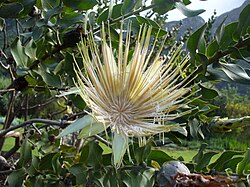
| P. aurea subsp. potbergensis | |
Scientific classification 
| |
| Kingdom: | Plantae |
| Clade: | Embryophytes |
| Clade: | Tracheophytes |
| Clade: | Spermatophytes |
| Clade: | Angiosperms |
| Clade: | Eudicots |
| Order: | Proteales |
| Family: | Proteaceae |
| Genus: | Protea |
| Species: | P. aurea
|
| Binomial name | |
| Protea aurea | |
Protea aurea, the long-bud sugarbush, is a shrub or small tree with a single trunk occurring in mountain fynbos, usually on cool, moist, southern slopes. It is endemic to the Cape Provinces of South Africa.2
The flowerheads are solitary and resemble a shuttlecock when open. Fruit is a densely hairy nut. Two subspecies are recognised: subsp. aurea and subsp. potbergensis with the later being rare and restricted to the Potberg.
References
References
- Rebelo, A.G.; Mtshali, H.; von Staden, L. (2020). "Protea aurea". IUCN Red List of Threatened Species. 2020 e.T62818A185536627. doi:10.2305/IUCN.UK.2020-3.RLTS.T62818A185536627.en. Retrieved 18 November 2021.
- "Protea aurea". Germplasm Resources Information Network. Agricultural Research Service, United States Department of Agriculture. Retrieved 2015-08-11.
- van Wyk, B. and van Wyk, P. 1997. Field Guide to trees of South Africa. Struik, Cape Town
- Pooley, E. 2005. A Field Guide to Wild Flowers of Kwazulu-Natal and the Eastern Region. National Floral Publications Trust, Durban