 | |
| Names | |
|---|---|
| Other names
PGH2, Endoperoxide H2, Prostaglandin R2
| |
| Identifiers | |
3D model (JSmol)
|
|
| ChEBI | |
| ChemSpider |
|
| MeSH | Prostaglandin+H2 |
PubChem CID
|
|
| UNII | |
CompTox Dashboard (EPA)
|
|
| |
| |
| Properties | |
| C20H32O5 | |
| Molar mass | 352.465 g/mol |
| Density | 1.129 ± 0.06 g/mL |
| Boiling point | 490 ± 40.0 °C |
| 0.034 g/L | |
Except where otherwise noted, data are given for materials in their standard state (at 25 °C [77 °F], 100 kPa).
| |


Prostaglandin H2 (PGH2), or prostaglandin H2 (PGH2), is a type of prostaglandin and a precursor for many other biologically significant molecules. It is synthesized from arachidonic acid in a reaction catalyzed by a cyclooxygenase enzyme.2 The conversion from arachidonic acid to prostaglandin H2 is a two-step process. First, COX-1 catalyzes the addition of two free oxygens to form the 1,2-dioxane bridge and a peroxide functional group to form prostaglandin G2 (PGG2).3 Second, COX-2 reduces the peroxide functional group to a secondary alcohol, forming prostaglandin H2. Other peroxidases like hydroquinone have been observed to reduce PGG2 to PGH2.4 PGH2 is unstable at room temperature, with a half life of 90–100 seconds,1 so it is often converted into a different prostaglandin. PGH2 is produced by every type of cell except for red blood cells and has a wide range of effects in the body.5
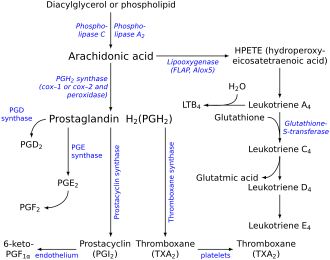
It is acted upon by:
- prostacyclin synthase to create prostacyclin
- thromboxane-A synthase to create thromboxane A2 and 12-(S)-hydroxy-5Z,8E,10E-heptadecatrienoic acid (HHT) (see 12-Hydroxyheptadecatrienoic acid)
- prostaglandin D2 synthase to create prostaglandin D2
- prostaglandin E synthase to create prostaglandin E2
- prostaglandin F synthase to create prostaglandin F2α6
It rearranges non-enzymatically to:
- A mixture of 12-(S)-hydroxy-5Z,8E,10E-heptadecatrienoic acid (HHT) and 12-(S)-hydroxy-5Z,8Z,10E-heptadecatrienoic acid (see 12-hydroxyheptadecatrienoic acid)
- These breakdown products are associated with increased aggregation of Amyloid beta peptides and Alzheimer's disease.7
Functions of prostaglandin H2:
- regulating the constriction and dilation of blood vessels
- stimulating platelet aggregation
- binds to thromboxane receptor on platelets' cell membranes to trigger platelet migration and adhesion to other platelets8
Effects of aspirin on prostaglandin H2:
- Aspirin has been hypothesized to block the conversion of arachidonic acid to prostaglandin

History
Prostaglandin H2 was discovered in 1973 by Diederik H. Nugteren and Elly Christ-Hazelhof while they were researching the formation of prostaglandin E2 from arachidonic acid using enzymes found in vesicular glands.9
Synthesis
The original synthesis of prostaglandin H2 by Diederik H. Nugteren and Elly Christ-Hazelhof was performed in 1973.9 Sheep vesicular glands were homogenized with 1M KH2PO4 and 0.001 M EDTA buffer and then centrifuged to isolate the COX-1 enzymes. Pure arachidonic acid was added to a solution containing the enzymes, and the mixture was shaken. Thin-layer chromatography was used to isolate a band of prostaglandin H2.
In 1986, due to low prostaglandin H2 product purity from thin-layer chromatography and column chromatography, high-performance liquid chromatography with hexane and isopropanol as solvents was developed as an alternative means of isolating the prostaglandin with 98% purity.10
References
References
- Wishart, David S.; Guo, An Chi; Oler, Eponine; Wang, Fel; Anjum, Afia; Peters, Harrison; Dizon, Raynard; Sayeeda, Zinat; Tian, Siyang; Lee, Brian L.; Berjanskii, Mark; Mah, Robert; Yamamoto, Mai; Jovel Castillo, Juan; Torres Calzada, Claudia; Hiebert Giesbrecht, Mickel; Lui, Vicki W.; Varshavi, Dorna; Varshavi, Dorsa; Allen, Dana; Arndt, David; Khetarpal, Nitya; Sivakumaran, Aadhavya; Harford, Karxena; Sanford, Selena; Yee, Kristen; Cao, Xuan; Budinsky, Zachary; Liigand, Jaanus; Zhang, Lun; Zheng, Jiamin; Mandal, Rupasri; Karu, Naama; Dambrova, Maija; Schiöth, Helgi B.; Gautam, Vasuk. "Showing metabocard for Prostaglandin H2 (HMDB0001381)". Human Metabolome Database, HMDB. 5.0.
- van der Donk WA, Tsai AL, Kulmacz RJ (December 2002). "The cyclooxygenase reaction mechanism". Biochemistry. 41 (52): 15451–8. doi:10.1021/bi026938h. PMID 12501173.
- Salomon RG, Miller DB, Zagorski MG, Coughlin DJ (October 1984). "Prostaglandin endoperoxides. 14. Solvent-induced fragmentation of prostaglandin endoperoxides. New aldehyde products from PGH2 and a novel intramolecular 1,2-hydride shift during endoperoxide fragmentation in aqueous solution". Journal of the American Chemical Society. 106 (20): 6049–6060. doi:10.1021/ja00332a049. ISSN 0002-7863.
- Hla T, Neilson K (August 1992). "Human cyclooxygenase-2 cDNA". Proceedings of the National Academy of Sciences of the United States of America. 89 (16): 7384–8. Bibcode:1992PNAS...89.7384H. doi:10.1073/pnas.89.16.7384. PMC 49714. PMID 1380156.
- Miller, Stephen B. (2006-08-01). "Prostaglandins in Health and Disease: An Overview". Seminars in Arthritis and Rheumatism. 36 (1): 37–49. doi:10.1016/j.semarthrit.2006.03.005. ISSN 0049-0172.
- Hirata, Takako; Narumiya, Shuh (2011-08-05). "Prostanoid Receptors". ACS Publications. doi:10.1021/cr200010h. Retrieved 2025-11-16.
- Boutaud, Olivier; Ou, Joyce J.; Chaurand, Pierre; Caprioli, Richard M.; Montine, Thomas J.; Oates, John A. (2002). "Prostaglandin H2 (PGH2) accelerates formation of amyloid β1−42 oligomers". Journal of Neurochemistry. 82 (4): 1003–1006. doi:10.1046/j.1471-4159.2002.01064.x. ISSN 1471-4159.
- Woodward DF, Jones RL, Narumiya S (September 2011). "International Union of Basic and Clinical Pharmacology. LXXXIII: classification of prostanoid receptors, updating 15 years of progress". Pharmacological Reviews. 63 (3): 471–538. doi:10.1124/pr.110.003517. PMID 21752876.
- Nugteren, D. H.; Hazelhof, E. (1973-12-20). "Isolation and properties of intermediates in prostaglandin biosynthesis". Biochimica et Biophysica Acta (BBA) - Lipids and Lipid Metabolism. 326 (3): 448–461. doi:10.1016/0005-2760(73)90145-8. ISSN 0005-2760.
- Zulak, I. M.; Puttemans, M. L.; Schilling, A. B.; Hall, E. R.; Venton, D. L. (1986-04-01). "A fast, nondestructive purification scheme for prostaglandin H2 using a nonaqueous, bonded-phase high-performance liquid chromatography system". Analytical Biochemistry. 154 (1): 152–161. doi:10.1016/0003-2697(86)90509-9. ISSN 0003-2697.