 | |
 | |
| Clinical data | |
|---|---|
| Other names | PiPT; N-Propyl-N-isopropyltryptamine |
| Drug class | Serotonergic psychedelic; Hallucinogen |
| ATC code |
|
| Identifiers | |
| |
| CAS Number | |
| PubChem CID | |
| ChemSpider |
|
| UNII | |
| CompTox Dashboard (EPA) | |
| Chemical and physical data | |
| Formula | C16H24N2 |
| Molar mass | 244.382 g·mol−1 |
| 3D model (JSmol) | |
| |
| |
 N N Y (what is this?) (verify) Y (what is this?) (verify) | |
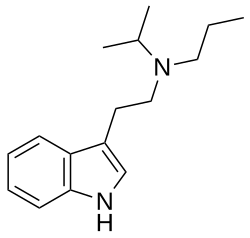
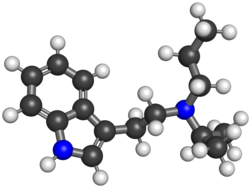
Propylisopropyltryptamine (PiPT), also known as N-propyl-N-isopropyltryptamine, is a psychedelic drug of the tryptamine family. It reportedly produces hallucinogenic effects that resemble those of other related dialkyl tryptamine derivatives,1 although PiPT is reportedly relatively weak and short-lasting. It has been sold as a designer drug, first being identified in 2021 in British Columbia, Canada.2
Use and effects
According to Alexander Shulgin in his 1997 book TiHKAL (Tryptamines I Have Known and Loved), PiPT had not yet been evaluated.3
Interactions
Chemistry
PiPT is short for N-propyl-N-isopropyltryptamine. PiPT is a tryptamine, which all belong to a larger family of compounds known as indolethylamines
Analogues
Analogues of PiPT include methylisopropyltryptamine (MiPT), ethylisopropyltryptamine (EiPT), diisopropyltryptamine (DiPT), and dipropyltryptamine (DPT), among others.3
Society and culture
Legal status
Canada
PiPT is not a controlled substance in Canada as of 2025.4
United States
PiPT is not an explicitly controlled substance in the United States.5 However, it could be considered a controlled substance under the Federal Analogue Act if intended for human consumption.
References
References
- Catalani V, Corkery JM, Guirguis A, Napoletano F, Arillotta D, Zangani C, Vento A, Schifano F (August 2021). "Psychonauts' psychedelics: A systematic, multilingual, web-crawling exercise". European Neuropsychopharmacology. 49: 69–92. doi:10.1016/j.euroneuro.2021.03.006. hdl:2299/24309. PMID 33857740. S2CID 233206904.
- Knill A, Tobias S, Matthews J, Ti L (June 2022). A Report on British Columbia’s Unregulated Drug Supply. Drug checking trends across British Columbia, January to December 2021 (PDF). British Columbia Centre on Substance Use (Report).
- Shulgin, Alexander; Shulgin, Ann (September 1997). TiHKAL: The Continuation. Berkeley, California: Transform Press. ISBN 0-9630096-9-9. OCLC 38503252.
- "Controlled Drugs and Substances Act". Department of Justice Canada. Retrieved 19 January 2026.
- Orange Book: List of Controlled Substances and Regulated Chemicals (January 2026) (PDF), United States: U.S. Department of Justice: Drug Enforcement Administration (DEA): Diversion Control Division, January 2026