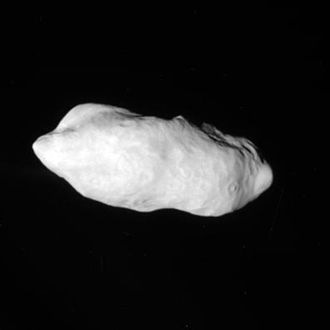
 Prometheus image from Cassini (December 26, 2009) | |
| Discovery | |
|---|---|
| Discovered by | Stewart A. Collins D. Carlson Voyager 1 |
| Discovery date | 24 October 1980 |
| Designations | |
Designation | Saturn XVI |
| Pronunciation | /prəˈmiːθiːəs/1 |
Named after | Προμηθεύς Promētheys |
| Adjectives | Promethean, -ian /prəˈmiːθiːən/2 |
| Orbital characteristics3: 4 | |
| 139378 km | |
| Eccentricity | 0.00223 |
| 0.612990 d | |
| Inclination | 0.008° |
| Satellite of | Saturn |
| Physical characteristics | |
| Dimensions | 137.0 × 81.0 × 56.2 km (± 1.0 × 2.8 × 0.8 km)4: 2 |
| 85.6±1.4 km4: 2 | |
| Volume | 327740±1710 km35: 4 |
| Mass | (1.59720±0.00072)×1017 kga |
Mean density | 0.4873±0.0026 g/cm35: 4 |
| 0.0007–0.0056 m/s24: 3 | |
| 0.018 km/s at longest axis to 0.028 km/s at poles | |
| synchronous4: 4 | |
| assumed zero | |
| Albedo | 0.67±0.073: 7 |
| Temperature | ≈ 74 K |
Prometheus /prəˈmiːθiːəs/ is an inner satellite of Saturn. It was discovered on 24 October 1980 from images taken by the Voyager 1 probe, and was provisionally designated S/1980 S 27.6 In late 1985 it was officially named after Prometheus, a Titan in Greek mythology.7 It is also designated Saturn XVI.8
Prometheus is extremely elongated, measuring approximately 137 km × 81 km × 56 km (85 mi × 50 mi × 35 mi). The surface is heavily cratered, giving it a similar appearance to nearby Epimetheus and Janus.9 It has several ridges and valleys and a number of impact craters of about 20 km (12 mi) diameter are visible. From its very low density and relatively high albedo, it is likely that Prometheus is a very porous icy body.
Interactions with F Ring and other moons
Prometheus is a shepherd satellite for the inner edge of Saturn's narrow F Ring. Pandora orbits just outside the F Ring, and has traditionally been viewed as an outer shepherd of the ring; however, recent studies indicate that only Prometheus contributes to the confinement of the ring.1011
Images from the Cassini probe show that Prometheus's gravitational influence creates kinks and knots in the F Ring as it shepherds material from it. The orbit of Prometheus appears to be chaotic, due to a series of four 121:118 mean-motion resonances with Pandora.12 The most appreciable changes in their orbits occur approximately every 6.2 years,13 when the periapsis of Pandora lines up with the apoapsis of Prometheus, as they approach to within approximately 1400 km. Prometheus is itself a significant perturber of Atlas, with which it is in a 53:54 mean-longitude resonance.13
Prometheus also participates in a 17:15 mean-motion resonance with Epimetheus, but only while it is on the outer orbit relative to Janus. No such configuration with Janus exists.14
Due to their gravitational interactions with the rings, Prometheus and Pandora are expected to crash into each other or Mimas in the next 20 million years.1516
Physical characteristics
The surface of Prometheus can be distinguished into two types of terrain, both equally cratered4 and separated from each other by long scarps, one of which could be indicative of an exposed core section. This core section would make up roughly two-thirds of the total volume of Prometheus.9
Prometheus' elongated shape could be a result of the low-speed merging of several similar-sized bodies.4
Gallery
Selected images
-
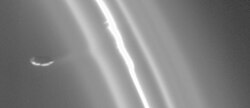 Prometheus pulling material from the F Ring
 -
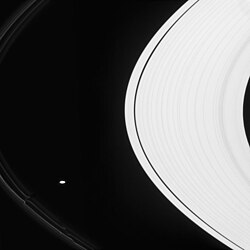 Prometheus tugging kinks into the F Ring
 -
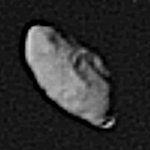 Voyager 2 (August 25, 1981) image
 -
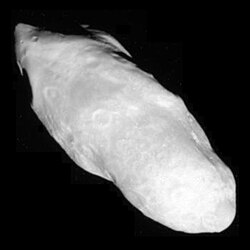 Cassini image (with moon's Saturn-facing end at lower right) reveals a surface covered with a blanket of fine material.
 -
 Image from Jan. 27, 2010. Saturnshine illuminates the moon's night side.
 -
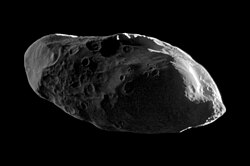 Brightened version of same image
 -
 Prometheus flyby
(December 6, 2015)
Animations
-
Prometheus collides with the F ring, pulls a streamer, and leaves behind a dark channel. 12 seconds 107 kbit/s
-
Movie of Prometheus and the F Ring looped once. 5 seconds 48 kbit/s
References
References
Notes
- Calculated from the standard gravitational parameter GM = (1.06602±0.00048)×10−2 km3·s–2 given by Lainey et al. (2023), divided by the gravitational constant G = 6.6743×10⁻² km3·kg–1·s–2.5
Citations
- "Prometheus". Lexico UK English Dictionary. Oxford University Press. Archived from the original on March 20, 2020.
- "Promethean". Lexico UK English Dictionary UK English Dictionary. Oxford University Press. Archived from the original on March 20, 2020.
- Ciarniello et al. 2024.
- Thomas & Helfenstein 2020.
- Lainey et al. 2023.
- IAUC 3532.
- IAUC 4157.
- USGS: Planet and Satellite Names and Discoverers.
- Thomas et al. 2013.
- Lakdawalla, E. (2014-07-05). "On the masses and motions of mini-moons: Pandora's not a "shepherd", but Prometheus still is". Planetary Society. Retrieved 2015-04-17.
- Cuzzi, J. N.; Whizin, A. D.; Hogan, R. C.; Dobrovolskis, A. R.; Dones, L.; Showalter, M. R.; Colwell, J. E.; Scargle, J. D. (April 2014). "Saturn's F Ring core: Calm in the midst of chaos". Icarus. 232: 157–175. Bibcode:2014Icar..232..157C. doi:10.1016/j.icarus.2013.12.027. ISSN 0019-1035.
- Renner et al. 2005.
- Spitale Jacobson et al. 2006.
- Cooper, N. J.; Renner, S.; Murray, C. D.; Evans, M. W. (2014-12-24). "SATURNʼS INNER SATELLITES: ORBITS, MASSES, AND THE CHAOTIC MOTION OF ATLAS FROM NEW CASSINI IMAGING OBSERVATIONS". The Astronomical Journal. 149 (1): 27. arXiv:1406.6492. doi:10.1088/0004-6256/149/1/27. ISSN 1538-3881.
- Poulet and Sicardy 2001.
- Esposito and De Stefano 2018.
Sources
- Marsden, Brian G. (October 31, 1980). "Satellites of Saturn" (discovery). IAU Circular (3532). Retrieved 2011-12-29.
- Marsden, Brian G. (January 3, 1986). "Satellites of Saturn and Pluto" (naming the moon). IAU Circular (4157). Retrieved 2011-12-29.
- Renner, Stéfan F.; Sicardy, Bruno; French, Richard G. (March 2005). "Prometheus and Pandora: Masses and orbital positions during the Cassini tour". Icarus. 174 (1): 230–240. Bibcode:2005Icar..174..230R. doi:10.1016/j.icarus.2004.09.005.
- Spitale, J. N.; Jacobson, R. A.; Porco, C. C.; Owen, W. M. Jr. (2006). "The orbits of Saturn's small satellites derived from combined historic and Cassini imaging observations". The Astronomical Journal. 132 (2): 692–710. Bibcode:2006AJ....132..692S. doi:10.1086/505206.
- Thomas, P. C. (July 2010). "Sizes, shapes, and derived properties of the saturnian satellites after the Cassini nominal mission" (PDF). Icarus. 208 (1): 395–401. Bibcode:2010Icar..208..395T. doi:10.1016/j.icarus.2010.01.025. Archived from the original (PDF) on 2018-12-23. Retrieved 2015-09-04.
- USGS/IAU (July 21, 2006). "Planet and Satellite Names and Discoverers". Gazetteer of Planetary Nomenclature. USGS Astrogeology. Retrieved 2011-12-29.
- Thomas, P. C.; Helfenstein, P. (July 2020). "The small inner satellites of Saturn: Shapes, structures and some implications". Icarus. 344: 20. Bibcode:2020Icar..34413355T. doi:10.1016/j.icarus.2019.06.016. S2CID 197474587. 113355.
- Lainey, V.; Rambaux, N.; Cooper, N.; Dahoumane, R.; Zhang, Q. (February 2023). "Characterising the interior of five inner Saturnian moons using Cassini ISS data". Astronomy & Astrophysics. 670: 6. Bibcode:2023A&A...670L..25L. doi:10.1051/0004-6361/202244757. L25.
- Thomas, P. C.; Burns, J. A.; Hedman, M.; Helfenstein, P.; Morrison, S.; Tiscareno, M. S.; Veverka, J. (2013-09-01). "The inner small satellites of Saturn: A variety of worlds". Icarus. 226 (1): 999–1019. doi:10.1016/j.icarus.2013.07.022. ISSN 0019-1035.
- Ciarniello, Mauro; Filacchione, Gianrico; Nicholson, Philip D.; Hedman, Matthew M.; Charnoz, Sebastien; Cuzzi, Jeffrey N.; El Moutamid, Maryame; Hendrix, Amanda R.; Rambaux, Nicolas; Miller, Kelly E.; Mousis, Olivier; Baillié, Kevin; Estrada, Paul R.; Waite, J. Hunter (2024-09-17). "The Origin and Composition of Saturn's Ring Moons". Space Science Reviews. 220 (7): 72. doi:10.1007/s11214-024-01103-z. ISSN 1572-9672.
- Esposito, L. W.; De Stefano, M. (2018). "Space Age Studies of Planetary Rings". In Murray, Carl D.; Tiscareno, Matthew S. (eds.). Planetary Ring Systems: Properties, Structure, and Evolution. Cambridge Planetary Science. Cambridge: Cambridge University Press. pp. 3–29. doi:10.1017/9781316286791. ISBN 978-1-107-11382-4.
- Poulet, F.; Sicardy, B. (2001-04-01). "Dynamical evolution of the Prometheus--Pandora system". Monthly Notices of the Royal Astronomical Society. 322 (2): 343–355. Bibcode:2001MNRAS.322..343P. doi:10.1046/j.1365-8711.2001.04128.x. ISSN 0035-8711.
External links
External links
Media related to Prometheus (moon) at Wikimedia Commons
- "Cassini–Huygens: Multimedia-Videos / Soft Collision". NASA. Archived from the original on 29 October 2007.
Prometheus slowly collides with the diffuse inner edge of Saturn's F ring ... pulls a streamer of material from the ring and leaves behind a dark channel.
- Prometheus Profile at NASA's Solar System Exploration site
- The Planetary Society: Prometheus
- 3-D anaglyph view of Prometheus