| Prolibytherium Temporal range: Burdigalian
~ | |
|---|---|
| |
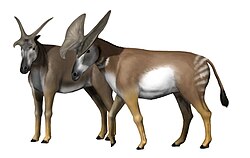
| Prolibytherium magnieri restoration, with female (left) and male (right) | |
Scientific classification 
| |
| Kingdom: | Animalia |
| Phylum: | Chordata |
| Class: | Mammalia |
| Infraclass: | Placentalia |
| Order: | Artiodactyla |
| Family: | †Prolibytheriidae |
| Genus: | †Prolibytherium Arambourg, 1961 |
| Type species | |
| †Prolibytherium magnieri | |
| Species | |
| |
Prolibytherium is an extinct genus of prolibytheriid artiodactyl ungulate native to Middle Miocene North Africa and Pakistan, from around 16.9 to 15.97 million years ago. Fossils of Prolibytherium were found in the Marada Formation of Libya, Vihowa Formation of Pakistan, and the Moghara Formation of Egypt.1
Description
The 1.80 metres (5 ft 11 in) long creature would have superficially resembled an okapi or a deer. Unlike these, however, Prolibytherium displayed dramatic sexual dimorphism, in that the male had a set of large, leaf-shaped ossicones with a width of 35 centimetres (14 in), while the female had a set of slender, horn-like ossicones.2
The taxonomic status of Prolibytherium remains in flux. At one time, it was described as a relative of Sivatherium (as a precursor to "Libytherium maurusium" (S. maurusium)). Later, it would be regarded as a palaeomerycid, or either as a climacoceratid, or as a basal member of Giraffoidea. With the discovery and study of a female skull in 2010, Prolibytherium is tentatively confirmed as a climacoceratid.2 A recent study published in 2022 found it to be part of a separate family, Prolibytheriidae.3
References
References
- "Prolibytherium". Fossilworks. Retrieved 13 June 2014.
- Sánchez, Israel M.; Quiralte, Victoria; Morales, Jorge; Azanza, Beatriz; Pickford, Martin (2010). "Sexual dimorphism of the frontal appendages of the early Miocene African pecoran Prolibytherium Arambourg, 1961 (Mammalia, Ruminantia)". Journal of Vertebrate Paleontology. 30 (4): 1306–1310. Bibcode:2010JVPal..30.1306S. doi:10.1080/02724634.2010.483555. JSTOR 40864406. S2CID 86847446.
- Wang, S.-Q.; Ye, J.; Meng, J.; Li, C.; Costeur, L.; Mennecart, B.; Zhang, C.; Zhang, J.; Aiglstorfer, M.; Wang, Y.; Wu, Y.; Wu, W.-Y.; Deng, T. (2022). "Sexual selection promotes giraffoid head-neck evolution and ecological adaptation". Science. 376 (6597): 1306–1310. doi:10.1126/science.abl8316. PMID 35653459. S2CID 249313002.