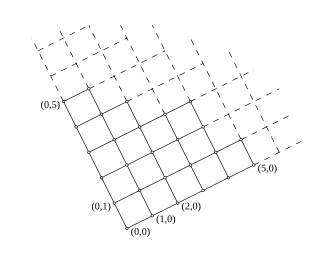
In mathematics, given partial orders and on sets and , respectively, the product order1234 (also called the coordinatewise order536 or componentwise order27) is a partial order on the Cartesian product Given two pairs and in declare that if and
Another possible order on is the lexicographical order. It is a total order if both and are totally ordered. However the product order of two total orders is not in general total; for example, the pairs and are incomparable in the product order of the order with itself. The lexicographic combination of two total orders is a linear extension of their product order, and thus the product order is a subrelation of the lexicographic order.3
The Cartesian product with the product order is the categorical product in the category of partially ordered sets with monotone functions.7
The product order generalizes to arbitrary (possibly infinitary) Cartesian products. Suppose is a set and for every is a preordered set. Then the product preorder on is defined by declaring for any and in that
- if and only if for every
If every is a partial order then so is the product preorder.
Furthermore, given a set the product order over the Cartesian product can be identified with the inclusion order of subsets of 4
The notion applies equally well to preorders. The product order is also the categorical product in a number of richer categories, including lattices and Boolean algebras.7
See also
See also
- Direct product of binary relations
- Examples of partial orders
- Star product, a different way of combining partial orders
- Orders on the Cartesian product of totally ordered sets
- Ordinal sum of partial orders
- Ordered vector space – Vector space with a partial order
References
References
- Neggers, J.; Kim, Hee Sik (1998), "4.2 Product Order and Lexicographic Order", Basic Posets, World Scientific, pp. 64–78, ISBN 9789810235895
- Sudhir R. Ghorpade; Balmohan V. Limaye (2010). A Course in Multivariable Calculus and Analysis. Springer. p. 5. ISBN 978-1-4419-1621-1.
- Egbert Harzheim (2006). Ordered Sets. Springer. pp. 86–88. ISBN 978-0-387-24222-4.
- Victor W. Marek (2009). Introduction to Mathematics of Satisfiability. CRC Press. p. 17. ISBN 978-1-4398-0174-1.
- Davey & Priestley, Introduction to Lattices and Order (Second Edition), 2002, p. 18
- Alexander Shen; Nikolai Konstantinovich Vereshchagin (2002). Basic Set Theory. American Mathematical Soc. p. 43. ISBN 978-0-8218-2731-4.
- Paul Taylor (1999). Practical Foundations of Mathematics. Cambridge University Press. pp. 144–145 and 216. ISBN 978-0-521-63107-5.