Article · Wikipedia archive · Last revised May 27, 2026

Proctodeum

A proctodeum is the back ectodermal part of an alimentary canal. It is created during embryogenesis by a folding of the outer body wall. It will form the lower part of the anal canal, below the pectinate line, which will be lined by stratified squamous non-keratinized and stratified squamous keratinized epithelium. The junction between them is Hilton's white line.

Last revised
May 27, 2026
Read time
≈ 1 min
Length
124 w
Citations
Source
Proctodeum
Details
PrecursorSurface ectoderm
Gives rise toLower anal canal
Identifiers
Latinproctodeum
Anatomical terminology
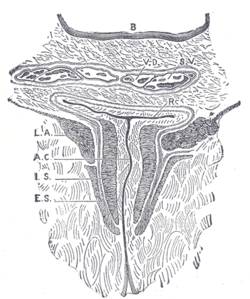
Coronal section through the anal canal. (Symington.) B. Cavity of urinary bladder. V.D. Ductus deferens. S.V. Seminal vesicle. R. Second part of rectum. A.C. Anal canal. L.A. Levator ani. I.S. Sphincter ani internus. E.S. Sphincter ani externus.
Coronal section through the anal canal. (Symington.) B. Cavity of urinary bladder. V.D. Ductus deferens. S.V. Seminal vesicle. R. Second part of rectum. A.C. Anal canal. L.A. Levator ani. I.S. Sphincter ani internus. E.S. Sphincter ani externus. source ↗

A proctodeum is the back ectodermal part of an alimentary canal. It is created during embryogenesis by a folding of the outer body wall. It will form the lower part of the anal canal, below the pectinate line, which will be lined by stratified squamous non-keratinized (zona hemorrhagica) and stratified squamous keratinized (zona cutanea) epithelium. The junction between them is Hilton's white line.

External links
  • "Poumons". www.embryology.ch (in French). Archived from the original on 2019-09-27. Retrieved 2007-11-07.